When Masked Citizens Took the Law Into Their Own Hands
By James Randall
Late on the night of March 24, 1871, armed men in white masks took control of the streets around the Storey County courthouse and jail in Virginia City. Guards with muskets and fixed bayonets turned citizens away from nearby intersections while another group forced open the courthouse door, disarmed the sheriff and his deputy, took the jail keys, and removed a prisoner named Arthur Perkins Heffernan.
By morning, Perkins was dead. A paper bearing the number 601 was attached to his body. In a city that already had police, a sheriff, courts, prosecutors, juries, and a county jail, a secret group had decided that lawful justice was not enough.
The history of Virginia City’s 601 Vigilance Committee is often retold as a broad story of frontier lawlessness. The surviving evidence is narrower, and more revealing. Two executions can be documented with confidence, those of Perkins and George B. Kirk. The real story is not the absence of law, but the moment when some residents decided they no longer trusted the law to act quickly or severely enough.
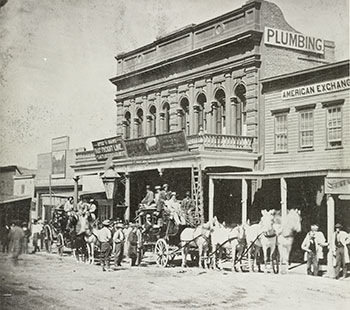
Before the 601, Virginia City Already Knew the Temptation of Vigilantism
Vigilante sentiment on the Comstock predated 1871. In September 1863, Mark Twain, then reporting from Virginia City, described a violent confrontation involving Jack McNabb, a gunman who shot police officers during an attempted arrest. An angry crowd wanted to hang him. Territorial authorities guarded the jail, stores and saloons closed, and Twain reported “some little talk of a Vigilance Committee.”
In that case, the authorities held their ground. McNabb remained in custody. The episode matters because it shows that the idea of summary punishment was already present in Virginia City years before the 601 appeared. The difference in 1871 was that the talk became organization.
Why 1871 Was Different
By early 1871, residents were living with a mixture of violent crime and fear of deliberate fire. Dan De Quille, the Territorial Enterprise journalist who published a detailed account only five years later, remembered frequent incendiary fires, murders, robberies, and what he called an “unusual amount of lawlessness.”
Fire had a special power to terrify Virginia City. Much of the city was built of wood, tightly packed on steep ground and exposed to wind. A successful arsonist did not threaten one victim or one business. He could threaten an entire block.
In February and March, public suspicion hardened around the belief that some fires were being set deliberately. That atmosphere helps explain why the vigilance committee that emerged in March was concerned not only with murderers and thieves, but with alleged incendiaries.
The Piper’s Opera House Fire and William Willis
Shortly after midnight on March 14, 1871, Hugh Kelly and Charley Fletcher discovered fire in the basement of Piper’s Opera House and extinguished it before it spread. Investigation soon centered on William Willis, a man suspected of involvement in other fires.
A Nevada Historical Society study reports that vigilantes removed Willis from jail, took him to Piper’s Opera House, placed a rope around his neck, and forced a confession. Willis implicated several men, including Arthur Perkins Heffernan, in incendiary activity.
Willis was not hanged. He was returned to legal custody, later pleaded guilty to first-degree arson, and received a 21-year prison sentence. That contrast is important. The men who used terror against Willis still allowed the courts to dispose of his case. Perkins would not receive the same chance.
Arthur Perkins Was Already Awaiting Trial
Perkins was about twenty-four years old. On March 5, 1871, he had shot and killed William “Bill” Smith in a Virginia City saloon. Dan De Quille described the killing as cold-blooded and placed it at the bar of the city’s principal hotel. Perkins was arrested and confined in the Storey County jail while the legal process moved forward.
Whatever later allegations connected him with arson, the immediate fact was simple: when the 601 came for him, Perkins was already in the custody of the law. He had not been convicted of Smith’s murder.
The Night the 601 Appeared
De Quille’s account describes an operation that was organized rather than spontaneous. The masked men had apparently obtained weapons from a local military armory. Guards controlled the surrounding streets while perhaps twenty to thirty men entered the courthouse.
They forced the door with a crowbar, surprised the sheriff and deputy in bed, secured their weapons, seized the jail keys, and opened Perkins’s cell. Another prisoner shared the cell and initially thought he too was being taken. The vigilantes told him to stay.
Perkins understood what the masked men wanted. They had come specifically for him.
Where Perkins Was Hanged
One of the most repeated later stories says Perkins was hanged from the rafters of Piper’s Opera House. The stronger near-contemporary evidence points elsewhere.
Dan De Quille placed the execution near the old Ophir mine workings, where Perkins was hanged from mining timber near the mouth of a tunnel. Alfred Doten, another Virginia City newspaperman, likewise placed the hanging at the old Ophir works. The opera-house version appears to be a later tradition rather than the best-supported location.
According to De Quille, Perkins stood on a plank laid across the tunnel mouth and tried to increase the drop by jumping upward before the plank was removed. After the execution, a cannon shot reportedly signaled that the vigilantes’ work was done. The masked guards then disappeared from the streets.
The Number 601
The next morning, the coroner found a paper attached to Perkins’s body bearing the numerals 601. A Sacramento Daily Union report of March 27, 1871, gave the wording as “Arthur Perkins, hung by Vigilance Committee No. 601.”
The meaning of the number remains uncertain. The familiar modern explanation, “six feet under, zero trials, one rope,” has not been found in nineteenth-century sources. Dan De Quille did not explain the number at all. Alfred Doten later speculated that it might have been the identifying number of the committee’s secretary, perhaps borrowing from the numbered systems used by San Francisco vigilance committees.
The uncertainty is important. A phrase that now sounds inseparable from the 601 may be a later invention.
Tickets of Leave
The 601 did not rely only on hanging. Contemporary reporting indicates that it issued written notices ordering selected men out of Virginia City. A Daily Alta California correspondent reported that three men received notices from “Secretary 601” giving them twenty-four hours to leave.
De Quille later called these orders “tickets of leave.” Their force came from the fact that the committee had already demonstrated what could follow defiance.
George B. Kirk Returned
George B. Kirk became the second well-documented man killed by the 601. De Quille described him as a dangerous character who had killed a man in California and had recently been released from Nevada State Prison.
Kirk received an order to leave Virginia City. He obeyed, but later returned. Friends reportedly warned him that remaining in town would cost him his life.
According to De Quille, vigilantes found Kirk at the residence of a female acquaintance around eleven o’clock at night, put him in a buggy, carried him to the Sierra Nevada mining works at the northern end of Virginia City, and hanged him from the timbers of a flume. A cannon again reportedly sounded after the execution.
The coroner’s jury concluded that Kirk had died “by being hanged by parties unknown to us.” The wording captures the peculiar position of the 601. The community knew what had happened. The formal record named no killer.
The Date of Kirk’s Death Is Not Settled
Even one of the best-known facts about Kirk illustrates the difficulty of reconstructing vigilante history. De Quille gave July 18, 1871, and reproduced a coroner’s verdict with that date. Yet a telegraphic report published in the Savannah Morning News on July 15 said that Kirk had already been hanged after returning to Virginia City, and the 1881 History of Nevada also gave July 13.
The sources cannot all be correct. The safest conclusion is that Kirk was hanged in July 1871, while the exact date remains unresolved between the competing contemporary and near-contemporary records.
How Many Did the 601 Hang?
Later retellings sometimes give the impression that the Virginia City 601 conducted a long series of executions. The evidence used for this article securely supports two: Perkins and Kirk.
After Kirk, De Quille wrote that the organization had not found it necessary to “deal with” anyone else. That does not rule out threats, expulsions, beatings, or later activity, but those claims need separate proof. Repetition in later western lore is not enough.
The Law Was Present, but the Vigilantes Rejected Its Pace
Calling the 601 an answer to a lawless frontier misses the point. Virginia City in 1871 already possessed the machinery of formal justice. Perkins was in jail precisely because the law had arrested him. Willis ultimately went to prison through the courts.
The vigilantes’ complaint was not that no legal system existed. It was that they believed the existing system was too slow, too uncertain, or too lenient for the danger they perceived.
That distinction turns the 601 from a simple frontier adventure into a harder civic question. A community that authorizes itself to punish without trial may act from fear, anger, or sincere conviction, but it also places accusation, judgment, and execution in the same private hands.
Why Were the Vigilantes Never Identified?
De Quille believed members of the 601 were thought to be “leading citizens and business men of the town,” but he also admitted that their identities were not known with certainty. Later retellings sometimes provide confident categories of bankers, merchants, mine owners, stockbrokers, and firemen. The surviving evidence is not strong enough to turn those assumptions into a membership roll.
After the Perkins lynching, a judge reportedly denounced the act, yet a grand jury failed to indict anyone. Masks, secrecy, public sympathy, and the apparent social standing of participants all may have helped protect the group, but the surviving record does not support a definitive explanation.
The Amazonian 601
The strangest echo of the male committee came only months later. On July 2, 1871, the Territorial Enterprise reported the formation of an all-female organization called the “Amazonian 601.” Its stated target was not robbers or incendiaries, but wife beaters.
A modern Nevada State Historic Preservation Office study confirms that an all-woman vigilante organization briefly appeared on the Comstock. The evidence presently available establishes the group’s formation, but not enough detail survives in the supplied research to say confidently how often it acted or exactly what punishments it imposed.
The episode nevertheless shows how quickly the name 601 became a local symbol. Once the number had acquired the power to frighten, others could borrow it.
A Name That Outlived the Committee
The 601 designation eventually appeared beyond Virginia City, including in Bodie, California, during the 1880s. Contemporary Bodie newspapers did not know what the number meant, a useful reminder that the now-familiar slogan explanation was not obvious even to people living close to the period.
Virginia City’s 601 therefore left behind something larger than two documented hangings. It created a compact symbol of extralegal authority, a warning that could be understood without a signature.
Conclusion
The most revealing fact about the 601 is not that Virginia City lacked law. It is that some of its citizens decided to step outside a functioning legal system and replace trial with secrecy, masks, threats, and execution.
Perkins and Kirk were the two documented victims. The committee also issued banishment notices and, at least in Willis’s case, used the threat of hanging to force a confession. Yet the later legend grew larger than the evidence, multiplying victims, inventing a neat explanation for the number 601, and moving Perkins’s death into Piper’s Opera House.
The documented history is more unsettling because it is more ordinary. Virginia City had courts and officers, but it also had fear, anger, fire, murder, and citizens convinced that the law was failing them. In March 1871, some of those citizens chose to act for themselves. By dawn, they had given Virginia City a number it would remember long after the masks were gone.
Sources
Primary and Contemporary Sources
De Quille, Dan [William Wright]. History of the Big Bonanza: An Authentic Account of the Discovery, History, and Working of the World Renowned Comstock Silver Lode of Nevada. Hartford: American Publishing Company, 1876. Chapter XXXIV, “The Six Hundred and One.”
Sacramento Daily Union. March 27, 1871. Contemporary report concerning Arthur Perkins and the paper identifying “Vigilance Committee No. 601.”
Daily Alta California. April 2, 1871. Report that several men received 24-hour notices from “Secretary 601.”
San Francisco Daily Morning Call. September 3, 1863. Mark Twain dispatch from Virginia City concerning Jack McNabb and discussion of a vigilance committee.
Savannah Morning News. July 15, 1871. Telegraph report dated July 13 concerning George Kirk’s return to Virginia City and hanging by vigilantes.
Territorial Enterprise. July 2, 1871. Report on the “Amazonian 601,” an all-female committee aimed at wife beating.
Brown, Grafton Tyler. Virginia City, Nevada Territory, 1861. Library of Congress Prints and Photographs Division.
Secondary Sources and Modern Scholarship
Angel, Myron, ed. History of Nevada. Oakland: Thompson & West, 1881. Near-contemporary compilation containing a chronological record of Nevada crimes, including Perkins and Kirk.
James, Ronald M. The Roar and the Silence: A History of Virginia City and the Comstock Lode. Reno: University of Nevada Press, 1998.
Nevada Historical Society Quarterly. Studies discussing Virginia City violence, incendiarism, the 601, and nineteenth-century criminal justice.
Nevada State Historic Preservation Office. Historic Context for Women’s Suffrage and Women’s Rights in Nevada. 2021. Includes discussion of the “Amazonian 601.”
Johnson, Susan Lee. “Correcting Recent Bodie Myths.” Useful for tracing the unsupported modern interpretation of the number 601 through the documentary record.