In the language of the men who built it, California had been Gum San, the Gold Mountain. When word of a second strike reached them from across the Sierra Nevada in 1859, they gave Nevada a name of its own: Yin Shan, the Silver Mountain. Within two decades, the community they built on that mountain, several crowded blocks east of Virginia City’s main thoroughfares, held as many as 2,000 people and functioned as one of the largest Chinatowns anywhere in the Intermountain West. Today the site is an open field. Almost nothing above ground remains to show it was ever there.
This article draws on National Park Service documentation of the Virginia City Historic District, the Fourth Ward School Museum’s “On Silver Mountain” exhibit essay by Jessica Escobar, and other historical and archaeological research to reconstruct a community that was, for a generation, indispensable to Virginia City’s daily life and permanently excluded from its center.
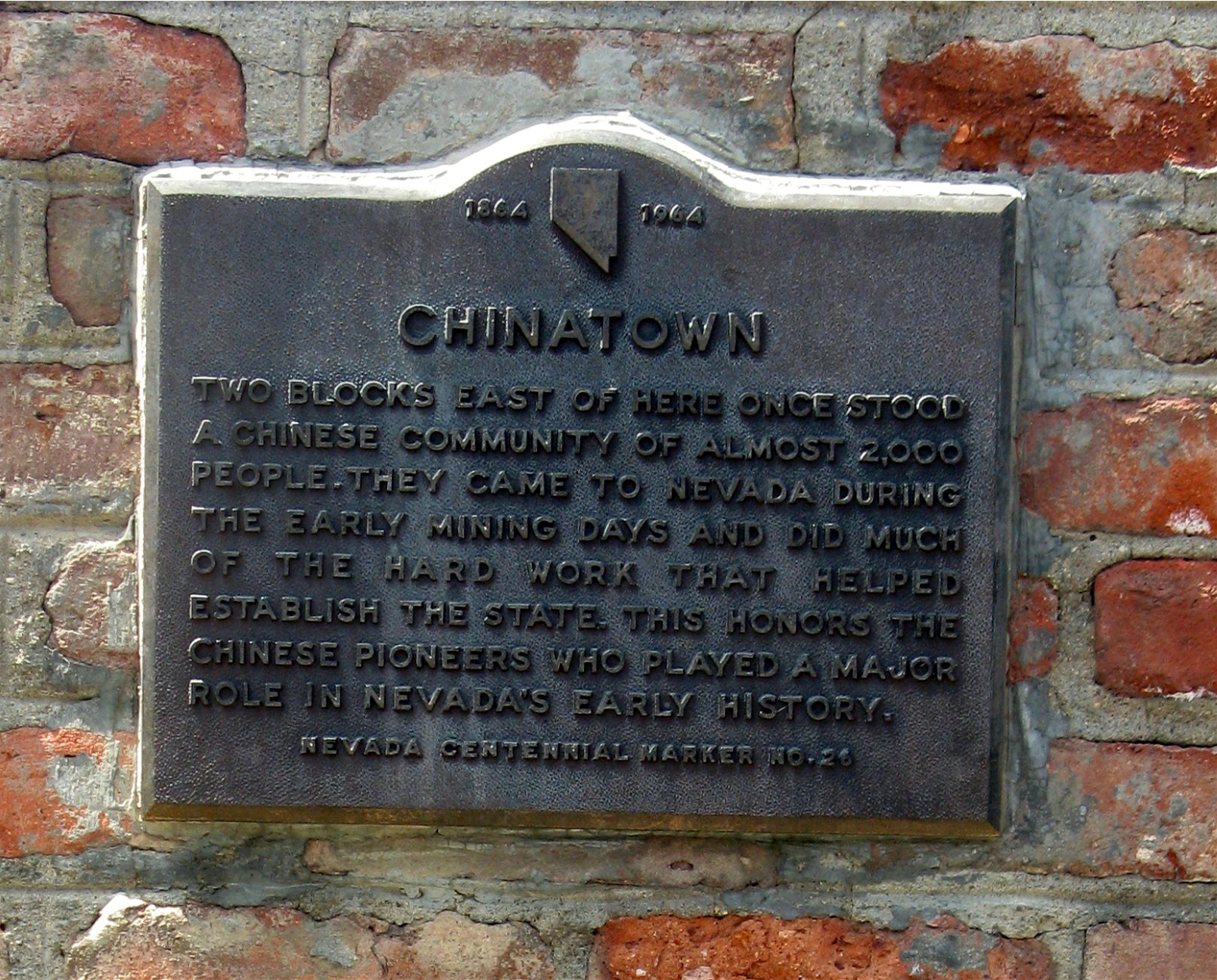
From the Rose Ditch to the Comstock
The Chinese presence on the Comstock predates the Comstock Lode itself. In the mid-1850s, Chinese laborers recruited from San Francisco were hired to dig the Rose Ditch, a canal built to carry water from the Carson River to the placer mines of Gold Canyon. It was hard, unglamorous work, the kind that opened a country to the people willing to do it. When the ditch was finished, many of the laborers stayed on to work the played-out placer claims that other miners had already abandoned. More Chinese immigrants joined them, and their settlement at the mouth of Gold Canyon became known simply as Chinatown, one of the first Chinese communities established anywhere in Nevada.
That original Chinatown did not last in place. After the 1859 discovery of the Comstock Lode drew the mining world’s attention up the mountain to Virginia City, the Gold Canyon settlement was renamed Dayton in 1861. Its location on the Carson River made it a natural site for the ore-processing mills that served the Comstock mines, and Dayton grew into the district’s freight and milling center. Many of the Chinese miners who had worked Gold Canyon’s placer deposits followed the opportunity uphill, to Virginia City itself.
There, on the eastern edge of downtown, a new and considerably larger Chinatown took shape.
A City Within the City
By the 1870s, Virginia City’s Chinatown was among the largest urban Chinatowns in Nevada, home to between 1,500 and 2,000 Chinese residents at its peak. The number is worth sitting with. Virginia City in this period was itself one of the most important cities between Chicago and the Pacific coast, and its Chinatown alone would have ranked as a substantial town by the standards of the surrounding territory.
The Chinese population statewide grew just as dramatically. Twenty-one Chinese men were counted in the western Great Basin in 1860. By 1880, Nevada’s Chinese population had surpassed 5,000, making it the largest foreign-born group in the state, ahead of the Irish, the group most Americans would have assumed held that distinction.
Chinatown itself covered several blocks of one and two-story wooden buildings, a mixture of lodging houses, laundries, noodle parlors, herb shops, and small mercantile stores stacked close together along narrow streets. Census records from 1870 and 1880 show a community with real occupational range: merchants, physicians, priests, teachers, restaurant owners, shopkeepers, and laborers, alongside cooks, launderers, wood cutters, peddlers, barbers, tailors, and boardinghouse operators. Chinese residents were, by law and by the practice of the local miners’ unions, barred from working underground in the mines that drove the town’s economy. They built their livelihoods instead in the trades the rest of Virginia City needed and, in many cases, could not do without.
Water offers a small but telling example of that resourcefulness. Accounts from the period describe Chinese residents using runoff water from the Fourth Ward School to irrigate garden plots, along with roots and stumps left behind by other wood collectors and land that no one else found worth claiming. Scarcity did not stop the community from generosity. The same accounts describe Chinese residents inviting Euro-American neighbors to join in banquets and festival celebrations, sharing what they had rather than guarding it.
Tongs, Temples, and the Shape of Community Life
Chinatown organized itself through structures that reached back centuries in China and had been reshaped by the particular pressures of immigrant life in Nevada. Beyond family ties and workplace associations, residents belonged to tongs, mutual-aid organizations, literally “meeting halls,” that offered members community status, protection, health and death benefits, job connections, and social life. Some tongs were entirely legitimate fraternal and business associations. Others operated on the wrong side of the law, and rivalries between them occasionally turned violent, in Virginia City as elsewhere.
The most notable of these organizations locally was the Zhigongtang, known in English as the Chee Kung Tong and sometimes called the Chinese Freemasons for its resemblance, in ritual and structure, to the Masonic order. Its stated purpose ran deeper than mutual aid. The Zhigongtang had been founded as a secret society dedicated to overthrowing the Qing dynasty, the Manchu government that had ruled China since 1644, and it maintained a presence in Virginia City and in Chinese communities across Nevada.
The Zhigongtang’s meeting hall, like similar association buildings elsewhere, became known to outsiders as a “joss house,” a term built from the Portuguese word for God, deusa. Euro-Americans who glimpsed the elaborate altars inside, with statues of deities such as the black-bearded Guan Gong, god of war and protector of his followers, understandably assumed they were looking at temples. They were not, not exactly. A joss house served the same civic function a Masonic lodge served for its members: fraternal, social, and political, with religious ritual, prayer, incense, and song woven through its gatherings rather than standing at the center of them. In a community without the funds to build a dedicated temple, the joss house carried that weight as well, hosting festivals, banquets, and the community’s most important gatherings.
Conflict and Coexistence
It would be simpler, and less honest, to describe Virginia City’s Chinatown purely as a besieged enclave or purely as a picturesque curiosity to the town around it. The record supports neither story alone.
Hostility was real and often organized. Anti-Chinese leagues operated in Virginia City, and in 1880 a local newspaper advertised an anti-Chinese torchlight demonstration, the kind of public spectacle meant to be seen and felt. That same year, Nevada voters weighed in directly on Chinese immigration in a ballot measure. The result left little room for interpretation: 17,259 votes against continued Chinese immigration, 183 in favor.
And yet the same town that produced those numbers also produced genuine curiosity and exchange. Many non-Chinese residents visited Chinatown for food, for medicine when Western doctors had failed them, for gambling, and, in some cases, for opium, and found in it something they considered exotic in the most literal sense: foreign goods, imported ceramics, unfamiliar sounds and smells that did not exist anywhere else in Storey County. Some non-Chinese Virginians became opium users themselves. A few married Chinese men, crossing a line that Nevada law did not sanction and that miscegenation statutes on the books would not fully clear away until 1959.
The exchange ran in both directions. Chinese residents adopted elements of American dress, and over time marriage practices among the community’s American-born children grew less traditionally Chinese. Public school education, however limited, exposed young Chinese-Americans to the surrounding culture in ways that reshaped the next generation’s sense of itself. Neither community absorbed the other. Both changed because of the other’s presence, in a town too small and too interdependent for either to stay entirely separate.
Daily Life Behind the Storefronts
What made Chinatown function, day to day, was rarely visible to outsiders who came only for an evening’s amusement.
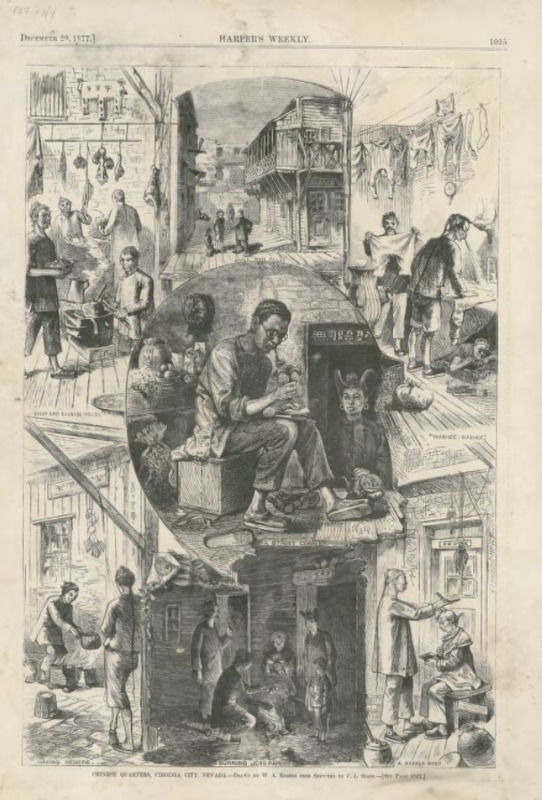
Food anchored the community, both practically and, to archaeologists a century later, materially. Excavations of the Chinatown site have recovered more food and drink related artifacts than any other category: animal bone, shellfish, storage jars, and serving vessels ranging from plain utility ware to finely decorated ceramics of Chinese, American, and even Japanese origin. Rice and tea, the staples of the diet at home, remained staples in Virginia City. The tea was always imported; some of the rice was grown domestically. Pork, chicken, shellfish, the preserved olives called kan-lan, vegetables, fruit, and soup filled out a diet that account after account describes residents supplementing with whatever the surrounding country offered, including produce peddled door to door: melons, tamales, watercress, radishes, lettuce, corn, and cabbage among them.
Medicine occupied its own respected niche. Chinese physicians, herbalists, and drugstore operators served their own community and, notably, drew Euro-American patients as well, people willing to try an alternative treatment when Western medicine had already failed them. Small glass vials of Chinese medicine, often mistaken by outsiders for opium bottles, actually held powders, liquids, pills, and syrups meant to treat ordinary ailments. Chinese wine, too, served medicinal purposes, rubbed into aching muscles or added to soups believed to ease pain. The bottles themselves tell their own quiet story to archaeologists: Chinese vials were formed by dipping and molding glass tubing, distinct in shape from the more rectangular, embossed bottles of American pharmacies found in the same ground.
Recreation carried its own weight in a community built largely, though not entirely, of men separated from their families by an ocean and a set of laws designed to keep it that way. A band of six to eight musicians played for New Year celebrations and funeral processions, instruments drawn from a musical tradition organized, in Chinese cosmology, around eight essential materials: metal, stone, silk, bamboo, gourd, clay, leather, and wood. Gambling was widespread and inventive. Fantan, played by wagering on how many gaming pieces would remain after they were removed from the table in counted groups, was common enough that different bet sizes corresponded to different kinds of tokens, coins for small stakes, chessmen and dominoes for larger ones. Chinese residents also played weiqi, the ancient strategy game better known today by its Japanese name, Go. One Chinatown pastime spread well beyond the community that invented it locally: an eighty-square game built around Chinese characters, the ancestor of what Nevada gambling now calls keno.
Opium carried the community’s greatest notoriety, and its history in Virginia City resists easy moralizing. The drug was legal for most of the nineteenth century, and it only drew serious official concern once Euro-Americans began using it in growing numbers. Opium dens operated in windowless rooms lined with mattresses and small lamps. When the Great Fire of 1875 leveled much of Chinatown, the dens were among the very first structures rebuilt, often deliberately difficult to distinguish from any other building on the street. Police raids followed periodically. The dens persisted anyway, pushed into back rooms, cellars, and house calls rather than eliminated.
Families Divided by Law
Few aspects of Chinese life in Virginia City were shaped as directly by American law as the family.
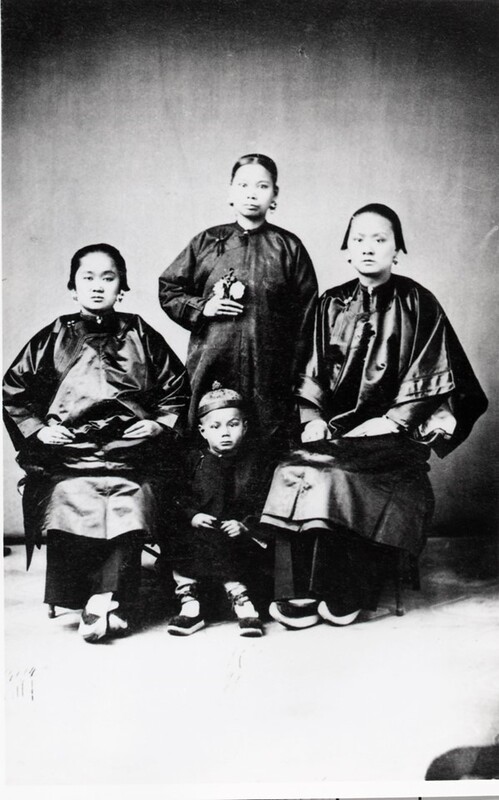
The traditional Chinese household was built around the extended family, but emigration rarely allowed that structure to travel intact. Most married men left wives and children behind in China, both to fulfill obligations to the family that remained there and to guarantee a reason to return. By some accounts, nearly a third to half of Chinese men in Virginia City were married while living apart from their wives and children, an ordinary domestic arrangement made extraordinary by distance and by design.
The Page Law of 1875 hardened that separation into policy. Nominally aimed at preventing the immigration of women for prostitution, the law’s practical effect fell on Chinese women generally, choking off legal immigration for wives as effectively as for anyone else. Combined with Nevada’s laws against marriage between Chinese men and Euro-Americans, the Page Law helped ensure that Virginia City’s Chinese community would remain overwhelmingly male for as long as it existed. Most bachelors who could not bring a wife from China and would not marry outside their community simply remained single. A small number crossed the legal line anyway, forming families the law did not fully recognize and that could never be, in Escobar’s phrase, entirely traditional.
The Great Fire and What Followed
Virginia City’s Chinatown burned in the Great Fire of 1875, the disaster that gutted much of the town in a single catastrophic stretch of hours. It was rebuilt afterward, wooden structure replacing wooden structure much as before. But rebuilding a neighborhood and restoring its fortunes are not the same undertaking, and Chinatown never fully recovered what the fire took from it.
The reasons were larger than any one fire. The Comstock Lode itself was running out. By the mid-1870s the richest veins had been worked hard enough that new strikes were growing rare, and a miscalculation of ore reserves in two of the district’s major mines triggered a financial reckoning that reached far beyond Virginia City: the collapse of the Bank of California and a crash on the San Francisco stock exchange, both in 1875, drained capital and confidence from the entire district. A second major fire struck Virginia City again in 1876, compounding the damage. Chinatown, already rebuilding once, absorbed these blows alongside every other part of the shrinking town, with fewer resources to draw on than most.
The politics of exclusion accelerated as the economics of decline set in. Nevada’s 1880 vote against Chinese immigration, the Chinese Exclusion Act of 1882, the Scott Act of 1888, and the Immigration Act of 1924 arrived in succession, each one narrowing the path for new arrivals and making the population that remained progressively older and more male. Nevada’s Chinese population, which had climbed past 5,000 by 1880, fell below 3,000 by 1890 and to just 1,276 by 1900. It would not begin to recover in any real sense until the Second World War shifted American hostility toward Japan and, eventually, brought about the repeal of Chinese exclusion. The most substantial growth in Nevada’s Chinese-American population, and the return of anything resembling a balanced, family-centered community, did not arrive until after the 1960s.
What Remains
The site of Virginia City’s Chinatown today is an open field, bounded roughly by Union and Sutton Streets on one side and F and H Streets on the other, inside the 14,750-acre Virginia City Historic District that the National Park Service has designated a National Historic Landmark. The district preserves more than 400 nineteenth-century buildings across Virginia City, Gold Hill, Silver City, and Dayton. Almost none of them stand on the ground where Chinatown once stood.
Wooden buildings and repeated fire proved a hard combination throughout the district’s history, and Chinatown’s structures, never rebuilt with the same investment as the buildings closer to the center of town, were especially vulnerable. What survives instead is underground and on paper: archaeological deposits of ceramics, medicine bottles, and food remains recovered from the site, the census records of 1870 and 1880 that name individual residents and their occupations, and a scattering of period photographs and sketches that capture fragments of a street life otherwise lost. Together they allow historians to reconstruct, imperfectly but with real confidence, a community that Virginia City depended on and never fully accepted, and that the town’s own record keeping preserved more faithfully than its landscape did.
Conclusion
Virginia City liked to think of itself as the richest place on earth, a boomtown built by a Comstock Lode that drew people from every part of the globe willing to take the risk. Its Chinese residents took that risk as readily as anyone, and for two decades they built a genuine city within the city, with its own economy, its own fraternal societies, its own medicine, food, music, and gambling halls, doing work the rest of the town needed and would not do itself.
What Virginia City never offered them was standing equal to that contribution. The same town that ate at Chinatown’s tables, sought out its doctors, and gambled at its games also voted seventeen thousand to one hundred eighty-three against letting more of them come, and wrote laws that made it nearly impossible for the men already there to bring their families to join them. Chinatown’s disappearance from the physical landscape, so complete that an open field is now the clearest marker of where it stood, is not simply a casualty of fire and economic decline. It is the visible result of a community that Virginia City used and, with equal consistency, refused to let take root.
About the Research
This article was researched using National Park Service documentation of the Virginia City Historic District, the Fourth Ward School Museum’s “On Silver Mountain” exhibit essay by Jessica Escobar, and other historical summaries drawing on census records, archaeological findings, and contemporary accounts. Where sources gave differing figures, such as the founding date of the original Gold Canyon Chinatown, the account most directly grounded in primary documentation has been given precedence.
Sources and Further Reading
National Park Service. “Virginia City Historic District, Nevada.” NPS.gov.
Escobar, Jessica. “On Silver Mountain.” Fourth Ward School Museum. Edited by Ron James, Susan James, and Sue Fawn Chung.