In 1870, a census taker walked the streets of Virginia City and recorded 7,048 residents. When the tally was finished, 3,456 of them, nearly half the city, had been born somewhere else. Ireland, Cornwall, Germany, China, Italy, and a dozen other places had all sent people to a mountainside in western Nevada that ten years earlier had barely existed at all.
This was not a curiosity of the census. It was the city’s operating condition. Virginia City did not simply attract immigrants the way any growing American town might. It depended on them, underground and on the surface, in the mines and the laundries and the hospital wards, to a degree that few other places in the country could match.
A City Built From Elsewhere
The scale of it is worth sitting with. Nevada as a whole was one of the most foreign-born states in the country in 1870, with 44.2 percent of its population born outside the United States. Virginia City ran close behind the state average, and in some respects surpassed it. An 1879 encyclopedia entry, drawing on the same 1870 federal census, gave the identical figures the government had recorded: 7,048 residents, 3,456 foreign-born, 539 of them Chinese. By 1880 the city had grown to 10,917 people, and the Chinese population stood at 519, essentially unchanged from a decade earlier even as the town around it expanded.
Those numbers describe population. They understate what immigrants actually did.
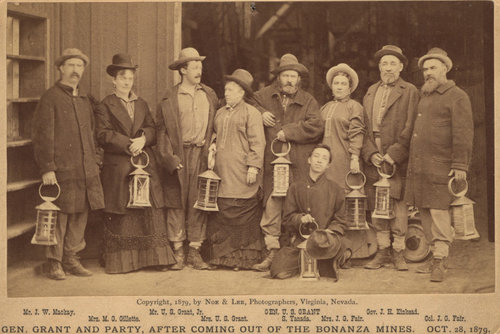
By 1880, according to census-based research into Virginia City’s mining workforce, 2,770 men worked underground in the city’s mines. Only 770 of them had been born in the United States. The rest, some 2,000 men, roughly 72 percent of the entire mining workforce, were foreign-born. Irish miners alone numbered 816. English and Welsh miners, many of them Cornish, added another 640. The Comstock’s silver did not come out of the ground through the labor of American-born men supplemented by a few immigrants. The immigrants were the labor force, and American-born miners were the minority working alongside them.
That fact reorders the familiar Comstock story. The bonanza kings and their millions occupy most retellings of Virginia City’s history. But the mine that made John Mackay rich needed men to sink its shafts, time its blasts, and hold back the water and heat that could kill without warning, and those men had, more often than not, crossed an ocean to be there.
The Irish Underground and Above It
Irish immigrants were already a substantial presence in Virginia City by 1860, when they made up nearly 12 percent of the city’s population, a proportion well above what the surrounding region would have suggested. By the following decade their numbers had grown further, and their influence had spread well past the mine entrance.
In Gold Hill, where the historian Ronald James examined the 1870 census in detail, 1,135 men worked as miners. Of those, 392 had been born in Ireland and 251 in England, and James’s analysis of English surnames in the same census suggests that more than half of the English-born miners were, in fact, Cornish rather than English by any narrower reckoning. Together, Irish- and Cornish-descended miners accounted for well over half the workforce in a town whose name is now shorthand for Comstock mining itself.
Irish men on the Comstock were not confined to the mine shaft. Timothy Francis McCarthy, an immigrant from County Cork who reached the district through the kind of chain migration common among Irish emigrants of his generation, worked not underground but as a blacksmith, a trade essential to any mining district’s daily operation and a reminder that “Irish Comstock worker” described far more than one occupation. Other Irish immigrants became teamsters, saloon keepers, distillers, contractors, policemen, and firemen. The community’s institutional presence was substantial enough that Virginia City’s first Catholic parish, established in 1860, grew within a decade into a much larger church, built to serve a Catholic population that Irish immigration had done the most to create. Father Patrick Manogue, himself Irish-born, helped lead that growth before rising to become a bishop.
And then there was the exception that later generations would remember best. John Mackay arrived on the Comstock with nothing. He worked as a common miner before rising, through a combination of skill, timing, and partnership with fellow Irish immigrants James Fair, James Flood, and William O’Brien, to control the Consolidated Virginia and California mines during the district’s greatest bonanza. The path from penniless immigrant miner to one of the wealthiest men in America was not a path many Comstock workers actually walked. But that a man could walk it at all, starting exactly where thousands of other Irish immigrants started, said something about what the Comstock was willing to offer, at least to a fortunate few.
What Four Dollars a Day Actually Meant
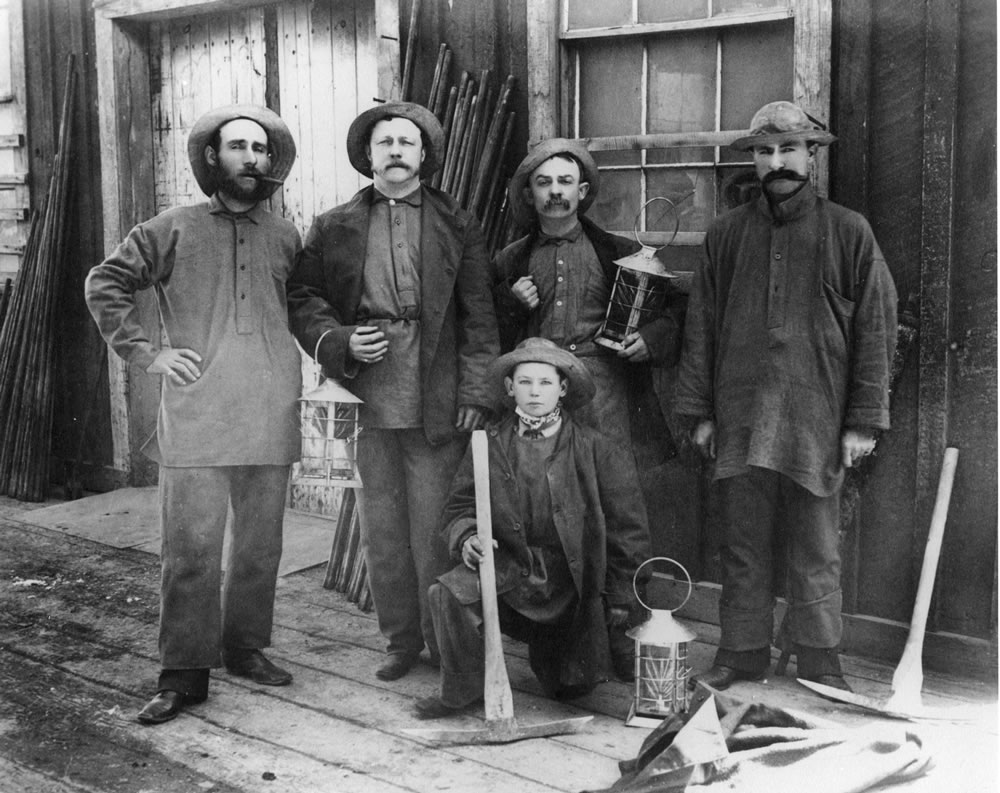
The wage that drew so many of these men west was, by the standards of the era, remarkable. Underground miners on the Comstock organized in 1863 and 1864 to establish a standard rate of four dollars a day, and the Virginia City Miners’ Union, founded on July 4, 1867, made that rate stick. An earlier organization, the Miners’ Protective Association, had pushed for the same figure as early as 1863, and even a temporary downturn that pushed wages to about $3.50 a day in 1865 did not hold. By 1867 the four-dollar rate was restored, and in 1872 the union secured an eight-hour workday as well, at a time when ten- and twelve-hour days remained standard in much of American industry. Roughly 3,000 miners belonged to the union during this period, and the four-dollar wage proved durable enough to survive, at least in most operations, into the depressed 1880s and 1890s, even after some upper-level workings reverted to ten-hour shifts.
Four dollars a day was, by any comparative measure, excellent pay. It was also earned in conditions that could kill a man in an instant or slowly over years. A late nineteenth-century history of the district recorded 1860 wages across other trades for comparison: masons at eight dollars a day, carpenters at six, common laborers at four, cooks at a hundred dollars a month, waiters at sixty. The miner’s wage sat comfortably among the highest of these, and the eight-hour day made it more attractive still.
But the cost of living on the Comstock ran just as high as the wages. Flour reached a dollar a pound during supply shortages. Butter cost the same. Hay, essential for the horses and mules that kept the district moving, could run as much as a hundred dollars a ton. The old claim that Comstock miners were simply well paid is true and also incomplete. They earned high wages into a local economy that consumed a large share of those wages before a man ever saved a dollar of them.
For an immigrant miner facing rockfall, blasting accidents, flooding, and heat that could become nearly unbearable more than a thousand feet underground, the calculation was not abstract. The Yellow Jacket fire of April 7, 1869, killed miners whose birthplaces, when later reconstructed by Ronald James from the census, traced back overwhelmingly to Cornwall, Ireland, England, and Canada, men who averaged barely over thirty years old and who had crossed an ocean or a continent to die together beneath a Nevada mountain that was not, in any sense, their own.
The Cornish Contribution
If Irish immigrants supplied much of the Comstock’s underground labor, Cornish immigrants supplied a good deal of its underground expertise. Cornwall’s centuries-old tradition of hard-rock tin and copper mining had produced a body of practical knowledge in shaft sinking, tunneling, blasting, timbering, and drainage that translated directly to the deep, hot, water-plagued mines of the Comstock. One estimate holds that at least a tenth of Nevada’s entire mining population during the 1860s and 1870s was Cornish, with particularly heavy concentrations in Virginia City, Gold Hill, and nearby Silver City.
Virginia City’s Cornish miners settled in sufficient numbers along South Howard Street, on the slope of Mount Davidson, that the neighborhood became known locally as Cornish Row. Archaeological excavation there, conducted by researchers from the University of Nevada, Reno, has recovered food remains, leather goods, tools, religious objects, and household refuse from what were once Cornish homes, evidence that moves the historical record past the general observation that Cornish miners lived in Virginia City and toward something more specific: where they lived, what their houses contained, and what they ate.
Later accounts of the Comstock sometimes emphasize friction between Irish Catholics and Cornish Protestants, and that friction was real. But it did not describe the whole relationship between the two communities. A study of the relatively prosperous district west of A Street in the 1880 census found 1,076 residents, of whom 360 were foreign-born and 277 of those were English or Irish. Twenty-two percent of married English residents in that neighborhood had Irish spouses, more than double the rate of marriage to American-born partners. Whatever rivalry existed between Irish and Cornish miners on the Comstock, it coexisted with intermarriage, shared neighborhoods, and presumably a great deal of ordinary daily cooperation that newspaper accounts of ethnic tension rarely troubled to record.
Merchants, Brewers, and Civic Life
Not every immigrant on the Comstock went underground. German and Austrian immigrants were especially visible above ground, in engineering, brewing, skilled trades, and retail. Joseph Fredricks, a German immigrant, ran a Virginia City business dealing in paints, oils, hardware, and wallpaper, one of many trades through which German-speaking immigrants supplied the district’s daily material needs. The community was large and established enough to support its own German-language newspaper, the Nevada Staats Zeitung, published on E Street near Piper’s Opera House according to an 1875 city directory, evidence of a population substantial enough to sustain journalism in its own language.
Jewish immigrants, many of German or Prussian origin, built one of the Comstock’s most economically significant commercial communities. By the mid-1860s, more than a hundred Jewish heads of household lived in Virginia City, most of them engaged in commerce, running dry-goods stores, clothing shops, groceries, and tobacco and liquor businesses.
Mark Strouse’s career illustrates how far that commercial success could extend into civic life. Born in Lauderbach, Germany, in 1845, Strouse emigrated to the United States in 1860 and reached Virginia City three years later. He built his fortune in the meat trade, eventually operating what became one of Nevada’s largest such businesses, the Central Market, which sold meat, sausage, fish, oysters, vegetables, and groceries under one roof. In 1868 the voters of Virginia City elected him chief of police. He went on to serve as city treasurer and as foreman of Virginia Engine Company No. 1, the volunteer fire brigade whose members formed one of the district’s most important civic institutions. Strouse’s path, from immigrant merchant to major employer to elected law enforcement official to city treasurer, traces a route into American civic life that few Chinese immigrants of the same period, however industrious or successful in business, were permitted to follow.
Italian immigration to Nevada increased through the 1870s, drawn partly by the comparatively high wages the Comstock offered even outside the mines. Angelo Ferretto arrived in Virginia City in 1866 and worked first in the mines, then in the timber trade, hauling wood down from the forests that supplied the district’s insatiable demand for lumber and fuel. He saved enough from that labor to purchase agricultural land, and eventually built one of the largest freight-hauling operations serving the Comstock, a path that ran from wage laborer to landowner to entrepreneur in the course of a single working life.
The Different World of Chinese Immigrants
European immigrants on the Comstock encountered real prejudice, anti-Catholic sentiment directed at the Irish, ethnic rivalry between Cornish and Irish miners, condescension toward accents and customs. But European immigrants could naturalize, join unions, vote, hold office, and, as Mark Strouse’s career demonstrates, rise into the civic establishment of the town itself.
Chinese immigrants faced something categorically different. They were effectively barred from the district’s major underground mines, not by a single sweeping statute, but by the practices of local mining-district rules and the miners’ unions themselves, reinforced by intense and often organized racial prejudice. The exclusion was not always informal. An 1871 Nevada statute authorizing a railroad right-of-way toward Virginia City explicitly prohibited the use of “Chinese or Mongolian labor” on that specific project, direct evidence that discrimination against Chinese workers could be written into law as well as custom, even where the broader exclusion from mining itself rested on union practice rather than statute.
Denied access to the district’s best-paying work, Chinese immigrants built economic lives in the occupations that remained. The 1870 census found that among roughly 460 Chinese men, about 20 percent worked as woodchoppers and 21 percent as laundry workers, with others employed as merchants, carpenters, tailors, doctors, druggists, and in other trades. By 1880 the concentration in laundry work had grown even more pronounced: 28.6 percent of Chinese men in Virginia City were identified with the laundry trade, and Chinese workers made up more than 80 percent of the city’s entire laundry workforce.
The reasons for that concentration were explicit at the time, not merely implicit. Mary McNair Mathews, a Comstock resident whose memoir the historian Ronald James has examined closely, wrote that Chinese domestic servants “will do things for us I would not like to ask a white person to do.” Laundry work in particular, physically punishing and considered socially degrading by most Euro-Americans of the period, became a niche that Chinese men filled partly by exclusion from other work and partly because white residents, including Mathews herself, were plainly relieved not to have to do it themselves. Mark Twain, who lived in Virginia City before he was Mark Twain, later wrote that Chinese laundries charged about $2.50 per dozen pieces washed, a price he noted white competitors could not profitably match.
Wood cutting occupied a similarly essential and similarly overlooked place in the district’s economy. Virginia City’s mines, mills, boilers, and households consumed extraordinary quantities of timber and firewood, and a substantial share of the men who supplied it, felling and hauling wood in strenuous outdoor labor far from the commercial center of town, were Chinese immigrants whose work kept the entire district running while remaining almost invisible in the era’s romantic accounts of silver kings and bonanza strikes.
Railroad construction told a related story. After Chinese crews had built much of the Central Pacific across Nevada, approximately 1,000 Chinese laborers worked on construction of the Virginia and Truckee Railroad toward the Comstock beginning in 1869, their presence generating considerable resentment among some white residents even as their labor built the rail line the district depended on. Comparable Chinese railroad crews in Nevada during this period earned roughly $30 to $35 a month, often for six-day weeks, a wage that stands in stark contrast to the $4 a day, or roughly $100 to $120 a month, that an organized underground miner could earn.
Yet the Chinese immigrant experience was not uniformly one of poverty and exclusion. Virginia City’s Chinatown supported its own merchant class, and archaeological research into the Yeong Wo Mercantile has documented a Chinese-owned business connected to a wider commercial network centered on San Francisco, dealing in imported silks, ceramics, newspapers, and religious materials. Commerce crossed the ethnic boundary in both directions, not only outward. A surviving 1883-84 ledger from a non-Chinese Virginia City store records a Chinese customer, Hi Chung, making a fifty-dollar purchase, a small but concrete piece of evidence that Chinatown functioned as part of Virginia City’s economy rather than sealed off from it.
Medical care offers one of the more surprising threads in this story. At least eight Chinese physicians are documented as having practiced in Virginia City during the 1870s and 1880s, treating patients with traditional Chinese medicine and herbal remedies. The best documented of them, a doctor known as Hop Lock, maintained offices at Taylor and Union streets and later on South C Street, and advertised his practice in the city’s English-language newspapers, publishing testimonials from white patients who had consulted him. Chinese medicine on the Comstock was not confined to Chinatown any more than Chinese commerce was.
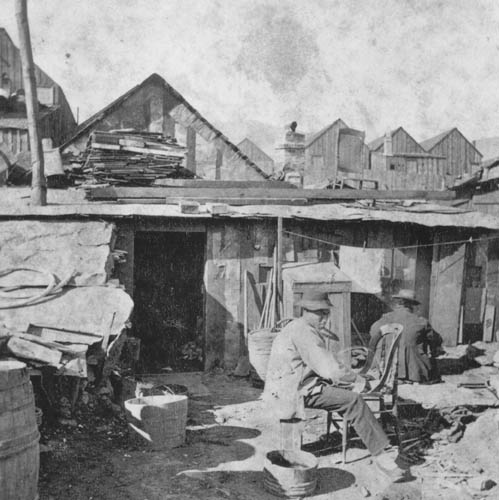
None of this softened the exclusion Chinese immigrants faced elsewhere in the district. Nevada Historical Society research into Virginia City’s Chinese community documents workers beaten while attempting to collect wages owed them, businesses vandalized, laundries set on fire, laborers stoned or pelted with bottles, and wages simply withheld by white employers who calculated, correctly, that the law offered little recourse. One elderly Chinese sawyer was reportedly attacked after demanding payment he was owed. A fire on June 24, 1872, destroyed roughly eighty buildings in Chinatown and left about 500 Chinese residents homeless, and the Great Fire of 1875 struck the same district again. The distinction between the experience of European immigrants and Chinese immigrants on the Comstock was not a matter of degree. It was a difference in kind, built into statute, custom, and the geography of the town itself, where an 1865 ordinance had pushed Chinese residents eastward toward H Street, into a low-lying area through which the city’s wastewater drained downhill from everyone else.
The Women Who Rarely Appear in the Story
Immigrant women sustained large parts of Virginia City’s economy and appear, even now, far less often in accounts of the district than the miners and merchants do. Ronald James’s analysis of the 1880 census found 156 women working as domestic servants, 91 as seamstresses, 64 running lodging houses, 34 teaching, and smaller numbers working in health care, laundry, millinery, and restaurants.
Irish women dominated domestic service to a striking degree. Of the 156 female servants counted in 1880, 78, exactly half, were Irish. Many were young and unmarried, but a significant number were widows or women separated from husbands, supporting children through wage labor in a district where a mining accident could remove a family’s income without warning. In some of the Comstock’s wealthier households, an intricate division of labor emerged: a Chinese man employed as cook, responsible for food preparation and heavier domestic tasks, working alongside an Irish woman responsible for children, for guests, and for the visible, socially presentable work of running a household. Chinese men and Irish women occupied adjacent but distinct niches inside the same homes, a small daily arrangement that quietly reflected the district’s larger racial hierarchy.
Laundry told a similar story from a different angle. Chinese men dominated the Comstock’s commercial laundry trade overall, but in neighborhoods with heavy Irish settlement, Irish widows and single mothers frequently took in washing themselves, work that carried real social stigma but that economic necessity made unavoidable. Nearly a hundred women worked as seamstresses in 1880, most of them young and unmarried, though widows sometimes returned to sewing when circumstances required it. Thirteen were identified specifically as milliners. British and French women were comparatively well represented among seamstresses, while Irish women, so prominent in domestic service and laundry, appeared there less often, evidence that occupational patterns on the Comstock were shaped simultaneously by ethnicity, gender, marital status, and class, layered together in ways a simple population count could never reveal.
Care for the Injured and the Sick
A mining district built on blasting powder, falling rock, deep shafts, and extreme heat generated injuries as a matter of routine, and Virginia City’s medical institutions grew, in significant part, to meet the needs of an immigrant workforce that had no family nearby to fall back on.
In the district’s earlier years, an 1864-65 city directory describes a county hospital under Dr. Thomas H. Pinkerton averaging about forty patients, while the city’s own hospital building stood largely unused, its function instead performed by a city physician, Dr. J. C. Tucker, who visited patients in their homes and was paid by the city for each visit. The city charter eventually authorized a Board of Health explicitly charged with controlling disease and providing for the indigent, a modest but real public commitment to residents who could not otherwise afford care.
The institution that changed the picture most substantially opened in 1876. The Daughters of Charity established St. Mary Louise Hospital, built largely through community donations and considered one of the most advanced medical facilities in Nevada. It accepted patients regardless of religious faith, offered roughly thirty-six rooms across five wards plus twelve private rooms, and could accommodate close to seventy patients at a time. Miners and mill workers typically paid about a dollar a month for coverage that entitled them to hospital treatment when needed, an arrangement that functioned as an early form of occupational health insurance decades before such coverage became common in American industry. Uncovered ward patients could be charged roughly ten dollars a week. Traumatic injury accounted for a substantial share of the hospital’s work: in 1876-77, about 20 percent of patients were admitted for trauma, a figure that reflects, more plainly than any statistic about wages, what underground labor actually cost the men who performed it.
Whether Chinese immigrants received equal access to St. Mary Louise Hospital remains, honestly, an open question. The institution’s stated policy accepted patients without regard to religion, but that is not proof of equal treatment by race, and the patient registers that would settle the matter have not yet surfaced in this research. What can be said is that Chinese immigrants maintained their own parallel medical resources, including at least eight documented physicians and a network of herbalists and druggists within Chinatown, resources that functioned whether or not the doors of the district’s largest hospital stood equally open to everyone who might have needed them.
What the Record Actually Shows
Virginia City’s silver came out of the Comstock Lode. The city that grew up around the mines to extract, process, finance, feed, house, and heal the people who worked them was built, to a very large extent, by immigrants. Irish and Cornish miners supplied both the labor and much of the technical expertise that made deep hard-rock mining possible. German and Jewish merchants supplied the retail economy and, in cases like Mark Strouse’s, a share of the city’s civic leadership as well. Italian immigrants like Angelo Ferretto moved from wage labor into land and enterprise. Chinese immigrants, effectively barred from the mines by union practice and prejudice rather than by mining law itself, built an entire parallel economy of laundries, restaurants, medicine, and wood cutting that kept the district functioning, even as that same district beat, robbed, and burned out Chinese residents with a regularity European immigrants rarely experienced.
None of this fits neatly into a single story of either opportunity or oppression. An Irish miner risked his life a thousand feet underground for four dollars a day and a documented chance, however slim, of becoming the next John Mackay. A Chinese laundryman built a stable, respected business in an occupation white residents considered beneath them, while remaining permanently barred from the mining wage that built the town around him. Both men were, in the fullest sense, part of what made Virginia City a city rather than simply a hole in a mountain. The record does not allow one story to stand in for the other, and it should not be asked to.
About the Research
This article was researched using the published federal census returns of 1870 and 1880, contemporary directories, memoirs, and newspaper accounts, and the published scholarship of historians including Ronald M. James, whose census-based studies of Comstock women, laundry workers, and mine-disaster victims underpin much of the demographic analysis here. Where the manuscript census and published census totals diverge slightly, as they do for Virginia City’s Chinese population, the discrepancy has been noted rather than resolved by assumption. Where the surviving record does not yet answer a question, including the specific matter of Chinese access to St. Mary Louise Hospital, that gap has been stated plainly rather than filled with inference.
References
U.S. Census Office. A Compendium of the Ninth Census, 1870.
U.S. Census Office. Statistics of the Population of the United States at the Tenth Census, 1880.
American Cyclopædia. “Virginia City, Nevada.” 1879.
Mathews, Mary McNair. Ten Years in Nevada: or, Life on the Pacific Coast.
Twain, Mark. Roughing It.
Nevada Legislature. 1871 Statutes of Nevada (Chinese labor prohibition provision).
Nevada Legislature. 1869 Statutes of Nevada (public health and indigent care authority).
Harper’s Weekly. “Chinese Quarters, Virginia City, Nevada.” December 29, 1877.
James, Ronald M. “Women of the Mining West: Virginia City Revisited.” Nevada Historical Society Quarterly.
James, Ronald M., Richard D. Adkins, and Rachel J. Hartigan. “Competition and Coexistence in the Laundry: A View of the Comstock.” Western Historical Quarterly 25 (1994): 165-184.
James, Ronald M. “Disasters on the Mining Frontier.”
Magnaghi, Russell M. “Virginia City’s Chinese Community, 1860-1880.” Nevada Historical Society Quarterly 24, no. 2 (Summer 1981): 130-157.
University of Nevada, Reno. Archaeological studies of Virginia City’s Chinatown and the Yeong Wo Mercantile.
Nevada Archaeologist, vol. 25 (2012). Cornish Row study.
U.S. National Park Service. Virginia City Historic District.
Smithsonian National Museum of American History. “Mining Charity.”