In the fall of 1864, a bartender named Charley Clintze stood at the bar inside Wood & Wilson’s saloon, taking a drink with three friends. A man named John K. Sale walked in from a back card room, drew a self-cocking English revolver, and told Clintze to defend himself. Nine shots followed. Clintze took three, including one that cost him two fingers. Sale escaped with a graze to the hand. Both men survived, and the Gold Hill Daily News covered the whole affair in careful, blow-by-blow detail two days later.
It is exactly the kind of scene a century of Western movies trained audiences to expect from a Comstock saloon. And it did happen, roughly as described, inside an actual Virginia City drinking establishment. But it was also, according to the archaeologists and historians who have spent the most time studying these places, closer to the exception than the rule.
Using Newspapers, Archaeology, and the Historical Record
This article draws on nineteenth-century newspapers including the Territorial Enterprise and the Gold Hill Daily News, on Storey County crime records, on Mark Twain’s own account of the town in Roughing It, and, most valuably, on the archaeological excavation of four actual Virginia City saloons conducted between 1993 and 2001 by Nevada’s state historic preservation office and University of Montana archaeologist Kelly J. Dixon. That dig recovered roughly 300,000 artifacts and gave historians something newspapers alone never could: a physical inventory of exactly what people ate, drank, and did inside these buildings.
More Than One Hundred Saloons, and No Two Alike
At its height in the 1870s, Virginia City supported more than one hundred saloons, a figure repeated across period and modern sources alike. That is a startling number for a town whose entire population, at its peak, is usually put somewhere between 15,000 and 25,000, sources vary on the exact figure, but even at the lower estimate it works out to roughly one saloon for every 150 residents, men, women, and children included.
The word “saloon” covered an enormous range of actual businesses. At the rough end, the contemporary historian Eliot Lord described some Comstock drinking rooms as little more than a cheap pine bar and a few black bottles. At the other end stood establishments with polished counters, mirrors, imported crystal, and gas lighting. A miner finishing a shift might duck into a workingman’s dive for a quick whiskey, or he might sit down to oysters, wine, and a newspaper in a saloon that would not have looked out of place in San Francisco.
Piper’s Old Corner Bar, operated by German immigrant John Piper alongside his opera house, offers the clearest example of the upscale end. Piper tackled Virginia City’s notoriously bad water by importing a two-foot ceramic carbon filter all the way from London, and he stocked German mineral water for patrons who wanted something other than whiskey. His establishment functioned as a theater saloon, a place to have a drink before or after a performance, and it drew Mark Twain himself as a regular.
The Hibernia Brewery and Saloon sat at the opposite end of the spectrum. Serving a largely Irish, working-class clientele, it held a supply contract with a brewing company for beer on tap, but archaeologists found its food remains and tableware to be among the poorest of any saloon excavated, pig’s feet rather than the fine cuts served elsewhere. O’Brien and Costello’s Saloon and Shooting Gallery combined a bar with an actual indoor target range, a form of entertainment more common than a modern reader might expect.
The variety extended to price as well as quality. The cheapest drinks cost a “bit,” 12½ cents, a unit of currency descended from the old Spanish silver dollar cut into eighths. “Two bits” for a quarter survives in American slang for exactly this reason. A customer could also pay with a “short bit,” a dime, and the accounting more or less evened out over time.
What the Bottles and Bones Actually Show
Archaeology corrected a good deal of what popular imagination assumes about frontier drinking. Patrons at all four excavated saloons consumed large quantities of wine and champagne alongside whiskey and beer, evidence that these were not exclusively rough, straight-whiskey establishments. Soda water bottles turned up bearing marks from bottlers as distant as San Francisco and Honolulu. Ginger, much of it imported from Jamaica, was mixed into ale to make a period version of ginger ale.
Food service was more sophisticated than the stereotype allows as well. Excavators recovered bones from beef, lamb, pork, poultry, and fish, along with oyster shells, some traced specifically to the Chesapeake Bay, shipped west after the transcontinental railroad’s completion in 1869 made such delicacies possible even in a mountain mining town.
The Boston Saloon, a Black-owned establishment discussed further below, offered particularly telling evidence. Its patrons ate some of the best cuts of meat found at any of the four sites, and archaeologists there recovered what is now recognized as the oldest known bottle bearing a Tabasco pepper-sauce imprint, dated to roughly 1870. Residue analysis on a ceramic lid from the same saloon detected a chili-pepper meat marinade, evidence of a genuinely cosmopolitan kitchen operating a very long way from any coast.
Coins, too, told a story. A long-standing bit of bar folklore holds that money always slips down between the floorboards of an old saloon. At the Boston Saloon site, the dig confirmed it: gold and silver coins turned up in exactly that spot.
Not Everyone Was Welcome Everywhere
If there is one place where Virginia City’s saloons diverged sharply from a single, uniform “frontier bar” image, it is here. The city’s more than one hundred drinking establishments sorted their customers, sometimes formally, more often through simple custom, along lines of ethnicity, race, and class.
The clearest and best-documented case is the Boston Saloon, opened around 1864 and relocated in 1866 to the corner of D and Union Streets by William A. G. Brown, a free-born Black man from Massachusetts. The Territorial Enterprise described it at the time as a popular resort for the city’s Black population, and it filled a real need: Virginia City’s roughly one hundred Black residents in 1870 had few other dedicated gathering places on the Comstock. But “separate” did not mean “lesser.” Brown’s saloon served some of the finest food and drink of any establishment excavated, in fine crystal glassware and good china, under some of the best lighting found at any of the four sites. Archaeologists also found evidence the Boston was not rigidly segregated in practice; a white patron was accidentally wounded there in August 1866 when a fellow card player’s pistol discharged, confirming that at least some white customers were present alongside the saloon’s primarily Black clientele.
At the other end of Virginia City’s social ladder stood the Washoe Club, organized in February 1875 as an explicitly exclusive institution rather than a public saloon at all. Its founding sixty members each paid $150 to join, generating $9,000 in starting capital, with total membership eventually capped at two hundred. Inside, members did not hand over cash at the bar; drinks and billiard charges were simply recorded against a monthly account. The club’s rooms included a library stocked with major newspapers, a card room, and a dedicated wine room, and its membership drew from the Comstock’s wealthiest mine owners and financiers. Nothing could stand further from the swinging-door dive of Western film convention.
Ethnic sorting extended well beyond these two examples. The Hibernia served an Irish clientele specifically; Virginia City’s Chinatown, home to an estimated 1,500 to 2,000 residents at its peak, supported its own saloons, gambling houses, and related establishments patronized primarily by Chinese residents, who faced severe legal and social discrimination elsewhere in the city, including exclusion from mining-district claims and underground union work. And “respectable” women were, by the standards of the era, largely absent from mainstream saloons; women present in most drinking establishments were typically employees, hurdy-gurdy dancers, “pretty waiter girls,” or, in a smaller number of cases, saloon owners themselves. The 1875 Nevada state census lists three women as saloon proprietors in their own right.
Yet even this picture resists easy oversimplification. Archaeologists recovered women’s clothing buttons at all four excavated saloon sites, evidence that at least some ordinary women, not automatically prostitutes, entered these spaces as customers seeking the same recreation the men around them were seeking.
Real Shootings, Not Daily Duels
Virginia City’s saloons did see gun violence, and it is documented by name, date, and newspaper account going back to the town’s earliest years. In 1859, a man known as French Pete was killed by Billy Brown in a B Street saloon. Billy Brown was himself later killed by Jack Williams in a billiard saloon on North C Street. Jack Williams, in turn, was shot dead at Pat Lynch’s saloon on December 10, 1862, while playing cards, the killer firing through a doorway and escaping into the night. In 1874, Barney Kenney, known as “Little Barney,” was shot and killed by Matt Redding inside the El Dorado Saloon. On January 2, 1877, a dispute the record calls a “saloon row” left both Richard Paddock and his killer, Thomas Hughes, dead within the same episode, Hughes shot by a police officer during the disturbance itself.
Contemporary observers described a genuinely violent early period. William Wright, writing under the pen name Dan De Quille in his 1889 history of the Comstock, recalled that “cutting and shooting scrapes” were nearly daily and nightly occurrences in the streets and saloons during Virginia City’s roughest years, so frequent that residents woke each morning half-expecting to hear that there had been “a man for breakfast.” The Sacramento Bee reported in September 1863 that more than a dozen men had been shot, wounded, or killed within a single month, warning readers it was “dangerous to venture into a crowd.” Conditions grew serious enough that a vigilance committee known as “601” organized in 1871 and carried out several hangings before order was substantially restored.
Set against this is the archaeological record, and it tells a quieter story. The physical remains recovered from the four excavated saloons were overwhelmingly bottles, tableware, food bones, and gaming pieces, not weaponry. The one site most associated with firearms, O’Brien and Costello’s, was literally built around a shooting gallery, a target-practice amusement rather than evidence of gunfights, and much of its spent ammunition reflects that recreational function rather than violence between patrons. Nevada’s state historians, who led the excavation, concluded plainly that the evidence shows saloons functioning as “centers of society and commerce rather than the arenas for deadly showdowns between ruffians, as often portrayed in books and movies.”
The honest picture sits between these two poles. Shootings happened, and they were newsworthy precisely because they were not routine background noise to an evening’s drinking. Two popular modern legends deserve particular skepticism here. The Delta Saloon’s famous “Suicide Table,” a card table supposedly linked to the deaths of three successive owners, cannot be traced to any nineteenth-century newspaper or documentary source; the earliest datable evidence for the story is a set of tourist postcards from 1947, when the table was actually on display at a different establishment entirely, the Sawdust Corner Saloon. Similarly, no nineteenth-century record has been located for a Virginia City saloon actually named the “Bucket of Blood”; that name traces specifically to the McBride family’s purchase of the building in 1931, decades after the boom years the gory origin story is supposed to describe.
Saloons, Brothels, and the Line Between Them
Virginia City had a substantial and well-documented prostitution economy, one of the most thoroughly studied on any American mining frontier thanks to sociologist Marion Goldman’s landmark 1978 study, built from the 1875 and 1880 census manuscripts and years of Territorial Enterprise reporting. In 1875, the census recorded 307 active prostitutes in the district, the single largest category of female employment outside the home, larger than domestic service, laundry work, and sewing combined.
But Goldman’s research draws a distinction that Western movies routinely erase: a saloon and a brothel were not, as a rule, the same business. Organized prostitution was concentrated in three separate, geographically distinct vice districts: the main red-light district along D Street, Chinatown’s own separate commercial-sex economy, and a small, notoriously rough strip on C Street known as the Barbary Coast, “only five or six small saloons,” in Goldman’s words, but responsible for a disproportionate share of the district’s violence. It was specifically here, in the Barbary Coast, that prostitution and saloon business were directly combined, with women helping to pour drinks in dives that housed only one or two of them at a time. The higher tiers of Comstock prostitution, independent courtesans like Julia Bulette working from their own cottages, and dedicated parlor houses such as Bow Windows, operated as entirely separate businesses from any ordinary saloon.
Virginia City’s own municipal ordinances reinforce this distinction. By the mid-1870s the city did not attempt to prohibit prostitution outright; instead it regulated where such houses could operate and barred women from publicly soliciting or displaying themselves in windows or doorways. Separately, and tellingly, the city also passed an ordinance penalizing saloons for hiring women to work on their premises, formal, if imperfectly enforced, evidence that Virginia City’s own lawmakers understood a working saloon and a working brothel as legally distinct kinds of establishments, whatever overlap existed in practice.
Julia Bulette herself remains the best-documented individual case. An independent, comparatively high-status courtesan, she was murdered in her cottage in January 1867; a drifter named John Millain was convicted and hanged the following year, in a hanging Mark Twain witnessed. Contrary to her later legend as a wealthy “Queen of the Comstock,” her actual probate filing valued her estate at only about $1,200, against debts that consumed a third of it. The city attorney’s own eulogy, printed in the Territorial Enterprise, captured the town’s complicated relationship with her plainly: “True she was a woman of easy virtue. Yet hundreds in this city have had cause to bless her name for her many acts of kindness and charity.”
The Old West Virginia City Rebuilt for Tourists
The Comstock’s mining fortunes collapsed after 1878, and Virginia City’s population collapsed with them. By 1945, longtime resident Mildred Giuffra later recalled a town that had shrunk to a grocery store, a post office, a restaurant, and only a couple of surviving bars scattered among a great many empty buildings.
What revived Virginia City was not silver. It was tourism, and the saloons themselves helped build the version of the Old West that visitors were actually looking for. John Zalac, who arrived in 1933 and eventually entered the liquor business, later described noticing by the mid-1940s that tourists did not necessarily want the town as it genuinely had been. They wanted the town they had already seen at the movies: gunslingers, red velvet, poker tables, antiques, elaborate Western décor. Bar owners responded in kind, adding chandeliers, hanging lamps, and Old West furnishings that had no particular connection to the 1860s and 1870s. Zalac himself became part-owner of a saloon called the Smokery, housed in a historic C Street building once associated with the earlier Delta Saloon; the partners revived the Delta name and redecorated to match what visitors expected to find. Nearby, the Bucket of Blood, the Crystal Bar, and the Brass Rail followed the same pattern.
It worked. Nevada’s 1931 legalization of wide-open gambling, growing automobile tourism, and postwar prosperity all fed a public appetite for a romanticized frontier past, an appetite Virginia City’s rebuilt saloons were happy to satisfy. The 1959 Comstock centennial and the same year’s television debut of Bonanza, set in the Virginia City area, sealed the transformation, introducing millions of Americans to a mythologized version of the town that increasingly stood in for the real one.
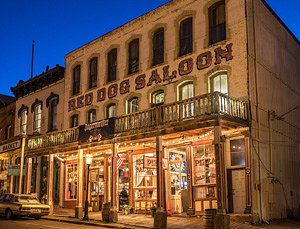
There is a genuine irony worth sitting with here. Much of what a modern visitor experiences as “authentic” nineteenth-century Comstock saloon atmosphere, the dark wood, the velvet, the gambling-den décor, is not a survival from the 1870s at all. It is a deliberate creation of the 1940s and 1950s, built by shrewd bar owners who understood exactly what story their customers had come to see. The real Comstock saloon, elegant reading rooms and imported London water filters sitting alongside genuine gunfire and hard-luck prostitution, was stranger, more varied, and in its own way more interesting than the Old West it was later remade to resemble.
References
U.S. Census Office. Nevada State Census, 1875. Carson City: John J. Hill, State Printer.
Gold Hill Daily News. “Shooting.” November 18, 1864.
Sacramento Bee. September 28, 1863.
Territorial Enterprise (Virginia City), various issues 1863-1880, including June 27, 1867.
De Quille, Dan (William Wright). A History of the Comstock Silver Lode & Mines. Virginia City, Nevada: F. Boegle, 1889.
Twain, Mark. Roughing It. 1872.
Dixon, Kelly J. Boomtown Saloons: Archaeology and History in Virginia City. Reno: University of Nevada Press, 2005.
James, Ronald M., and Kelly J. Dixon. “Havens in a Heartless World, Parts I and II: Virginia City’s Saloons and the Archaeology of the Wild West.” Online Nevada Encyclopedia, Nevada Humanities.
James, Ronald M. The Roar and the Silence: A History of Virginia City and the Comstock Lode. Reno: University of Nevada Press, 1998.
Goldman, Marion S. “Sexual Commerce on the Comstock Lode.” Nevada Historical Society Quarterly, Summer 1978.
Goldman, Marion S. Gold Diggers and Silver Miners: Prostitution and Social Life on the Comstock Lode. Ann Arbor: University of Michigan Press, 1981.
Angel, Myron, ed. History of Nevada: With Illustrations and Biographical Sketches of Its Prominent Men and Pioneers. Oakland, California: Thompson & West, 1881.
Nevada State Historic Preservation Office. “African Americans and the Boston Saloon.” Nevada Historical Marker No. 266.
The Washoe Club. “History.” thewashoeclubmuseum.com.
Barber, Alicia. “How Virginia City Became an Old West Tourist Draw.” KUNR, May 10, 2019.