By James Randall
Every guidebook says the same thing: nobody knows where Julia Bulette is actually buried. The white picket fence on Flowery Hill that thousands of visitors have photographed, the one visible from the Bucket of Blood Saloon’s old coin-operated telescope, is not her grave. It never was. It was built for tourists in the mid-twentieth century, a stand-in for a real grave that history simply lost.
That much is well documented. What has never been seriously examined is whether the real grave might not be lost at all, but sitting, unmarked and unremarked, a short distance from the fake one, waiting in a photograph nobody thought to look at closely.
The Grave Nobody Can Find
Julia Bulette was murdered in January 1867, and her funeral, by every account, was one of the largest and strangest Virginia City ever staged. Members of Virginia Engine Company No. 1, the volunteer fire company that had made her an honorary member, marched her mahogany casket out of town in a procession that drew crowds and closed saloons. She was buried, tradition says, on the slope of Flowery Hill, since as a woman of her profession she could not be laid in consecrated ground with the town’s respectable dead.
And then the record goes silent. No newspaper account, no probate document, no sexton’s ledger fixes the precise spot. The Julia C. Bulette Chapter of E Clampus Vitus, the local historical order most invested in her memory, states plainly on its own website that not one scrap of paper has ever surfaced pinpointing her burial site. The general hillside is known. The exact grave is not.
Into that vacuum, Virginia City’s tourist economy supplied an answer. Nevada historian Ronald M. James has written that in the 1950s, as the town was reinventing itself for visitors, the owner of the Bucket of Blood Saloon built a fenced gravesite on Flowery Hill and installed a coin-operated telescope on the saloon’s back porch so tourists could view it from across the valley. The fenced grave that generations of visitors have photographed as “Julia’s grave” was built for viewing in the 1950s, not dug for burial in 1867.
A Photograph That May Predate the Fake
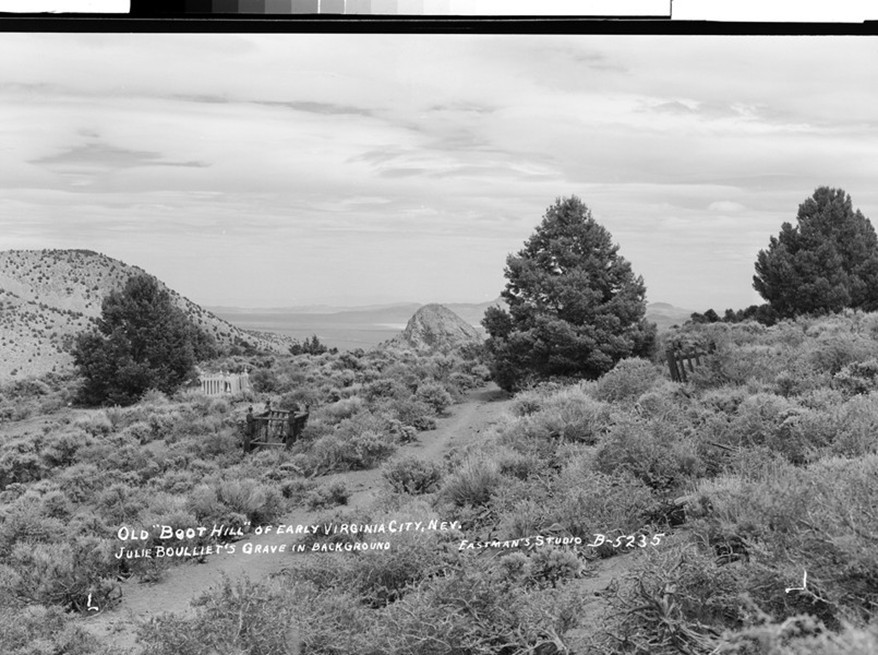
Which brings us to a photograph that, if its date holds up, changes the question entirely.
The image was made by Eastman’s Studio, a commercial photography company that operated across multiple cities and produced work intended to be accurate and saleable rather than romanticized. Cataloged by the University of California, Davis and dated to 1947, it is captioned, in the photographer’s own handwriting across the bottom of the print: “OLD ‘BOOT HILL’ OF EARLY VIRGINIA CITY, NEV.” and “JULIE BOULLIET’S GRAVE IN BACKGROUND.” The misspelling of Bulette’s name is itself a small piece of evidence. It reads like a photographer working from what he’d been told locally, not from a script written for tourists.
If that 1947 date is accurate, the photograph predates the tourist grave by several years. A staged attraction built for coin-operated telescope viewing in the 1950s cannot be the site shown in a photograph taken before that decade began. Whatever Eastman’s Studio photographed in 1947, it was not yet the fake.
The 1949 Newspaper Search
Two years after that photograph, the question of Julia’s real grave became a small local news story in its own right. On November 13, 1949, the Nevada State Journal sent a reporter, Peggy Trego, and a photographer up Six Mile Canyon to track down the grave, guided by local tradition and, in the end, by a member of the Virginia City Volunteer Fire Department, Victor Mariani, who pointed them toward “a tiny light spot” on a distant hillside.
What they found was a cemetery abandoned some seventy-five to eighty years earlier, its markers scattered and mostly ruined, with one grave standing out: an old-fashioned “cradle type” wooden enclosure, freshly whitewashed, its rounded headboard carrying only the carved initials “J. B.” The Journal‘s own headline hedged its bet: “Julia Bulette’s? Headboard on this grave carries only the initials ‘J. B.’” The article is careful, almost scrupulously so, never to claim certainty. “Many People Believe This Is Where She Lies Buried,” reads the subhead, and the story ends with the reporters having a quiet drink to Julia’s memory back on C Street, unresolved.
What the 1949 story makes clear, and what is easy to miss, is that this was already understood at the time as one candidate grave among several similar enclosures on the same hillside, not a single, obviously correct site. The reporters found “about four grave markers of this kind” still standing in the old cemetery, along with roughly eight other picket-fence enclosures in varying states of collapse. The “J. B.” grave stood out mainly because it had been kept painted, and because a fireman’s institutional memory pointed to it.
Two Photographs, One Hillside
Here is where the investigation now underway on this site becomes genuinely useful, and where it is important to be precise about what is established fact and what remains a well-supported hypothesis rather than a confirmed conclusion.
A side-by-side comparison of the Eastman photograph against the accepted tourist gravesite reveals real physical differences. In the Eastman image, the fenced grave and the ground around it slope gently from right to left, with no sharp drop-off directly in front of the enclosure. The known tourist site, by contrast, sits close to a point where the hillside falls away much more steeply, a location that makes sense if the grave was deliberately placed for maximum visibility from the valley floor and from the saloon’s telescope across the way. A staged attraction wants to be seen. A grave dug in 1867 had no such requirement.
A skyline comparison points in the same direction. When the distant hills and horizon visible in the Eastman photograph are cropped and set beside a modern photograph taken from a position roughly twenty feet to the right of the tourist grave, the near and far ridgelines align closely enough to place both photographs in the same general vicinity, roughly the same patch of hillside above Six Mile Canyon. That alignment does not, by itself, prove where any individual grave sits. It does establish that the Eastman photograph was taken somewhere on this same hillside, not at some other cemetery entirely, which had been an open question worth checking rather than assuming.
The fence construction itself offers a further, more delicate clue. Examined closely, the corner posts of the white picket enclosure in the Eastman photograph do not match the corner posts at the known tourist site. The horizontal pickets between posts are the parts most likely to have been repaired or replaced over the decades, since they are thinner and more exposed to weather, but sturdy corner posts are the kind of construction detail that tends to survive if a fence is genuinely the same structure photographed at two different times. If the Eastman photograph shows the same fence as the tourist grave, only built earlier, the corner posts should match. On the evidence gathered so far, they do not look like the same posts.
Taken together, these three lines of evidence point toward a specific, testable hypothesis: that the enclosure in the 1947 Eastman photograph sits on the same hillside as the tourist grave but is a distinct structure, located an estimated hundred feet or so further east, in a comparatively level stretch of ground uphill from the spot where the fake grave was later built for viewing.
What the 1949 Newspaper Photograph Adds, and Complicates
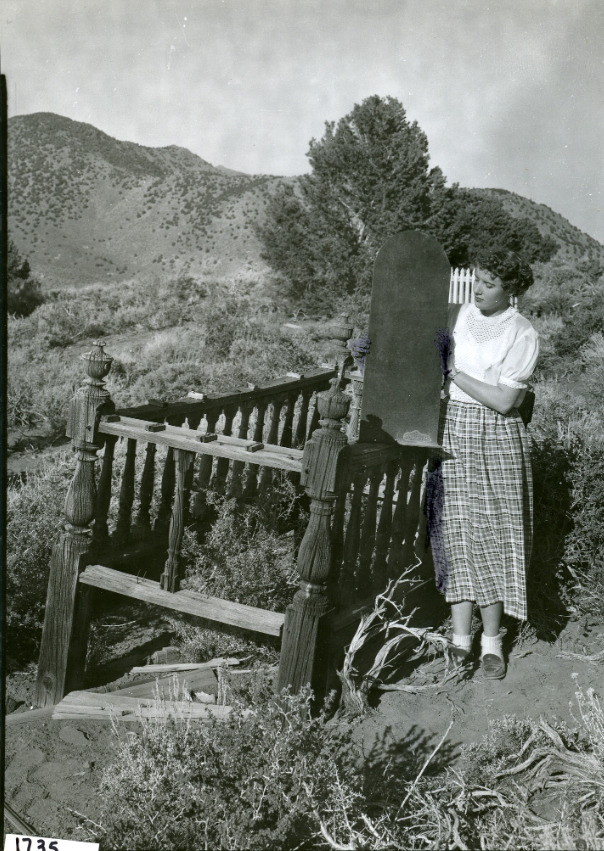
A second photograph deepens the picture without quite settling it. It shows a young woman standing beside a wooden grave enclosure, holding what appears to be the carved “J. B.” headboard, in a pose and setting that closely resembles the fenced grave on the left side of the Eastman photograph. If this image dates to around 1949, as it appears to, it would place it squarely within the same window as the Nevada State Journal‘s own expedition that November, and possibly depicts the very grave the Journal photographed for its story.
This is worth stating plainly as a complication rather than glossing over: the woman in this photograph is holding a marker carved with the initials “J. B.,” the same initials the Journal found and photographed. That detail could mean this is, straightforwardly, a photograph of the same “J. B.” grave the newspaper wrote about. It could also mean something more ambiguous. If Julia’s traditional grave and a differently sloped, differently fenced enclosure identified in the Eastman photograph are in fact two separate structures on the same hillside, as the fence and topography evidence suggests, then “J. B.” carved on a headboard in one photograph does not automatically confirm which enclosure the Eastman caption was describing. Initials are common. Coincidence, while less likely than intention, cannot be ruled out from a photograph alone.
The honest position is that these two photographs, the 1947 Eastman image and the 1949 newspaper photograph, appear to document the same neighborhood of graves on the same hillside, quite possibly the same specific enclosure, but they do not by themselves prove which single grave, if any, holds Julia Bulette’s remains. No burial record ever will, since none exists.
What Can Be Said With Confidence
Several things can be stated plainly. The fenced, whitewashed “Julia’s grave” that tourists have photographed for decades, viewable once through a coin-operated telescope on the Bucket of Blood Saloon’s back porch, was built as a visitor attraction in the 1950s, not as a burial marker in 1867.
Separately, a 1947 commercial photograph, made before either proposed date for the tourist grave’s construction, documents a fenced burial enclosure on the same general hillside, captioned at the time as Julia’s grave. Physical comparison of that photograph against the known tourist site, examining slope, skyline, and fence construction, suggests the two are not the same structure, and that the Eastman photograph’s grave sits roughly a hundred feet further east, on more level ground.
What cannot be said, honestly, is that this settles the matter. No document from 1867 or the years immediately after ties any specific grave to Julia Bulette by name. The “J. B.” initials that both the 1949 newspaper and the mid-century photograph document are suggestive, not conclusive. What the evidence does support is something more modest and, in its way, more interesting: a specific, physically distinct grave enclosure, photographed and captioned as Julia’s before the well-known tourist site existed, differing from that later site in ways that are difficult to explain as mere restoration or repair. It is the strongest documentary lead toward the actual location of Julia Bulette’s grave that has surfaced in decades, and it deserves further investigation rather than either dismissal or premature certainty.
Why the Question Still Matters
It would be easy to treat this as a minor curiosity, one more unresolved detail in a story already thick with myth and embellishment. But the search for Julia Bulette’s actual grave says something about how Virginia City’s history has been handled more broadly. A woman with no surviving family to advocate for her, buried outside consecrated ground because of her profession, was first forgotten by the record and then, a century later, supplied with a grave built for paying customers to look at from a distance. The fake became so entrenched that most visitors today have no idea it isn’t real.
If a nineteenth-century commercial photographer, working years before any tourist attraction existed, happened to capture the genuine site on film, and if a 1949 newspaper crew independently found and photographed the same hillside grave guided only by a fireman’s institutional memory, that would mean Julia Bulette’s real resting place has been hiding in plain sight in two published photographs for most of a century, while thousands of visitors were shown a substitute a short walk away.
That possibility deserves to be taken seriously, examined carefully, and stated with exactly the degree of confidence the evidence supports, no more and no less.
Bibliography
Primary Sources
- Eastman’s Studio. “Old ‘Boot Hill’ of Early Virginia City, Nev., Julie Boulliet’s Grave in Background.” Photograph B-5235, 1947. University of California, Davis, digital collections. View source
- Trego, Peggy. “Lonely Hillside Holds the Last Secret of Famous Julia Bulette.” Nevada State Journal, Reno, Nevada, November 13, 1949, p. 31.
- Photograph of unidentified woman at wooden grave enclosure holding carved “J. B.” headboard, circa 1949. Photographer and original publication not yet identified; included here for its apparent connection to the 1949 Nevada State Journal investigation.
Secondary Sources and Modern Research
- James, Ronald M. “Sex, Murder, and the Myth of the Wild West: How a Soiled Dove Earned a Heart of Gold.” FolkloreThursday, November 12, 2020.
- “Julia’s Grave: History or Myth?” Julia C. Bulette Chapter 1864, E Clampus Vitus.
- “Who Was Julia?” Julia C. Bulette Chapter 1864, E Clampus Vitus.
- Site investigation, photographic comparison, and fence analysis conducted independently for this article, 2022–2024, including on-site topographic observation and skyline photograph comparison.