By James Randall
At the height of the Comstock bonanza, an estimated 80 million board feet of lumber disappeared each year into the mines beneath Virginia City and Gold Hill. Much of it never came out. Cut in the forests around Lake Tahoe, the wood crossed mountains and valleys by skid road, steam tug, narrow-gauge railroad, V-flume, lumberyard, and Virginia & Truckee train before miners assembled it into a vast wooden framework underground.
The journey reveals a Virginia City larger than the city visible on Mount Davidson. Its industrial reach extended twenty to thirty miles west, into forests that supplied the mines with the material that kept unstable rock from collapsing. The Comstock did not merely purchase Tahoe lumber. It created a transportation system that tied the lake’s forests to an underground city of shafts, drifts, and excavated chambers.
The Scale of a Buried Forest
The strongest surviving estimate of peak demand comes from the nineteenth century. An 1896 article in Popular Science Monthly reported that roughly 80 million board feet of lumber went into Comstock drifts and chambers each year during the bonanza period. It also placed annual fuel consumption at about 250,000 cords of wood.
Later federal historical engineering research supports the lumber figure. A Historic American Engineering Record study concluded that the mines consumed at least 80 million board feet annually in the 1870s and cited an 1880 estimate that more than 600 million board feet had already been buried in the Comstock. The report offered a useful comparison: that quantity could have built six-room houses for a city of approximately 150,000 people.
“Buried” is the essential word. Lumber used in houses, hotels, stores, mills, hoisting works, railroad structures, and buildings destroyed by fire remained visible in the world above ground, at least for a time. Mine timbers entered another economy. Once installed in exhausted workings, a great deal of the wood was abandoned in place.
One widely repeated number deserves caution. Nevada’s Spooner Summit historical marker states that the Comstock used two million cords of firewood annually at peak production, eight times the 250,000-cord estimate published in 1896. Until the marker’s underlying source is identified, the lower contemporary figure is the more defensible one. The disagreement is a reminder that even impressive numbers need provenance.
Why the Comstock Needed a New Kind of Timbering
Virginia City stood in a dry, sparsely wooded landscape. Ordinary urban growth already demanded imported lumber and fuel for homes, boardinghouses, commercial buildings, warehouses, mills, steam boilers, fences, railroad ties, and repeated reconstruction after fires. Underground mining turned a scarcity into an industrial necessity.
The Comstock ore bodies could be exceptionally wide, and the surrounding ground was often weak and treacherous. Traditional posts and crosspieces might support a narrow tunnel, but they were inadequate when miners removed ore from immense chambers. The mines needed a structure that could grow in several directions as the excavation advanced.
In 1860, Ophir Mine superintendent W. F. Babcock called in German-born mining engineer Philip Deidesheimer. The Nevada Bureau of Mines and Geology credits Deidesheimer with devising the square-set system in about six weeks. Within months, the new method supported a chamber approximately sixty-five feet wide.
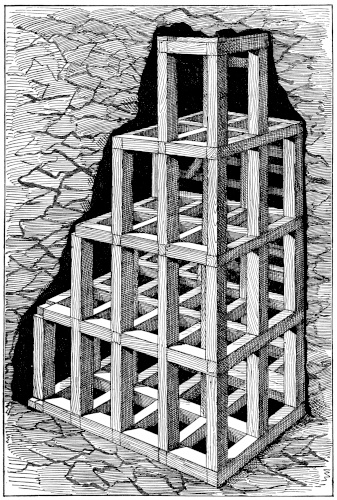
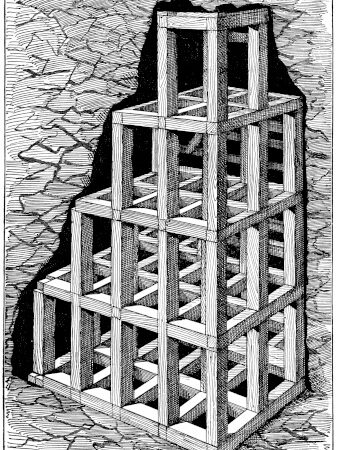
Square sets were interlocking wooden frames. Vertical posts and horizontal caps and girts formed cube-like units that could be extended upward, sideways, forward, and backward. Research at the Savage Mine describes typical pieces of roughly six to seven feet for vertical members and four to five feet for horizontal ones. The Savage adopted the system in 1861, soon after its introduction at the Ophir.
The result resembled a three-dimensional wooden lattice. Rather than placing supports beneath a tunnel roof, miners constructed the skeleton of a building inside the mountain, then enlarged it as they removed ore. Waste rock could be packed into exhausted portions, but the timber framework was what made the great stopes possible.
Dan De Quille, the pen name of Territorial Enterprise journalist William Wright, described the system while the bonanza was still underway. His 1876 History of the Big Bonanza includes an illustration titled “Timbering the Mines” and sections on both Comstock mining and Sierra wood cutting. Later scholarship attributes to him the phrase that best captures the relationship: “The Comstock Lode may truthfully be said to be the tomb of the Sierra.”
It was more than a reporter’s flourish. The mines were swallowing a forest.
From Local Woodlots to the Tahoe Basin
Operators first cut timber wherever it could be reached economically near the Comstock. Those supplies could not keep pace. As mines deepened and square-set construction spread, the resource frontier moved west into the Carson Range and Lake Tahoe Basin.
By the 1870s, this was no longer a matter of a few woodcutters hauling logs by wagon. The Lake Tahoe Watershed Assessment describes a shift after about 1873 toward large, capitalized enterprises using log rafts, steam tugs, sawmills, camps, skid roads, wagon roads, logging railroads, reservoirs, V-flumes, and connecting rail transportation.
Two great arteries eventually carried Tahoe wood toward the Comstock. The southern and eastern system centered on Glenbrook and Spooner Summit. The northeastern system ran through Sand Harbor, the mills near present-day Incline Village, the Great Incline, and a flume toward Washoe Valley and Lakeview.
Both networks existed because geography resisted the mines. Timber grew west of the Carson Range, while Virginia City stood high on its eastern side. Lumbermen answered by combining steam power, gravity, water, rails, and an extraordinary number of transfers.
Glenbrook and the Carson & Tahoe Lumber Empire
Large-scale lumbering at Glenbrook began by 1861. Over time, the settlement became the headquarters of the dominant lumber combine serving the Comstock.
The Carson & Tahoe Lumber & Fluming Company was organized in 1873. Its leading interests included Duane L. Bliss, H. M. Yerington, D. O. Mills, and J. A. Rigby. The company records preserved at the University of Nevada, Reno describe an enterprise that, at its peak, controlled approximately 50,000 acres of timberland, three Glenbrook mills, two steamers, two logging railroads, a narrow-gauge railroad, several flumes, numerous camps, and a Carson City box factory. Nevada historical documentation places its workforce at roughly 500 men in the logging camps.
From 1873 until the major operation closed in 1898, the company reportedly removed about 750 million board feet of lumber and 500,000 cords of wood from Tahoe Basin forests. That lumber total belongs to one company, not to the entire Comstock supply system.
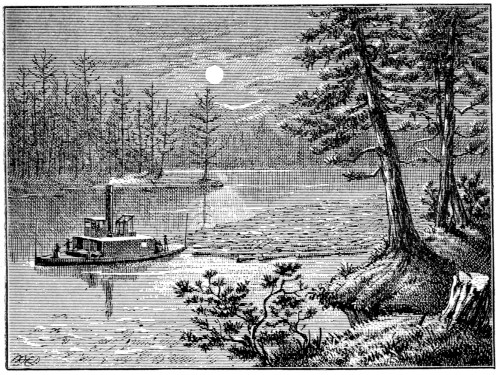
Glenbrook was therefore not simply a lakeside sawmill. Logs could be hauled or skidded from the forest, brought to the shore, assembled into rafts, and towed across Lake Tahoe by steam tug. At Glenbrook, mills turned them into lumber sized for buildings, railroads, mills, and the standardized demands of underground timbering.
The wood had reached the mill. The mountain still stood in its way.
Railroad Uphill, Water Downhill
The Carson & Tahoe company built a narrow-gauge railroad about 8.75 miles from Glenbrook toward Spooner Summit. Operating from 1875 to 1898, the line climbed through switchbacks and passed through a 487-foot tunnel near the summit. Its purpose was unusually specific: it carried lumber and cordwood uphill from the Glenbrook mills to Summit Camp and the head of the flume.
The Baldwin locomotive Glenbrook, built in 1875, survives at the Nevada State Railroad Museum. It is a physical remnant of a journey otherwise difficult to imagine. Loaded cars climbed away from Lake Tahoe so their cargo could be surrendered to gravity on the other side of the ridge.
At Spooner Summit, workers transferred wood into a V-shaped flume extending approximately eleven to twelve miles down Clear Creek toward Carson City. Nevada’s historical marker reports that as much as 300,000 board feet passed over the summit in a day during peak operations.
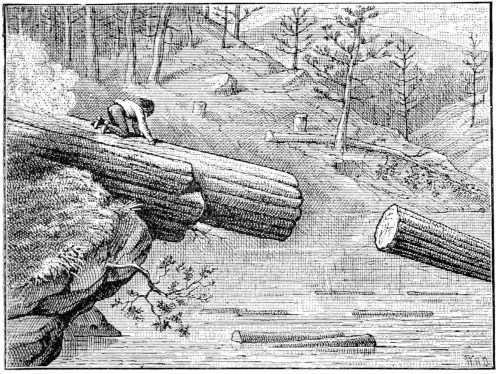
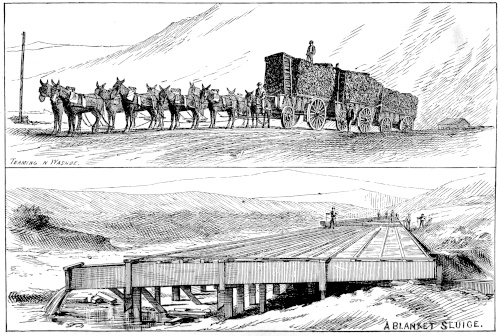
The V-flume was an elegant answer to limited water. Two boards joined at an angle concentrated a relatively shallow flow at the bottom. Lumber and cordwood could slide or float down grades where wagon transport would have been slow and expensive. By 1872, the Clear Creek flumes had been consolidated so material could travel continuously from Spooner toward the eastern foot of the Carson Range.
The mature route can be followed step by step:
- Trees were felled in the Tahoe Basin and moved by skid road, haul road, animal team, or logging railway.
- Logs reached shoreline loading points and, when necessary, were rafted and towed by steam tug.
- Glenbrook sawmills converted the logs into lumber and cordwood.
- The Lake Tahoe narrow-gauge railroad carried the wood uphill to Spooner Summit.
- An eleven- to twelve-mile V-flume sent it down Clear Creek.
- Workers collected and sorted it in a Carson City lumberyard.
- The Virginia & Truckee Railroad hauled it uphill to Virginia City, Gold Hill, and the Comstock mines.
The Carson-Tahoe lumberyard at the bottom of the flume reportedly measured about a mile long and half a mile wide. A V&T spur served the property. Some lumber went to the company’s planing mill and box factory on Stewart Street. Mine timbers and cordwood continued toward the Comstock.
Carson City thus functioned as the intermodal terminal in the Tahoe-to-Comstock system. The V&T did not reach into the forests and load raw trees. It received wood after lake, mill, mountain railroad, and flume had already done their work.
The Great Incline and the Name of a Community
The northeastern Tahoe system was different, but no less ambitious. The Sierra Nevada Wood and Lumber Company, organized by Walter Scott Hobart and managed by John Bear Overton, worked extensive timberlands around the lake’s northeastern shore.
Logs could be rafted and towed by the steamer Niagara to Sand Harbor. A two-mile narrow-gauge railroad carried them to the company’s Mill Creek sawmill. Finished wood then confronted the Carson Range by means of the machine that gave Incline Village its name.
Completed in 1880, the Great Incline was a steam-powered cable railway approximately 4,000 feet long. Sources differ on whether its vertical rise was about 1,400 or 1,800 feet, a discrepancy best left unresolved until company or engineering records establish the measurement used. Approximately 8,000 continuous feet of wire cable ran around enormous bull wheels, moving specially canted cars over the steep double track.
The reported capacity reached 300 cords per day. At the top, wood entered a V-flume descending toward Lakeview and Washoe Valley, where wagon or rail connections carried it onward to the Comstock.
Incline Village was not named merely for sloping ground. Its name preserves an industrial machine built to lift the Sierra’s forests over a mountain for mines on the other side.
What the Comstock Did to Tahoe’s Forests
The timber companies transformed the Tahoe Basin on a scale that remains visible in the historical record. The Forest Service watershed assessment describes industrial clear-cutting expanding sharply after 1873, when companies had enough capital to build integrated transport networks. Crews cut accessible stands, then drove roads and rails farther into the forest.
The consequences went beyond the removal of trees. Skid roads and bare slopes accelerated erosion. Sediment moved into streams and altered watersheds. Logging debris changed fire behavior. Repeated cutting and burning helped replace portions of the old forest with a younger, differently composed second-growth landscape.
The forest surrounding Lake Tahoe today is therefore not simply the forest the miners saw. Much of it grew after Comstock-era logging had removed older stands. Even where trees returned, the age, density, and species mix could differ from what existed before industrial cutting.
Contemporary observers could see the change. De Quille’s “tomb of the Sierra” image joined the underground mine to the stripped mountain. The phrase acknowledged an environmental footprint long before modern environmental language existed.
Virginia City consumed timber twice. First it burned wood above ground in boilers, stoves, mills, and fires. Then it entombed wood underground as structural support. The two uses met during mine fires, when the lifesaving framework became fuel.
The Great Fire of 1875 made the danger especially vivid. Burning surface works threatened to carry flame into shafts containing millions of board feet of timber. Square sets made enormous excavation possible, but they also placed a combustible wooden architecture beneath Virginia City. Underground fires could persist beyond the surface disaster that ignited them.
The People Inside the Timber System
The scale of the industry can obscure the labor that made it work. Hundreds of men felled trees, maintained camps, drove teams, operated locomotives and mills, assembled rafts, tended flumes, sorted lumber, and loaded trains.
Evidence also places Chinese workers in Tahoe-area lumber operations. Archaeological research drawing on Nevada census records identified thirty-eight Chinese residents at Glenbrook in 1880, some near a wood contractor. The Forest Service watershed history likewise notes immigrant labor, including Chinese workers, in the large lumber enterprises.
The available evidence establishes presence, but not yet a full account of names, jobs, wages, or living conditions. The Carson & Tahoe company records and Bliss family papers at UNR may make that history recoverable. Payrolls, camp accounts, and correspondence could turn a broad statement about labor into the lives of identifiable workers.
What Remains on the Ground
Although mills, flumes, rails, and camps largely disappeared, the timber system did not vanish without a trace. Historic American Engineering Record surveys near Genoa Peak and Spooner Summit document logging roads, spur roads, skid-road intersections, dams, camp sites, and Comstock-era stumps.
These remnants matter because they connect documentary quantities to physical places. A figure such as 80 million board feet per year is almost too large to picture. A weathered stump beside a graded logging road shows where that story began. The locomotive Glenbrook shows one of the machines that moved it. Square-set illustrations show where much of it ended.
Together, the surviving landscape, artifacts, photographs, maps, and company papers make it possible to follow the wood from living tree to underground framework.
Conclusion
Virginia City’s physical footprint did not stop at Storey County. It reached across Carson City, over Spooner Summit, around Lake Tahoe, and into logging camps where men cut the material required to hold open the Comstock’s immense excavations.
The system changed several places at once. It helped build Glenbrook into an industrial settlement, gave Incline Village its name, sustained specialized railroads and steamships, filled Carson City’s lumberyard, supplied traffic to the V&T, and altered Tahoe’s forests and watersheds for generations. Above all, it allowed miners to construct a wooden architecture inside Mount Davidson on a scale few other American mines required.
De Quille’s description of the Comstock as the “tomb of the Sierra” endures because it was literal as well as literary. The wealth raised from beneath Virginia City depended on a second extraction far to the west. Silver came out of the mountain. The Sierra went in.
Sources
Primary and Near-Primary Sources
De Quille, Dan [William Wright]. History of the Big Bonanza: An Authentic Account of the Discovery, History, and Working of the World-Renowned Comstock Silver Lode of Nevada. Hartford, CT: American Publishing Company, 1876. gutenberg.org/ebooks/34576
“Nevada Silver.” Popular Science Monthly 49 (October 1896). wikisource.org
Archives and Federal Documentation
University of Nevada, Reno Special Collections. Carson and Tahoe Lumber and Fluming Company Records; Bliss Family Records.
Murphy, Dennis D., and Christopher M. Knopp, eds. Lake Tahoe Watershed Assessment. General Technical Report PSW-GTR-175. U.S. Forest Service, 2000.
Library of Congress, Historic American Engineering Record. Comstock-era logging roads and Lake Tahoe timber infrastructure documentation.
Nevada and Technical Sources
Nevada Bureau of Mines and Geology, “Physics of Timbering,” Science of the Comstock. Nevada State Historic Preservation Office historical markers for Glenbrook, Spooner Summit, the Historic Flume and Lumberyard, and the Great Incline of the Sierra Nevada. Forest History Society, “Timber for the Comstock.” Nevada Archaeological Association research on Chinese residents and labor in Glenbrook and other timber districts.