By James Randall
The road between Virginia City and Carson City dropped and curved for roughly fourteen miles, and on a good day a stage driver could make the run in a little over an hour. Hank Monk once did it, according to a Gold Hill newspaper that knew him personally, in one hour and eight minutes. That is the kind of detail biographers of the man usually skip past on their way to the famous story, the one about Horace Greeley and a terrifying ride down the Sierra. It shouldn’t be skipped. It is, if anything, the more useful fact, because it explains something the legend never quite gets around to explaining: why anyone believed the legend in the first place.
Monk spent the better part of twenty-five years handling stage teams across some of the roughest driving country in the West, on routes linking Virginia City, Carson City, Gold Hill, Genoa, Placerville, Reno, and the shores of Lake Tahoe. By the time he died in 1883, he had become one of the most recognized men in Nevada, not because of the story that made him a national name, but because working Nevadans had watched him drive for a generation. The Greeley ride only confirmed what they already knew.
A Driver Before He Was a Legend
Henry James Monk was born, by the best surviving evidence, on March 24, 1826, in Waddington, a town in St. Lawrence County, New York, hard against the Canadian border. The record isn’t perfectly clean. Nevada Historical Society cataloging notes give his birth year as 1828, apparently following an 1883 obituary and the recollection of Monk’s own brother, and that discrepancy has never been fully resolved. The stronger evidence points to 1826. A detailed profile of Monk published in the Gold Hill Evening News on March 28, 1876, seven years before his death and while he was still working, gives the earlier date, and modern Carson City records follow it as well. A profile written about a living man by people who knew him carries more weight than a hurried obituary, so 1826 is the date this article uses, with the caveat noted rather than quietly resolved.
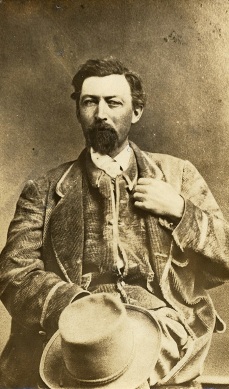
That same 1876 profile says Monk had loved horses since boyhood, and that he had once driven eight abreast through the streets of Boston during a public celebration, a detail that suggests a young man already drawing crowds before he ever saw California.
He reached the Pacific Coast in 1852, part of the great westward movement that followed the gold discoveries, and took work on one of the more modest stage routes available to a newcomer, the roughly forty miles between Sacramento and Auburn, driving for the California Stage Company under managers named Burch and Hayward. From there he moved to the Sacramento-Placerville road, learning the mountain grades that would define the rest of his working life.
Driving a stage in this period meant something considerably more demanding than steering a wagon. A driver controlled teams of four or six horses at once, changed teams at relay stations along the route, judged speed on descents with no engine braking to help him, negotiated curves cut into hillsides barely wide enough for the coach, and kept animals under control that could, and sometimes did, bolt outright. Westerners called the best of these men Jehus, borrowing the name from the Old Testament king who “driveth furiously.” Monk earned the title as thoroughly as any driver working the Sierra.
Coming to Nevada and the Comstock
In 1857, four years before Nevada Territory existed as a political entity, Monk began driving the route between Genoa and Placerville, then one of the principal trans-Sierra roads connecting California to the settlements of what was still western Utah Territory. The line changed hands more than once during his years on it, passing from J.V. Crandall to Brady and Sundland and eventually to Wells, Fargo and Company, and Monk apparently kept his seat through every change of ownership.
He also drove for George Chorpenning’s central overland mail operation, reportedly handling Chorpenning’s first eastbound run out of Placerville on July 1, 1858. That detail matters more than it might first appear. It places Monk inside the actual mail and transportation network that connected California to the interior West before either the transcontinental railroad or the Virginia and Truckee Railroad existed to make the journey easier. He was not simply ferrying curious travelers through mountain scenery. He was part of the infrastructure that kept the region connected at all.
As Nevada’s mining towns grew, so did the roads Monk drove. Along with the Genoa run, he took the Carson City to Virginia City route, worked Carson City to Steamboat Springs, and covered lines into Reno and around Lake Tahoe. He drove Carson to Virginia City for a man named Billy Wilson, and later worked the Tahoe route for J.M. “Doc” Benton, who ran livery, stage, and ice businesses out of Carson City beginning in 1867. It was on the Virginia City run, according to the 1876 Gold Hill profile, that Monk made the run from a Virginia City hotel door to the Ormsby House in Carson in one hour and eight minutes, a claim that deserves further newspaper verification but that appeared in print while Monk was alive to dispute it if it were false. Fourteen winding, mountainous miles in scarcely more than an hour was not a modest boast. It was the kind of driving that built a reputation before any Eastern editor ever climbed aboard his coach.
The Ride That Made Him Famous
In the summer of 1859, Horace Greeley, the powerful editor of the New York Tribune, was crossing the continent by stage on his way to California. He reached the Sierra in late July, and it is at this point that history and legend begin to tangle in ways that have confused readers for more than a century and a half.
The story that eventually made Monk a household name across the country runs, in its most familiar form, something like this. Greeley had a lecture engagement waiting in Placerville and worried aloud to his driver that he might arrive late. Monk answered him with a line that would outlive them both: “Keep your seat, Horace, I’ll get you there on time.” He then drove at a pace that terrified his passenger. Greeley was thrown violently around the coach. In the more elaborate retellings, the buttons came off his coat and his head went through the roof of the stage. He begged Monk to slow down. Monk only repeated his promise.
It became, within a decade, one of the most repeated stories in the American West.
Greeley’s own account, written almost immediately after the trip and published the following year in An Overland Journey, from New York to San Francisco in the Summer of 1859, tells a narrower story, though not a tame one. He describes reaching Genoa, eating there, pushing on another fifteen miles before stopping for the night, and setting out again before dawn because roughly seventy-five miles of mountain road still lay ahead. He describes the road itself as little more than a shelf carved into the mountainside, with a drop beside it running anywhere from five hundred to fifteen hundred feet. He writes that his coach was driven at about ten miles an hour, touching eleven at points, and that the horses were so wild two men could barely harness them. For roughly four hours and forty miles, he says, they held what he himself called a “break-neck rate.” At one point a trace worked loose and the horses genuinely ran away before the driver brought them back under control.
That is not a mild description. Ten or eleven miles an hour sounds unremarkable to a modern reader accustomed to interstate highways, but on a narrow, unguarded mountain shelf, behind horses capable of bolting, with no engine braking and no seatbelt, it was extraordinarily fast, and Greeley’s own choice of the phrase “break-neck” tells you exactly how it felt from inside the coach.
What Greeley’s account does not do, in all its considerable detail, is name Hank Monk. He calls the man holding the reins simply “our driver.” He never mentions a lecture engagement, never records himself demanding speed, never quotes the famous promise, never describes coat buttons or a head through the roof, never says he begged anyone to slow down. Every dramatic flourish that made the story famous is absent from the one account written by the man who was actually there.
That silence does not prove Monk wasn’t driving. It does mean the vivid dialogue that generations of Americans came to know by heart cannot be treated as established fact. Something genuinely dangerous happened on that road in the last days of July 1859. The theatrical version of what was said inside the coach appears to be exactly that: theater, added afterward by storytellers who understood that Greeley’s own sober prose, however accurate, wasn’t nearly as much fun to repeat around a campfire.
Twain’s Joke, and Twain’s Doubt
Mark Twain gave the story its permanent form in Roughing It, published in 1872. He tells it not once but repeatedly, as a running joke about how inescapable the anecdote had become. In Twain’s telling, every stage driver and every fellow traveler between Nevada and California seemed determined to tell him the same story, whether he wanted to hear it again or not, complete with the line that has outlasted almost everything else written about Hank Monk: “Keep your seat, Horace, and I’ll get you there on time!”
Then, at the close of the chapter, Twain adds a footnote that undercuts everything that came before it. The whole adventure, he writes, never occurred.
That footnote would seem to end the discussion, except that Twain himself was apparently not so certain. Correspondence uncovered by the Mark Twain Project shows that while he was preparing the book for publication, Twain wrote directly to Horace Greeley to ask whether the story was actually true. He explained that he had been told it was invented but wanted Greeley’s own word before he committed himself to that judgment in print. Whether Greeley ever answered him is not known. Twain published his footnote anyway, apparently on secondhand assurance rather than firsthand confirmation from the one man who could have settled the question.
It is a small, almost private moment of doubt buried inside one of the most confidently dismissive footnotes in American humor writing, and it deserves more attention than it usually gets. The man who told the world the story never happened wasn’t entirely sure of that himself.
What Monk Said About It
The most valuable piece of evidence in the entire case did not come from Twain, or from Greeley, or from any of the countless retellings that spread across the West in the 1860s. It came from Monk.
The 1876 Gold Hill Evening News profile, written while Monk was alive and still driving, states that he covered the 109 miles of the Greeley run in ten hours, and that he remarked, characteristically, that he could have done it faster if the horses had been better. The same article records something more telling still: Monk considered Mark Twain’s version of the story “not all correct.”
Read carefully, that is not a denial. Monk did not say the ride never happened, and he did not say he wasn’t the man driving. He disputed the particulars, the dialogue, the theatrics, while apparently accepting the underlying fact of the journey itself. That is precisely the distinction Greeley’s own account supports. Something real and genuinely dangerous took place on that mountain road. The version that made Monk famous nationwide, the one with the flying coat buttons and the head through the roof, was embellishment layered onto a true event by storytellers who came after.
Contemporaries who knew Monk personally described him as a man who rarely brought the story up on his own, and who apparently didn’t consider the ride especially remarkable measured against the rest of his career. That fits a working driver’s sense of proportion better than it fits a man who had built his reputation on a single wild afternoon. Monk had been driving difficult mountain roads at speed for years before Greeley ever climbed into his coach. To Monk, the run to Placerville may simply have been another day’s work that happened to carry a famous passenger.
A Comstock Celebrity in His Own Lifetime
By the 1870s, Monk had become something close to a tourist attraction in Carson City, independent of anything Twain had written. Visitors reportedly wanted to see Hank Monk and have him drive them out to Lake Tahoe nearly as much as they wanted to see the lake itself. An 1883 notice, written after his death, made the comparison explicit: a visitor could no more leave Carson City without seeing Hank Monk than a visitor to Rome could leave without seeing St. Peter’s.
That is not the kind of thing said about a man remembered for one wild ride decades in the past. It describes someone whose skill and reputation were current and ongoing, a working professional whose name had become a kind of local institution.
Monk died in Carson City on February 28, 1883, apparently of pneumonia. He is buried in Lone Mountain Cemetery, in a plot now marked by a replacement stone, since the original monument did not survive. The inscription associated with his grave calls him, in the language of his own era, “the whitest, biggest-hearted and best-known stage driver in the West,” a phrase that reads awkwardly to modern ears but was intended, in 1883, as the highest praise his community could offer.
The Photograph From Placerville
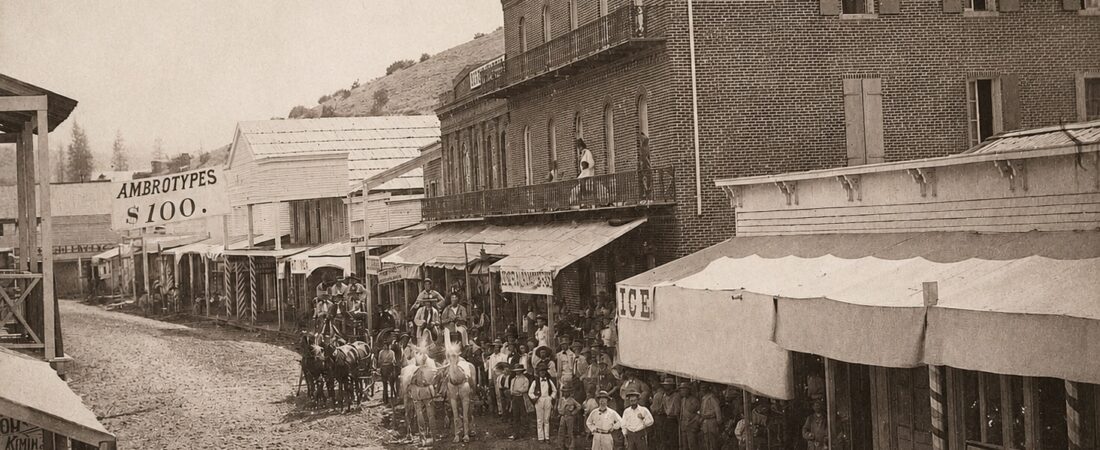
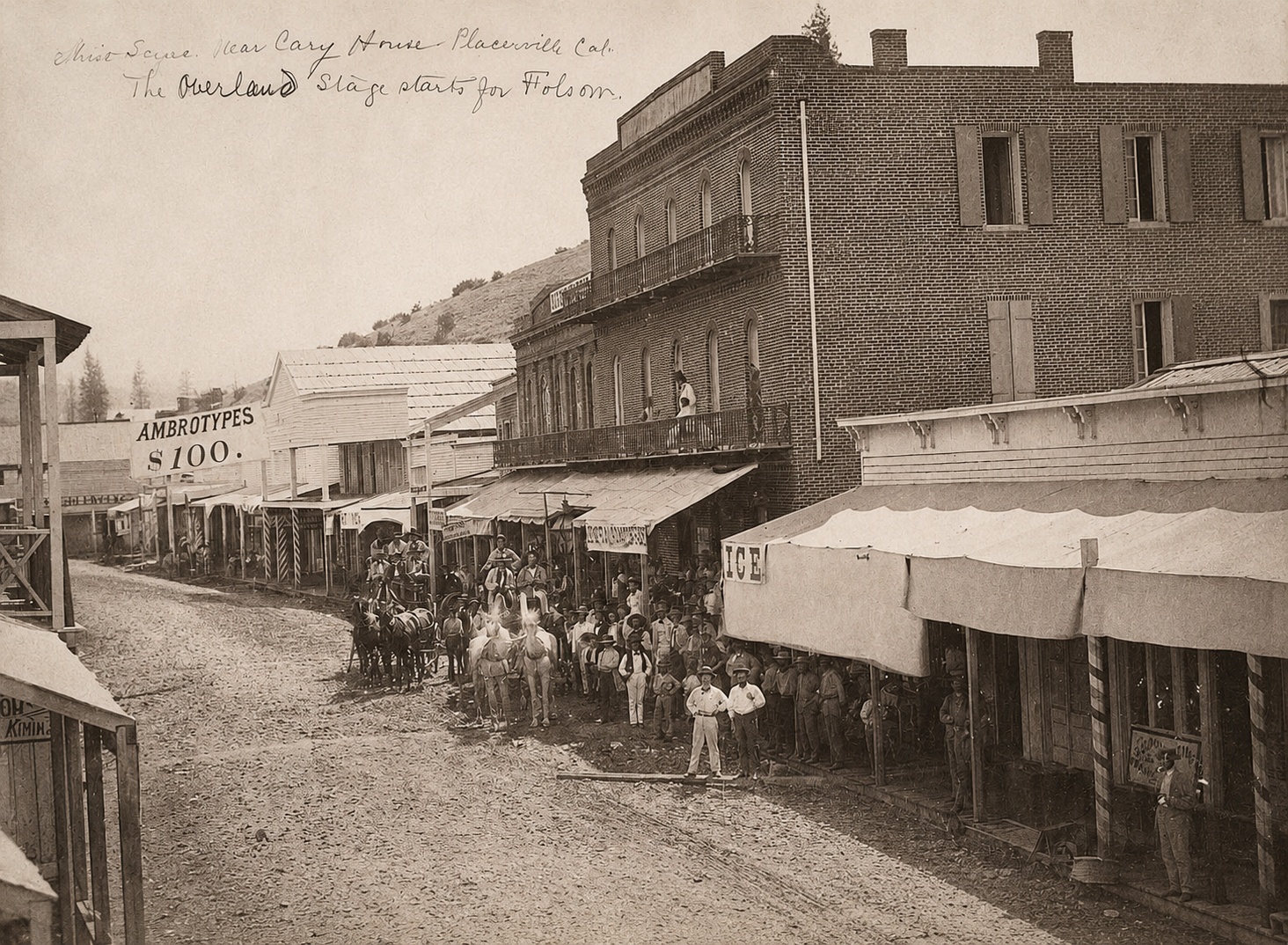
One especially evocative piece of visual evidence survives from almost the exact moment of the famous crossing. The Bancroft Library at the University of California, Berkeley, holds a photograph of Placerville’s Main Street and the Cary House, showing a crowd gathered around a waiting stagecoach, dated July 31, 1859, essentially the moment Greeley would have reached the town after his crossing of the Sierra. Tradition has long associated the image with Greeley and Monk specifically.
The Bancroft Library itself is careful not to claim more than the evidence supports, noting that it cannot confirm the photograph actually depicts Greeley and Monk, and suggesting the identification may have grown out of the story’s later fame rather than out of anything documented at the time the photograph was taken. That caution is worth respecting rather than smoothing over. What the photograph documents beyond dispute is Placerville itself, and the stagecoach culture of the town, at almost precisely the moment the Monk legend was born, whether or not the two men pictured are the two men history remembers.
Separating the Record From the Legend
| Claim | Assessment |
|---|---|
| Monk was a widely known professional Comstock stage driver | Documented |
| Born March 24, 1826 | Strongly supported (1828 also appears in some records) |
| Arrived on the Pacific Coast in 1852 | Strongly supported |
| Drove the Genoa-Placerville route | Documented |
| Drove the Carson City-Virginia City route | Documented in a contemporary newspaper |
| Made the Virginia City-Carson run in 68 minutes | Strong contemporary claim, worth further verification |
| Drove Horace Greeley across the Sierra in 1859 | Strongly supported, probable |
| Covered 109 miles in ten hours | Strong contemporary claim |
| Greeley demanded Monk hurry | Unverified |
| “Keep your seat, Horace, I’ll get you there on time” | Traditional, unverified as spoken dialogue |
| Greeley’s coat buttons torn off | Legendary |
| Greeley’s head through the coach roof | Almost certainly embellishment |
| The stage traveled at genuinely dangerous speed | Documented by Greeley’s own account |
| Monk died February 28, 1883, of pneumonia | Documented |
The Point of the Story
It is tempting to tell Hank Monk’s story as a debunking, a chance to correct a hundred and fifty years of exaggeration and move on. That undersells what actually makes him worth remembering.
The Comstock did not need to invent Hank Monk. It had a driver who spent a quarter century handling teams on some of the most punishing roads in the West, who was trusted to move mail, passengers, and mining district commerce over terrain that could kill a careless man in an instant, and who was recognized and sought out by ordinary Nevadans years before an Eastern newspaperman ever rode behind his team. That career would have made him locally famous with or without Horace Greeley.
What Greeley’s crossing did was hand the Comstock’s own oral tradition a story vivid enough to travel east, and once Mark Twain got hold of it, a story vivid enough to become part of the permanent literature of the American frontier. The interesting history isn’t really the question of whether the buttons flew off Greeley’s coat. It’s watching a real, working stage driver, already respected on his own terms, get quietly absorbed into a taller and taller tale, one that had outrun the facts before the man who lived it was even dead, and that he apparently corrected without much fuss whenever anyone bothered to ask him directly.
References
Greeley, Horace. An Overland Journey, from New York to San Francisco in the Summer of 1859. New York: C.M. Saxton, Barker & Co., 1860.
“Hank Monk: A Simple Story of a Simple Life.” Gold Hill Evening News, March 28, 1876. Transcribed via FromThePage, University of Nevada, Reno, Doten newspaper clippings collection.
Twain, Mark. Roughing It. Hartford: American Publishing Company, 1872, Chapter XX.
Mark Twain Project. Correspondence regarding Twain’s inquiry to Horace Greeley.
Nevada Historical Society. Rare Print File, “Monk, Hank, 1828?-1883.”
California State Parks. Biographical summary of Hank Monk, citing the San Jose Pioneer, March 1, 1883.
Carson City government records. Lone Mountain Cemetery, Hank Monk plot W1C-01-54.
Nevada Historical Society Quarterly. Study of George Chorpenning’s central overland mail operation.
Placerville, Main Street and Cary House photograph, July 31, 1859. The Bancroft Library, University of California, Berkeley. BANC PIC 1958.024:49–ffALB.