By the 1870s, Virginia City had become something far more complicated than a mining settlement. The mines still drove its economy, but the town above them had acquired the institutions and routines of an urban community: schools crowded with children, an opera house used for entertainment and public gatherings, a hospital, stores supplied from far beyond Nevada, and a railroad tying the Comstock to Carson City and the wider West.
For the ordinary resident who never descended a shaft, daily life was shaped by the same mineral wealth that made Virginia City famous, but usually at a distance. A shopkeeper, cook, teacher, laundress, merchant, child, physician, or theatergoer experienced the Comstock through crowded streets, changing prices, public institutions, ethnic neighborhoods, civic organizations, fires, crime, and the rhythm of boom and bust. The surviving evidence does not allow us to reconstruct every household routine, but it does reveal a town trying, with surprising speed, to become a city.
A City Built Before It Was Planned
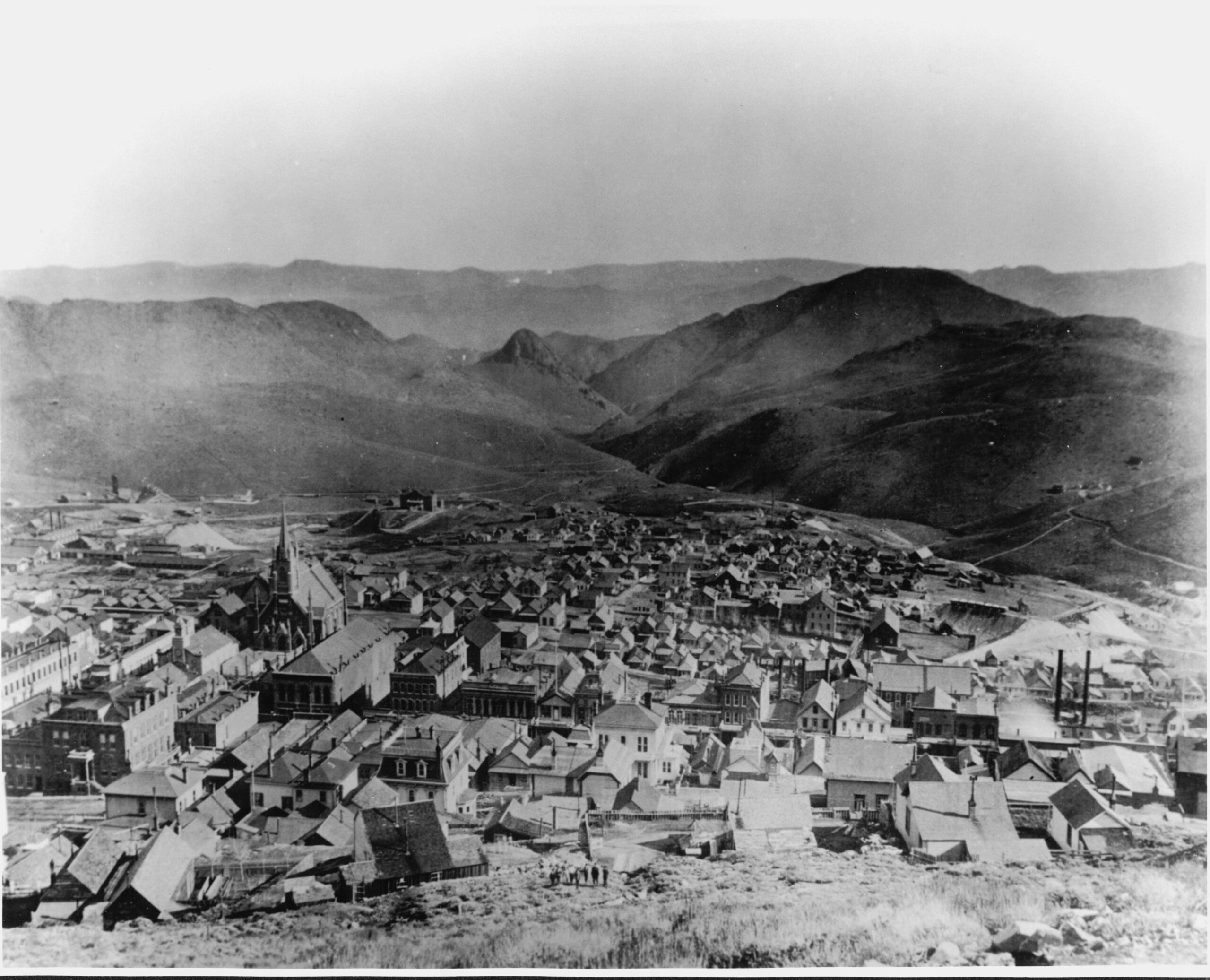
Virginia City grew so quickly after the Comstock Lode discoveries of 1859 and 1860 that its physical form reflected improvisation more than orderly planning. A travel account from 1865, preserved in later historical work but not yet traced to its original publication, described streets of differing widths that did not run parallel. The description is plausible and consistent with the town’s steep setting, but because the original source has not yet been located, it should be treated cautiously rather than as a definitive eyewitness statement.
The larger point is better documented. Within roughly fifteen years of settlement, Virginia City possessed banks, a stock exchange, large public schools, an opera house, and a charitable hospital. Its population rose rapidly, although the familiar claim that the town reached 25,000 people should be treated as a rounded estimate rather than a census-confirmed fact. Storey County as a whole recorded 16,115 residents in the 1880 census, after the peak years had passed.
What residents confronted every day was a city laid across a difficult mountainside. Moving people, food, fuel, merchandise, and building materials through that landscape was part of ordinary life long before anyone worried about preserving Virginia City as a historic place.
Getting In, Getting Out, and Bringing the World to Virginia City
Before the railroad, Virginia City depended heavily on wagons and stage traffic over rough roads. That changed dramatically when the Virginia and Truckee Railroad reached the Comstock. The first ceremonial spike for the Virginia City connection was driven on September 28, 1869, and the first official passenger train reached the city on January 29, 1870. The line gave residents a much faster connection to Gold Hill and Carson City and, through larger transportation networks, to markets far beyond Nevada.
The timing mattered. The completion of the transcontinental railroad in 1869 and the arrival of the V&T helped make goods that once would have seemed extravagant in an isolated mountain settlement increasingly obtainable. The research notes preserve one revealing example: live oysters could be brought to the Comstock from both coasts during prosperous years. That detail says as much about Virginia City’s ambitions as it does about its diet. Residents with sufficient means expected some of the comforts associated with San Francisco and other established cities, even though they lived high on a dry Nevada ridge.
Boom Years, Borrasca Years
The wealth of the Comstock did not reach every household evenly, and it did not last at the same level from year to year. Local historical material uses the mining term borrasca for the lean periods that followed the bonanzas. During prosperous years, imported luxuries might appear on the table. In bad years, household objects themselves showed the strain.
The Fourth Ward School Museum’s institutional history preserves small, unusually intimate examples of that decline in material comfort: chairs repaired with baling wire and oil lamps fitted with cork stoppers when proper filler caps were unavailable. These are not grand events, but they are among the most useful details in the surviving research because they bring economic contraction down to the scale of a kitchen or parlor. A mining slump was not merely a falling stock price. It could mean making an old chair last another year.
Children in a Mining City
Nothing demonstrates Virginia City’s transformation into a settled community more clearly than its schools. The Fourth Ward School, dedicated on November 28, 1876, was built because the city’s existing public schools were overcrowded. Designed by C. M. Bennett in the Second Empire style, the four-story building contained sixteen classrooms. A figure of 1,025 grammar and high school students was reported in the October 15, 1876 Sunday Territorial Enterprise and later quoted in federal architectural documentation. Because the original newspaper page has not yet been independently examined for this research, the enrollment number deserves a little caution, but the scale of the building and the overcrowding problem are well supported.
The school also reminds us that nineteenth-century Virginia City was capable of modern public investment. Its conveniences included indoor flush toilets, hand-washing sinks, drinking fountains, gas lighting, and central heat. Those features were advanced for a school of its place and period. Children growing up on the Comstock were surrounded by mine whistles, hoisting works, saloons, boarding houses, and speculation, but many also entered a school building equipped with technology that would have impressed visitors from older communities.
Opera, Theatricals, and Public Life
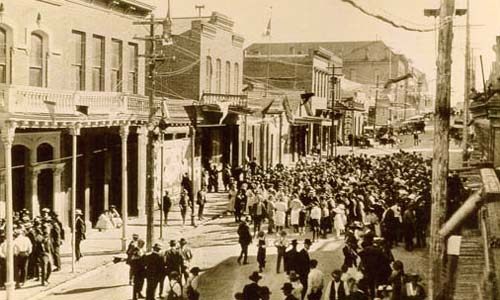
Piper’s Opera House was not simply a place where visiting performers appeared. It functioned as one of Virginia City’s central gathering places, hosting Shakespeare, prizefights, political discussion, and other public entertainment. Research associated with the University of Nevada, Reno excavation beneath the opera house supports its broader role as a community space used by men, women, and children.
Women also participated in organized theatrical activity. Ronald M. James and C. Elizabeth Raymond’s scholarship on Comstock women, cited in the research materials through a secondary discussion, records the Virginia Benevolent Association using the opera house for women’s public and private theatricals. That is an important corrective to the familiar picture of Virginia City social life as an almost exclusively male world of mines and saloons. The town’s civic and entertainment culture included women not merely as spectators, but as organizers and performers.
A Hospital on the Comstock
By 1876 Virginia City had a substantial civilian medical institution. St. Mary Louise Hospital opened on March 6 of that year in a four-story brick building of roughly 14,000 square feet. It contained 36 rooms, five wards, and 12 private rooms, with space for as many as 70 patients. The hospital was staffed by the Sisters or Daughters of Charity, and part of its support came from a one-dollar monthly levy on miners and millmen.
The exact story of how the hospital came to be is less certain. One later marker credits Marie Louise Mackay with donating the land. St. Mary’s Art Center, which occupies the historic building, gives an account centered on a serious 1873 industrial accident and identifies Jacob Van Bokkelen as a prior landowner. Those accounts may ultimately be reconcilable, but the research presently available does not establish how. A careful history should therefore resist choosing the tidier version simply because it makes a better story.
The surviving research is also thin on the medical system that preceded the hospital. That absence should not be mistaken for proof that Virginia City lacked physicians or other care before 1876. It means only that this research pass did not establish those arrangements well enough to describe them confidently.
An Immigrant City
Virginia City’s ordinary population was remarkably diverse. Nevada had a higher proportion of foreign-born residents than any other state in 1870, and the Comstock drew people from many parts of the world. The research is especially revealing for Chinese residents because census occupations survive.
Chinese people in Virginia City were not confined to the laundry trade. The 1870 manuscript census, as reproduced and analyzed in a specialist secondary source, lists Chinese residents working as merchants, miners, laborers, laundrymen, cooks, gamblers, and women recorded by the census taker with the period term ‘harlots.’ By 1880, Chinese doctors and restaurant owners also appear. The original census schedules have not yet been examined directly in this research, so the secondary transcription remains an intermediary, but the breadth of occupations is significant.
That evidence complicates an easy stereotype. Chinatown and Chinese laundries were visible parts of Virginia City, but Chinese residents participated in a broader economic world. They sold, cooked, treated patients, labored, gambled, mined, and conducted businesses in the same unstable urban economy as everyone else.
Crime, Vigilantes, and the Limits of Civic Order
Virginia City built schools, theaters, hospitals, and rail connections with striking speed, but formal institutions did not always command complete public confidence. The best-known example in the research is the ‘601’ Vigilance Committee associated with the lynching of Arthur Perkins Heffernan in 1871. The strongest cluster of accounts places the episode on March 24, when masked men removed Heffernan from jail and hanged him after he had killed a man at a hotel bar. George P. Kirk was hanged on July 18 in what appears to have been the group’s second and final execution.
Even here, the sources require restraint. Accounts disagree over the exact date, spelling of Heffernan’s name, the location of the original killing, and whether an earlier organization calling itself the 601 existed as early as 1861. The 1871 episode is the better-supported historical event. A reported all-female ‘Amazonian 601,’ supposedly announced by the Territorial Enterprise on July 2, 1871 to combat wife-beating, is especially intriguing, but the original newspaper page has not yet been verified. It is a promising lead, not a fact ready to be repeated without qualification.
For an ordinary resident, the significance is less the romance later attached to vigilantes than the contradiction they reveal. Virginia City could be sophisticated enough to operate an opera house and build an advanced public school, yet some residents still believed masked extralegal punishment had a place beside courts and jails.
Fire and the Fragility of Everyday Life
On October 26, 1875, the Great Fire destroyed roughly three-quarters of Virginia City. The detailed story of that disaster belongs in its own article, but any account of daily life in the 1870s has to acknowledge what such a fire meant for ordinary residents. A city built densely and rapidly could lose homes, businesses, possessions, and familiar streets in a matter of hours.
The fire also makes the construction of major civic institutions in 1876 more striking. Within months, St. Mary Louise Hospital opened, and before the year ended the Fourth Ward School was dedicated. Those dates should not be turned into a simplistic story of instant recovery, but they do show a community still investing in permanence immediately after a catastrophic loss.
Conclusion
The miners made the Comstock famous, but they did not make Virginia City by themselves. A functioning city required merchants to import food, railroad workers to move passengers and freight, teachers to manage crowded classrooms, women to organize charitable and theatrical work, cooks and restaurant keepers to feed people, physicians and religious sisters to care for the sick, and families willing to remain through fire, speculation, and economic reversals.
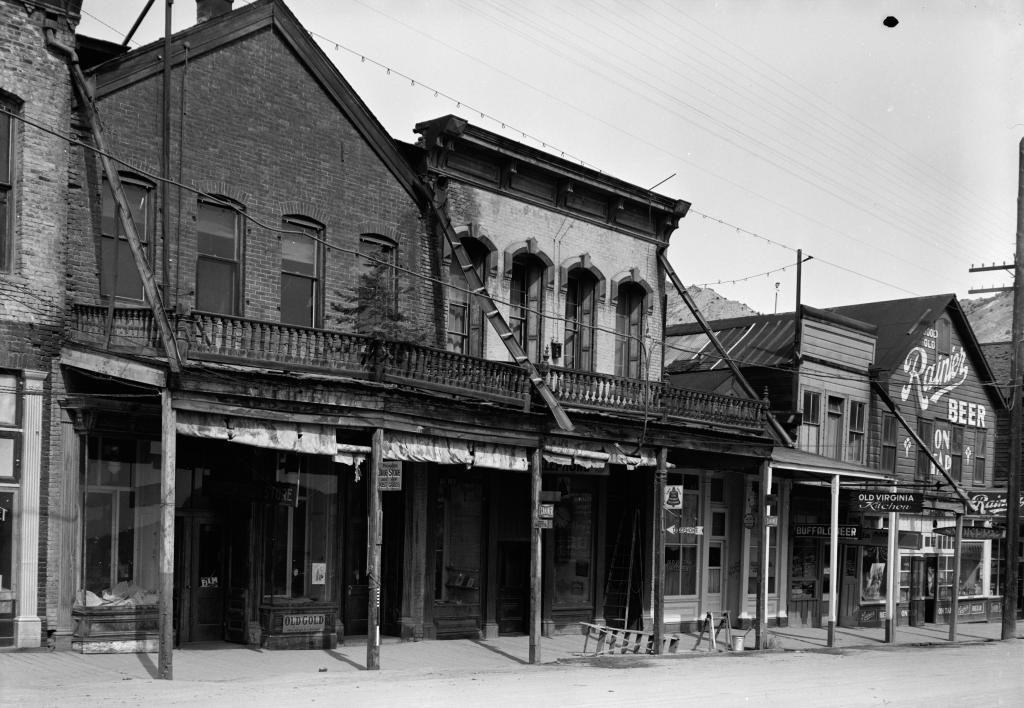
The most revealing evidence is often the least spectacular. An oyster arriving from a distant coast, a schoolchild using an indoor wash basin, a theater filling for a public performance, a chair held together with baling wire during a bust year: these details show what the Comstock looked like when its history was lived at street level. Virginia City was never only what happened beneath the ground. Its larger achievement was that, for a time, thousands of people built an urban life above it.
References
Primary and Contemporary Sources
- U.S. Ninth Census (1870) and Tenth Census (1880), manuscript population schedules, Virginia City, Storey County, Nevada. Original schedules held by the National Archives; occupation data consulted through secondary reproduction identified below.
- Gold Hill Daily News (Gold Hill, Nevada), 1863-1882. Library of Congress, Chronicling America, LCCN sn84022046. Digitized by University of Nevada, Las Vegas Libraries. Archive identified in the supplied research; specific daily-life issues were not directly searched in that research pass.
- Territorial Enterprise, October 15, 1876. Fourth Ward School enrollment figure as quoted in later Library of Congress architectural documentation; original newspaper page not independently examined in the supplied research.
- Library of Congress. Historic American Buildings Survey/Historic American Engineering Record documentation, Fourth Ward School, South C Street, Virginia City, Storey County, Nevada.
Secondary Sources and Modern Scholarship
- James, Ronald M. The Roar and the Silence: A History of Virginia City and the Comstock Lode. Reno: University of Nevada Press, 1998. Cited by secondary sources in the supplied research for the 601 episode; not directly consulted in that research pass.
- James, Ronald M., and C. Elizabeth Raymond, eds. Comstock Women: The Making of a Mining Community. Reno: University of Nevada Press, 1998. Cited through secondary discussion in the supplied research for the Virginia Benevolent Association.
- Online Nevada Encyclopedia, Nevada Humanities. “Nineteenth-Century Immigration and Ethnicity in Nevada: An Overview.”
- “A Chinese American Historian By Chance: Chinese in Virginia City, Nevada During Comstock Silver Lode Mining 1870s-1880s.” Chinese American Historian, October 2016. Used in the supplied research as a secondary conduit to manuscript census occupations.
- University of Nevada, Reno; Nevada State Historic Preservation Office; and Comstock Archaeology Center. The Archaeology Beneath Piper’s Opera House: A Study of a Nineteenth-century American Performance Hall. Excavation report, 2002.
- Fourth Ward School Museum. Institutional history materials.
- St. Mary’s Art Center. Institutional history of the former St. Mary Louise Hospital.
- Historical Marker Database. “St. Mary Louise Hospital.” Marker text attributed to Julia C. Bulette Chapter No. 1864, E Clampus Vitus, 2003.
- Streets of Silver. “Vigilantes and Outlaws.” Secondary account citing Ronald M. James, The Roar and the Silence.
- 601 Vigilance Committee. Institutional self-history. Used only to note the unresolved claim of an earlier 1861 organization.