By James Randall
Introduction: The Undisputed Facts
Julia Bulette died in her own bed on D Street in Virginia City sometime before dawn on Sunday, January 20, 1867. A neighbor found her at half past eleven that morning, a pillow pressed over her face, the bedding beneath her head soaked with blood. The physicians who examined her found finger marks on her throat and concluded she had been strangled, though two wounds on her forehead and temple, at first taken for a pistol blow, turned out to have come from a knotted stick of firewood left near the bed. A newspaper carrier walking past around five o’clock that morning had heard a single scream from the direction of her house. He noticed nothing else out of place and delivered her paper as usual. Furs, watches, jewelry, and dresses were gone.
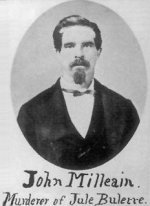
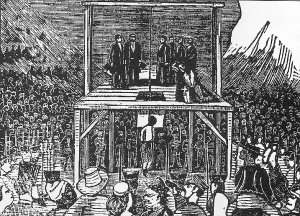
No one was arrested for more than four months. The case broke only after a Gold Hill woman named Mrs. Cazentre offered a dry-goods dealer a distinctive silk dress pattern, and the dealer recognized it as one he had sold to Julia Bulette herself ten days before her death. That thread led to John Millain, a French laundryman on the Geiger Grade, and from Millain to a trunk of Julia’s belongings stored at a bakery on D Street. Millain was tried in June 1867, convicted of first-degree murder on evidence that was entirely circumstantial, and sentenced to hang. His attorney, Charles E. DeLong, carried an appeal to the Nevada Supreme Court, which affirmed the conviction over one dissent. Millain was executed on April 24, 1868, having never publicly admitted to killing Julia Bulette, and having never publicly denied it in any way the record preserves as unambiguous.
Everything beyond this point depends on how much weight a reader is willing to put on a single disputed document: the account DeLong published in Millain’s name the day before the hanging, under the title Life and Confession of John Millain. That document is the only place Millain is said to have described, in any detail, what happened inside and beneath Julia Bulette’s house that night. It names two other men, Douglass and Dillon, as the ones who went inside. Neither man was ever found.
What follows treats that document seriously without treating it as settled. The case for Millain as Julia Bulette’s killer and the case for Millain as, at most, an accomplice both run through the same confession. The difference between them is not which evidence each side uses, but how far each side trusts the man who wrote it down.
The Affirmative Case: If DeLong’s Confession Is Accurate
The Assumption This Argument Requires
The affirmative case, that Millain was the man who strangled Julia Bulette, or was close enough to the killing that the distinction hardly matters, rests on treating Charles DeLong’s written account of Millain’s confession as a substantially faithful record of what Millain actually told him. That is a real assumption, not a certainty, and this article states it plainly before relying on it. DeLong’s own cover note to the Virginia City printers who published the pamphlet admits as much. He explained that Millain had reviewed an earlier draft of the confession, taken it back to his cell to revise, and then never returned it. What went to print was DeLong’s reconstruction of that draft from memory, not a document Millain had signed or given final approval to. A reader who wants to use the confession as evidence of guilt has to accept DeLong’s version of Millain’s words on DeLong’s word alone.
Why DeLong’s Account Deserves Serious Weight
There are real reasons to take that word seriously, and they rest on DeLong’s documented career rather than on a general assumption of honesty. He was not an obscure or reluctant appointee. Admitted to the California bar a decade earlier and twice elected to that state’s legislature, DeLong had already served as Speaker of the Nevada Territorial House and as a delegate to Nevada’s first constitutional convention by the time he took Millain’s defense. He fought the case at every stage the law allowed him, from the district court through a formal appeal to the Nevada Supreme Court and a motion for rehearing after the conviction was affirmed. That is not the record of a lawyer going through the motions. Less than two years after Millain’s execution, President Grant appointed DeLong United States Minister to Japan, a post he held for most of the rest of his life. A man about to represent the United States government abroad, in a role built on personal credibility, had substantial reasons not to fabricate a signed public document about a case that had drawn the attention of the entire Comstock. He published the confession over his own name, addressed to named local printers, in a pamphlet meant for public sale, not as an anonymous rumor passed along secondhand.
DeLong had also, in open court during the trial itself, staked out the position that his client was probably innocent, telling the jury that everything the prosecution had proven might be true and Millain still not only possibly but probably innocent, and that the evidence in front of them described, in his words, a pitiable fool rather than a murderer. A lawyer willing to make that argument to twelve jurors under oath, in a courtroom watching him do it, had already committed himself in public to a version of events in which his client was a bystander rather than a killer. The confession he published nine months later told largely the same story. That consistency across two very different settings, an adversarial jury trial and a private document written for posthumous publication, is worth something, even if it falls short of proof.
The Confession as DeLong Told It
DeLong’s account has Millain passing the International Hotel at the corner of C and Union streets on the night of January 19 when he encountered two men, Douglass and Dillon, in conversation. Douglass greeted him, and Millain waited nearby while the two men kept talking. He overheard Dillon ask who would help them, and Douglass answer, “Frenchman will do.” Douglass then turned to Millain directly and asked if he would help with a job that night, telling him there was money in it. Millain agreed. Douglass told Dillon to go ahead and go to bed with her, and Dillon left in the direction of Julia Bulette’s house.
Douglass and Millain spent the next stretch of the evening, by Millain’s own account, touring the town’s brothels together before doubling back toward D Street. Douglass picked the lock on a space beneath Julia’s house with a piece of wire, and the two of them waited there. Douglass left and returned with a third, unnamed man and two bottles of wine, telling Millain the others preferred whisky. Millain drank the wine, ate, and fell asleep, stupefied, he said, by its effect. Roughly two hours later Douglass woke him, handed him a cocked revolver, and posted him at the foot of the steps to give an alarm if anyone approached, while Douglass and the third man went up. Millain said he heard one smothered cry from inside, “Oh! Oh! Oh!,” before Douglass and Dillon emerged with Julia’s furs, dresses, and jewelry, which Douglass handed to him, saying, “Here, Frenchman, you take these, you have a room and a trunk.” Millain insisted, in DeLong’s telling, that this was the first moment he understood a killing had occurred, not merely a robbery.
The following morning, according to the confession, Douglass and Dillon came to Millain’s room, removed the diamonds from their settings, and sent him to sell them. He approached a woman named Mrs. Moch, who took the stones to a jeweler and returned an offer of seventy-five dollars that Millain declined. He gave the diamonds back to Douglass and Dillon, who sold them elsewhere and later gave Millain a portion of the proceeds, telling him to keep quiet. Some days afterward, Millain, a member of Virginia Engine Company Number One, walked in Julia Bulette’s funeral procession wearing a piece of black crape on his arm as a mourner, which he later said was done to avoid suspicion, though it drew none at the time.
What the Confession, Taken at Its Word, Would Prove
If a reader accepts this account largely as written, and further concludes that Millain, even in confessing, minimized his own role, the case for Millain as the actual killer strengthens considerably. He placed himself at the scene by his own admission. He held a loaded revolver while a killing took place a few feet away. He accepted stolen property directly from the men he says did the killing, and he spent the following weeks personally selling and pawning that property under a fabricated story, at one point telling several people it had belonged to his dead wife. No corroborating trace of Douglass or Dillon has ever surfaced in any surviving record, despite months of investigation into the murder before Millain’s arrest and public interest in the case for years afterward. A reader inclined to doubt a condemned man’s account of his own culpability has ample room, within the confession’s own text, to conclude that Millain was describing his own crime through the safest possible telling of it.
The trial evidence independent of the confession supports this reading without needing it. Witnesses traced an unusual concentration of Julia’s property directly and repeatedly into Millain’s hands: a distinctive dress pattern sold to him personally, jewelry pawned under his name, a trunk retrieved from a bakery where he had left it. Sheriff Mulcahy and Chief of Police Edwards both later testified, at trial rather than merely to the newspapers, that Millain had told them during his initial interrogation that he had been present when the killing occurred and knew who had done it. Four months after Julia’s death, Martha Camp discovered an armed man concealed in her room in the middle of the night and later identified him on the street as Millain, an incident the confession never mentions at all. Taken together, this is a portrait of a man capable of entering a woman’s home alone with violent intent, whatever his account of January 19 admits or omits.
The Case for Doubt: Millain as Accomplice, or Not the Killer at All
This Argument Does Not Require Distrusting DeLong
The most direct version of the case against Millain’s guilt as the actual killer does not require believing DeLong lied or invented anything. It only requires taking the confession at its word rather than assuming, as the affirmative case does, that Millain understated his role within it. Read plainly, DeLong’s document describes a man who stood watch outside a house while other men went in, who says he did not know a killing was planned, and who reacted with apparent surprise when the men emerged. If that account is accurate, Millain was a participant in a robbery that turned into a murder, not the man whose hands were on Julia Bulette’s throat.
A second, harder version of the argument holds that DeLong exaggerated or reshaped Millain’s account, whether from the pressures of an unpopular case, professional ambition, or the incentives of a document he intended to sell to a public that had already convicted his client in the newspapers. This article does not adopt that position, but it cannot be dismissed outright. DeLong’s own cover note establishes that what reached print was his reconstruction of an earlier, withdrawn draft, assembled from memory after his client declined to finalize it. That is a specific, documented reason for caution about the confession’s precise wording, distinct from and in addition to the more forgiving reading above.
The Trial Record Itself Is Thinner Than the Confession Suggests
The newspaper accounts that circulated before trial reported that Millain had confessed the murder outright to Chief Edwards. The sworn testimony given at trial told a narrower story. Edwards testified under oath that Millain had said he was present when the killing occurred and knew who had done it, not that he had done it himself. That distinction, between a man admitting he watched a murder and a man admitting he committed one, is not a small one, and it did not originate with DeLong’s later confession. It came from the prosecution’s own witness, under cross-examination, in open court. Either the newspapers had overstated what Edwards first reported, or Edwards himself gave a more careful account once he was under oath. Either way, the strongest contemporaneous evidence that Millain confessed to the killing itself does not hold up as cleanly as the pretrial press coverage implied, and the trial record on this point leans toward the same story DeLong’s confession would later tell: presence and knowledge, not necessarily the act.
No witness at trial placed a second or third man inside Julia Bulette’s house, but none placed Millain inside it either. The prosecution’s entire case, as Judge Rising himself summarized it in pronouncing sentence, rested on Millain’s possession of the murdered woman’s property and his inability to explain how he came by it. That is a formidable case for participation in the robbery. It is a materially weaker case, standing alone, for who administered the fatal violence.
The Physical Evidence Leaves Room for More Than One Man
The confession describes an evening that began well before midnight and a killing that occurred roughly two hours after Millain was posted at the foot of the steps, following a stretch of eating and drinking. The physicians who examined Julia Bulette’s body and the newspaper carrier who reported a scream heard around five in the morning together place the attack itself considerably later, closer to dawn than to midnight. This is not a clean contradiction. The two hours Millain describes between being roused and the killing could plausibly land in the pre-dawn hours if the earlier parts of the evening, the encounter at the hotel and the tour of the brothels, ran long. But the confession does not supply a clock, and a reader weighing the account has to do that reconciling work rather than having it handed to them, which is itself worth noting rather than smoothing over.
The nature of the injuries is more suggestive. Julia Bulette was struck with a knotted stick before she was strangled by hand, and a pillow was pressed over her face, likely to muffle any outcry. That is at least two distinct methods of violence, arguably three, applied to one victim in a small room in a short span of time. It is not proof that more than one person was present, since a single determined attacker could have used a stick, then hands, then a pillow, but it is consistent with the confession’s account of more than one man inside the house, and a careful reader should weigh it as such rather than assuming it points cleanly in either direction.
Millain’s Own Conduct Cuts Both Ways
The case against Millain’s innocence leans heavily on his behavior after the murder: the funeral procession, the months of quietly disposing of stolen property, the fabricated story about a dead wife. DeLong made the opposite argument to the jury directly, and it deserves to be heard on its own terms rather than dismissed as a lawyer’s rhetorical flourish. Millain left his trunk, containing much of the property, at a bakery under conditions DeLong described as unlocked and unconcealed. He sold jewelry and dresses openly, to acquaintances, near the scene of the crime, rather than fleeing the district or disposing of the goods somewhere he could not be traced. DeLong asked the jury to consider whether this was the behavior of a calculating murderer covering his tracks or, in his words, a pitiable fool who did not fully grasp the danger he was in. Guilt of theft and guilt of murder are not the same question, and a man can be transparently, almost carelessly guilty of the first while genuinely innocent of the second.
Millain’s silence at his own sentencing, and his refusal to finalize or return the written confession DeLong had drafted with him, admit more than one reading. It can be the silence of a guilty man protecting confederates who were never caught, or it can be the silence of a man who felt DeLong’s version of his account did not represent him fully or fairly and would not put his name to it either way. From outside the surviving record, those two possibilities cannot be distinguished.
The Case Did Not Stay Closed
Five years after the execution, a Nevada newspaper reported that Sacramento police believed they had a man in custody, a former Virginia City resident named Bob Durkin, who might have been connected to Julia Bulette’s murder. Nothing conclusive ever came of the report, and no independent evidence has surfaced tying Durkin to the crime. But the fact that a regional newspaper treated the question as still open in 1873, years after a man had already been hanged for the killing, is itself a piece of evidence about how confidently the case was regarded at the time, separate from how confidently it has been regarded since.
Weighing the Two Cases
The strongest version of the affirmative case does not actually require believing DeLong distorted anything. It requires believing the opposite: that DeLong’s account is close to accurate, and that Millain, even in confessing, told the version of the story least damaging to himself. Under that reading, the confession becomes evidence against Millain almost by its own design, since a fabricated account of pure victimhood by circumstance is exactly what a guilty man in his position would be expected to offer.
The case for doubt, at its strongest, requires almost nothing beyond taking that same document at face value. Read plainly, without assuming Millain was lying about his own limited role, the confession describes an accomplice, not a killer, and nothing in the independent trial evidence, the property, the pawned jewelry, the fabricated stories, actually contradicts that reading. The property evidence proves Millain profited from the crime. It does not, by itself, prove whose hands did the strangling.
What tips the balance, to the degree it tips at all, is the physical evidence and the trial testimony that exists independent of the confession entirely. Chief Edwards’s own sworn account, that Millain admitted presence and knowledge rather than the act itself, is significant precisely because it did not originate with DeLong’s later, disputed document. It came from the prosecution’s witness, under oath, before the confession existed in written form. That single point of agreement between a hostile witness and Millain’s own eventual account is the closest thing the record offers to independent corroboration, and it corroborates the accomplice reading rather than the sole-killer reading. Against that has to be weighed the complete absence of any trace of Douglass or Dillon, ever, in any record, which is the strongest fact working against Millain’s version and the one his defenders have never been able to answer.
Conclusion
The evidence supports a confident conclusion about what Millain did and a far less confident one about what he did. He unquestionably came into possession of a substantial share of Julia Bulette’s stolen property within days of her death, and he unquestionably tried, repeatedly and clumsily, to sell it under a story he invented. On that much, the trial record leaves no real room for doubt, and it required no confession to establish.
Whether Millain strangled Julia Bulette himself is a different question, and this article’s own reading of the evidence is that the record does not resolve it with confidence in either direction, though it leans, on balance, toward Millain as a participant in a robbery gone fatal rather than as the sole hand at her throat. The strongest contemporaneous evidence against a lone-killer reading, Chief Edwards’s sworn trial testimony describing an admission of presence rather than of the act, exists independently of the confession DeLong later published and cannot be dismissed as a condemned man’s self-serving invention. The physical evidence, a stick, a pillow, and strangulation together, sits more comfortably with more than one person in that room than with one man managing all three in the dark. And no version of Douglass or Dillon has ever surfaced to either confirm or refute the story that carries their names.
None of this clears Millain, and none of it should. A man who profits from a murder, conceals the fact of it for months, and cannot account for his own conduct honestly to anyone, not the jury, not his own attorney, not the crowd that watched him hang, has forfeited any claim to the reader’s sympathy regardless of whose hand did the strangling. But the historical question and the moral one are not the same question, and a website devoted to getting Comstock history right owes its readers the distinction. John Millain was hanged for a murder the surviving evidence cannot prove, beyond a reasonable doubt as a modern reader would define it, that he committed alone. What it proves without difficulty is that he helped take a woman’s life apart, in the literal sense of her belongings, after someone, possibly including him, had already taken the rest.
References
Primary Sources
Charles E. DeLong. Life and Confession of John Millain (Properly, Jean Marie A. Villain), Convicted as the Murderer of Julia Bulette, as Given by Him to His Attorney. Virginia City: Lammon, Gregory & Palmer, 1868.
Daily Territorial Enterprise (Virginia City), January 22, 1867. Coroner’s inquest report and initial account of the murder.
Daily Territorial Enterprise (Virginia City), June 27, 1867. Trial testimony, including the medical evidence and Chief Edwards’s sworn account of Millain’s jailhouse statements.
Daily Territorial Enterprise (Virginia City), July 6, 1867. Sentencing proceedings and Judge Rising’s remarks.
Daily Territorial Enterprise (Virginia City), January 5, 1868, and February 28, 1868. Nevada Supreme Court appeal and scheduling of the execution.
Gold Hill Daily News (Gold Hill), June 28 and 29, 1867. Trial and verdict coverage.
State v. Millain, 3 Nev. 409 (1867). Nevada Supreme Court opinion affirming the conviction, including Justice Lewis’s dissent.
Storey County District Court. Murder Trial of John Millain, trial transcript, June 26, 1867.
Trial witness testimony, compiled from surviving trial records, including the accounts of Dr. Wm. Gaston, Dr. C. C. Green, S. Rosener, Mary Jane Minier, W. S. Edwards, and other trial witnesses.
Secondary and Later Sources
Robin Flinchum, “A Mysterious Murder on the Comstock,” Nevada Magazine, and related author interviews on her research into the case, including her conclusion that the evidence more likely than not points to Millain as Julia Bulette’s killer.
Samuel Clemens (Mark Twain), letter on Millain’s execution, published in the Chicago Republican, May 31, 1868. A contemporary eyewitness account of the hanging, reflecting the public opinion of the day rather than independent proof of guilt.
“The Case of the Comstock Courtesan,” reprinted from the Eureka Daily Sentinel, May 31, 1873, in a Nevada Historical Society “This Was Nevada” feature, describing later suspicion falling on a man named Bob Durkin.
A note on sourcing: this article draws its account of the confession directly from DeLong’s published text, its account of the trial from contemporary newspaper coverage and surviving trial testimony, and its account of DeLong’s own career from the biographical record of his legal and diplomatic service. Where later historians have reached their own conclusions about Millain’s guilt, those conclusions are identified as later scholarship rather than treated as part of the contemporary record.