In the autumn of 1857, two brothers named Ethan Allen Grosh and Hosea Ballou Grosh were working a silver ledge above Gold Canyon, in a stretch of western Utah Territory that had not yet earned a name of its own. They were the sons of a Pennsylvania clergyman, trained in mineralogy, and unlike most of the men scratching at the hillsides around them, they understood what they had found. Within a few months both were dead. Hosea drove the edge of a pick through his own foot and died of the infection that followed. Ethan Allen, trying to reach California that winter with ore samples and the notes that might have proven his claim, was caught in an early snowstorm while crossing the Sierra Nevada. He died of exposure in December, his records lost with him.
Two years later, other men found the same ground and became rich beyond anything the Grosh brothers could have imagined. The lode took its name not from the men who first understood its value, but from a sheepherder who had merely taken over their cabin.
The Blue Stuff Nobody Wanted
For most of the 1850s, the placer miners working Gold Canyon were after one thing only, and it was not silver. Small parties panned the streambeds for gold, much as thousands of other prospectors were doing across the West, and for years they cursed a heavy, bluish-black clay that clogged their rockers and made the gold harder to wash out. They shoveled it aside as waste. Nobody thought to ask what it actually was.
Henry Tompkins Paige Comstock had drifted through the same country as a trapper and sheepherder, and he had known the Grosh brothers well enough to visit their camp and prospect alongside them. When word reached him of Ethan Allen’s death, he moved into the empty cabin and laid claim to the land, though by his own account it was only for grazing his sheep. He examined the chest of ore samples and papers the brothers had left behind, but Comstock could not read, and whatever secrets the notes held stayed locked away from him.
The real breakthrough came in June 1859, when two Irish prospectors named Peter O’Riley and Patrick McLaughlin were digging a pit near the head of Six-Mile Canyon to collect water for their rocker. They struck rich black sand mixed with gold, the same troublesome blue clay that had annoyed miners for years. This time, someone had it properly assayed. On June 27, 1859, an assayer named Melville Atwood in Grass Valley, California, examined a sample and found it worth roughly $876 a ton in gold and an extraordinary $3,000 a ton in silver. The blue stuff was not waste. It was some of the richest ore ever found in North America.
Comstock heard the news within days. He hurried to the site, insisted the ground belonged to him through his grazing claim, and through sheer persistence talked his way into a share alongside O’Riley, McLaughlin, and his own partner, Emanuel Penrod. He had not found the ore. He had not even understood what it was when he lived beside it. But he made himself impossible to ignore, and in the way these things sometimes go, his name is the one that stuck. The chronicler Dan De Quille, who knew Comstock personally, later wrote that he “made himself so conspicuous on every occasion that he soon came to be considered not only the discoverer, but also ‘Father of the Lode.’” History has been slower to correct that impression than the facts deserve.
The men who actually found it fared little better than the Grosh brothers had. Comstock sold his interest for $11,000, opened a store that failed, and shot himself in Montana eleven years later. McLaughlin sold his share for $3,500 and spent the rest of his life doing odd jobs. O’Riley held out longer, selling for closer to $40,000, but eventually lost his mind and died in an asylum. Of the men whose names might reasonably have gone on the lode, only Comstock’s survived, and he was the one who had contributed least to finding it.
Christening a Boomtown
The camp that grew up around the strike needed a name, and the story told about how it got one has become one of the most beloved tales on the Comstock. According to the popular version, a hard-drinking prospector named James Fennimore, known to everyone as “Old Virginny” for his native state, stumbled one night and shattered a bottle of whiskey on the ground. Rather than mourn the loss, he supposedly poured out what remained and declared the camp christened in his own honor. The earliest known telling of this scene appears in Dan De Quille’s History of the Big Bonanza, published in 1876, seventeen years after the events it describes, and even De Quille’s own retellings vary in the exact wording of Finney’s toast.
No document from 1859 itself confirms the story, which places it more comfortably in the realm of tradition than established fact. What can be said with more confidence is that Finney was a real and well-regarded prospector, one of four men who had located a rich outcropping at Gold Hill earlier that same year, and that the settlement was named in his honor one way or another. Whether that honor arrived through a formal decision at a miners’ meeting or through a broken bottle in the dark, the name Virginia stuck, first to a claim called the Virginia Lead and then to the town itself. Finney did not live to see how far his name would travel. He died in June 1861, thrown from a horse while drunk, not yet forty-five years old.
From Tent City to Industrial Town
Word of the strike reached California within weeks, and the direction of migration across the Sierra reversed itself almost overnight. A decade earlier, men had crossed this same ground racing toward California’s gold fields. Now they raced back the other way. Through the winter of 1859 and into 1860, prospectors and speculators poured into the district faster than anyone could house them, and the slopes of Mount Davidson filled with tents and dugouts.
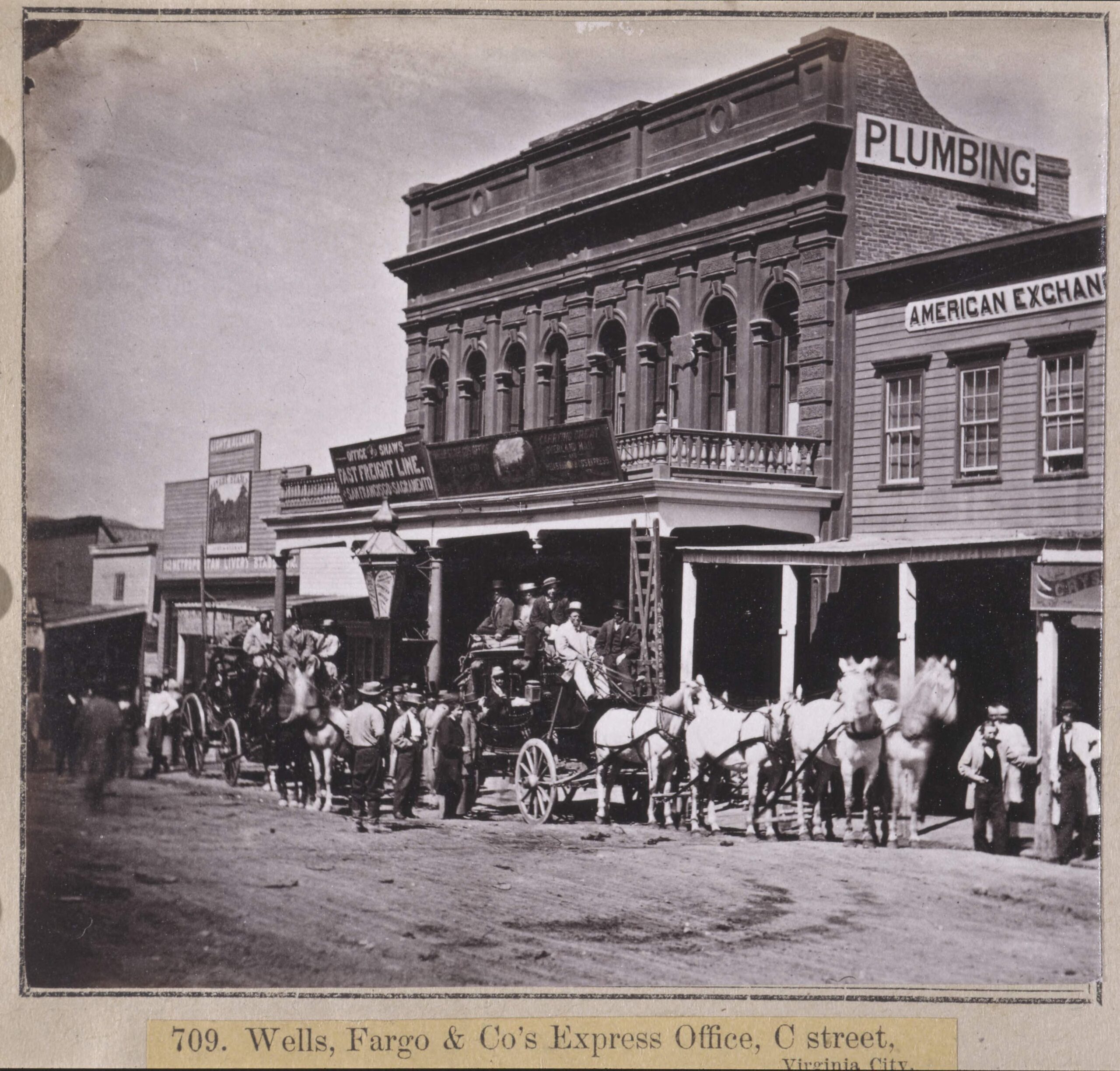
What followed was not the slow evolution of a frontier village but something closer to instant urbanization. By 1862, Virginia City and neighboring Gold Hill together held roughly four thousand residents. Two years later the number had climbed past fifteen thousand, making Virginia City the second-largest city west of the Mississippi, trailing only San Francisco. At its peak in the mid-1870s, the population reached perhaps twenty-five thousand. Wood buildings gave way to brick and stone as the risk of fire demanded sturdier construction, and the town acquired the full apparatus of a genuine city: hotels, banks, assay offices, stamp mills, a telegraph office, a fire department, schools, and churches.
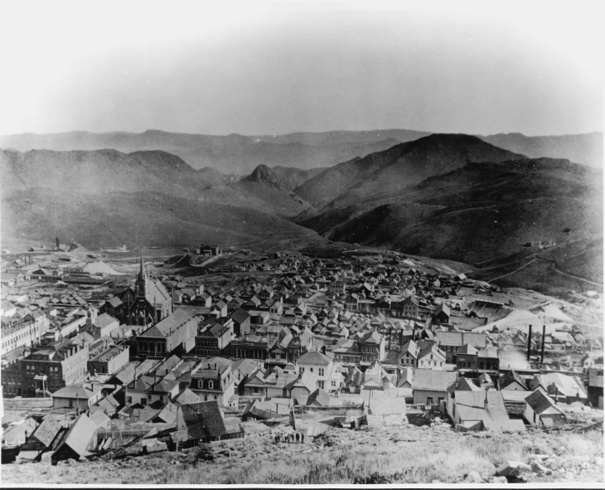
Describing Virginia City as a mining camp, as many still do, undersells what it actually became. The National Park Service characterizes the Comstock district as an early and unusually complete example of large-scale industrial mining, built on corporate capital rather than a lone prospector’s pick and pan. Pulling the ore from beneath Mount Davidson required steam hoists, massive pumps to fight underground flooding, and elaborate timbering systems to keep the tunnels from collapsing under their own weight. Between 1860 and 1880, workers extracted and milled nearly seven million tons of ore from the Comstock, and the wealth it generated did not stay in Nevada. San Francisco’s Bank of California and its mining stock exchange grew directly out of Comstock capital, tying the fortunes of some of the West’s richest men to the tunnels running beneath Virginia City and Gold Hill.
The town’s newspaper of record, the Territorial Enterprise, had actually begun life in Genoa in December 1858, the first paper published anywhere in what would become Nevada. It followed the boom to Virginia City in the fall of 1860, and under editor Joseph T. Goodman it grew into one of the most respected papers in the West. A young reporter named Samuel Clemens joined its staff in 1862, and in February 1863 he began signing his dispatches with a new name borrowed from his riverboat days: Mark Twain.
A Territory Born of Silver and Distance
When the Comstock was struck in 1859, there was no Nevada at all, only the far western reaches of Utah Territory, governed from Salt Lake City more than five hundred miles away. That distance had already strained relations between the mostly non-Mormon settlers drawn west by mining and the Mormon authorities who governed them, and the sudden flood of population and wealth around Virginia City made the arrangement look increasingly unworkable. Congress carved Nevada Territory out of Utah’s western edge on March 2, 1861, less than two years after O’Riley and McLaughlin’s strike. James W. Nye became the territory’s first and only governor, and Orion Clemens, Twain’s older brother, served as territorial secretary and often as acting governor in Nye’s absence.
Nevada Territory was not yet a month old when the Civil War began at Fort Sumter, and the territory’s political loyalties settled firmly with the Union almost from the start.
Statehood Was Not a Foregone Conclusion
The popular memory of Nevada’s admission to the Union tends to skip past an inconvenient detail: Nevadans rejected statehood the first time it was offered to them. A constitutional convention met at Carson City from early November through mid-December 1863, and the document it produced went before voters on January 19, 1864. The result was not close. Voters rejected the proposed constitution by more than four to one, with 8,851 opposed and 2,157 in favor, largely because of language that would have taxed unproductive mining claims regardless of whether they were actually generating a profit. In a territory whose entire economy rested on mining, that provision was a nonstarter.
Congress tried again. On March 21, 1864, Lincoln signed an Enabling Act authorizing a second attempt, and delegates reconvened in Carson City on July 4, choosing Independence Day deliberately for the symbolism. This time the tax language was rewritten to fall only on the net proceeds of mines rather than their unrealized potential, a formula still reflected in Nevada law today. The convention approved the revised constitution by a vote of nineteen to two and sent it to the voters.
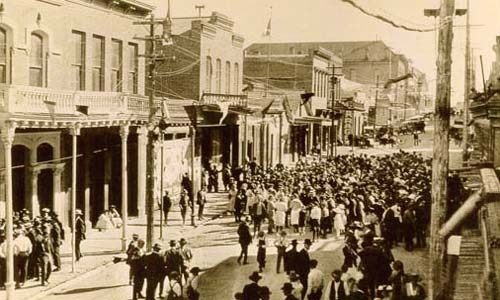
They ratified it decisively on September 7, 1864. Statewide, roughly ten thousand voters approved the constitution, and just over a thousand opposed it. But the number worth lingering on is more specific. Storey County, home to Virginia City and Gold Hill, cast 5,448 votes in favor and only 142 against, supplying more than half of all the yes votes cast in the territory. Carson City had drafted the constitution and Washington would soon admit the state, but it was Virginia City’s population, wealth, and political weight that made both possible in the first place.
The Most Expensive Telegram Nevada Ever Sent
Ratification was not the end of the story. Governor Nye needed a certified copy of the constitution in Washington before Lincoln could act, and he sent it by two routes: overland mail and sea. Neither arrived in time. On October 24, 1864, with the presidential election barely two weeks away, Secretary of State William H. Seward informed Nye that Washington still had nothing but a report of the vote count, not the document itself, and Lincoln would not proclaim statehood without it.
Nye turned to the telegraph. On October 26, a telegrapher named James H. Guild began transmitting the entire text of the constitution, all 16,543 words of it, from Carson City in Morse code. There was no direct line to Washington, so the message had to be relayed and retranscribed at Salt Lake City, then sent to Chicago, Philadelphia, and finally the War Department’s telegraph office in the capital. Guild spent roughly seven hours on the Carson City leg alone. The message reached Lincoln on the evening of October 28, after two days of relaying and transcription. Its great length displaced the war telegraph office’s usual traffic for several hours. When War Department clerks finished transcribing it, the document ran to 175 pages. The final sheet recorded the cost of sending it: $4,303.27, an almost unthinkable sum for a single telegram in 1864. Congress later reimbursed Nevada for a portion of the expense, appropriating $3,416.77 toward it the following March.
Three days after Lincoln received the constitution, on October 31, 1864, he issued a proclamation admitting Nevada to the Union as the thirty-sixth state. He did not need a final congressional vote to do it. The Enabling Act had already authorized him to proclaim statehood by his own signature once an acceptable constitution was in hand, and so Nevada became a state through Lincoln’s proclamation, eight days before the country went to the polls.
What the Rush Was Really About
Nevada’s history has long carried a tidy explanation for why statehood arrived in such haste: Lincoln needed Comstock silver to finance the Union war effort and rushed Nevada into the fold to secure it. It is a satisfying story, and it is largely a myth. Nevada’s former state archivist, Guy Rocha, has argued the point directly. Comstock silver was already being mined within United States territory whether Nevada was a state or not; statehood added nothing to the federal government’s ability to tax or benefit from that wealth. Even Nevada’s own legislature perpetuated a version of this myth as late as 1955, passing a commemorative resolution that credited Virginia City’s silver with materially aiding the Union cause.
The real motives were more political than financial. Nevada, with barely forty thousand residents, fell well short of the population new states typically had, while several more populous western territories remained territories for years afterward. What Nevada offered Republicans was reliability. A new state meant two more Senate seats, a House seat, and three electoral votes, all but certain to go to Lincoln and his party in an election he could not afford to lose. It also meant one more vote in Congress for the constitutional amendment abolishing slavery, which had already failed once in the House that June. When the House finally passed the Thirteenth Amendment on January 31, 1865, by a vote of 119 to 56, barely clearing the required two-thirds majority, Nevada’s newly seated representative, Henry G. Worthington, cast his vote in favor.
As it turned out, Lincoln did not need Nevada’s help to win reelection. He carried the Electoral College 212 to 21, a margin so wide that Nevada’s three electoral votes were almost beside the point, and even those arrived incomplete: one of the state’s three electors was reportedly stranded by a blizzard and never arrived in time to cast his ballot. The silver had not saved the war effort, and the electoral votes had not saved the election. What Virginia City had actually done was more durable than either. It had built, in the space of five years, the population and wealth that turned a scattered stretch of desert into a state, and it had cast the votes that made that state’s constitution real.
Nevada’s boundaries were not yet complete at statehood. Congress added more territory from Utah in 1866 and later transferred land from Arizona Territory, meaning the state’s modern shape took several more years to settle into place.
References
Primary Sources
- National Archives. “Nevada Constitution Telegram Transcription.” General Records of the Department of State.
- Lincoln, Abraham. “Proclamation 119.” October 31, 1864.
- United States Congress. “Nevada Enabling Act.” March 21, 1864. 13 Stat. 30.
- Marsh, Andrew J. Official Report of the Debates and Proceedings in the Constitutional Convention of the State of Nevada. San Francisco: F. Eastman, 1866.
- De Quille, Dan (William Wright). History of the Big Bonanza. 1876.
- Lord, Eliot. Comstock Mining and Miners. U.S. Geological Survey, 1883.
- Daily Alta California. October 20, 1863.
Secondary and Scholarly Sources
- Smith, Grant H. The History of the Comstock Lode, 1850-1997. University of Nevada Press.
- James, Ronald M. The Roar and the Silence: A History of Virginia City and the Comstock Lode. University of Nevada Press, 1998.
- Nevada State Library, Archives and Public Records. “History of the Nevada Constitution.”
- Nevada Legislative Counsel Bureau. Political History of Nevada.
- National Park Service. “Virginia City Historic District.”
- Rocha, Guy. “Why Did Nevada Become a State?” Nevada Web.
- Nevada Historical Society. “Grosh Brothers Manuscript Collection.”