By James Randall
In the early months of 1859, a handful of prospectors walked up from the played-out camp of Johntown to look at a hill one of them had noticed on an earlier trip through the canyon. It was not much to look at, a slope of ordinary sagebrush and rock, distinguished mainly by a patch of soil the color of old brass. They panned it anyway. The gold came up at about fifteen cents to the pan, modest by the standards of California a decade earlier, but enough to make four men stop walking and start digging. They named the place for the hill itself. Weeks later, a mile and a half up the same canyon, another group of prospectors would find the vein that made the Comstock Lode famous. Gold Hill’s men had already found the southern end of it, and never entirely caught up in the telling.
The town that grew from that discovery spent the next two decades as Virginia City’s working partner rather than its rival, producing a large share of the Comstock’s silver while its neighbor collected most of the fame. Drawing on the near-contemporary accounts of Eliot Lord and Myron Angel, later mine histories, and the town’s own newspaper records, the story of Gold Hill turns out to be less a footnote to Virginia City’s history than a parallel one, complete with its own mines, its own incorporation fight, and a cast of characters who went on to shape places as far away as Santa Monica and the tennis courts of Wimbledon.
A Yellow Hill Above Gold Canyon
The four men credited with the discovery, James Finney, Alexander Henderson, John Bishop, and John Yount, were placer miners working ground that had been worked before, most of it thinning out after years of modest returns. Finney went by “Old Virginny,” a nickname that would attach itself to Nevada’s most famous mining town within the year, though that is a separate story and belongs to Virginia City rather than to the hill that took his eye first. What the four men found here was not, as far as any of them knew at the time, part of anything larger. It was simply a good showing of gold in a hill that looked different from the ground around it, and that was reason enough to stay.
The larger discovery came in June, when prospectors working a spring about a mile and a half to the north struck the ore body that would take Henry Comstock’s name and make Virginia City the most famous mining town in the American West. By the time geologists worked out what the whole formation actually was, Gold Hill’s claim already sat on its southern end. The town had, in the plainest reading of the dates, found the Comstock Lode before anyone called it that. It would spend the rest of its history as the quieter half of a story someone else got to name.
Storey County’s own records place the naming in 1859, matching the discovery itself, though no single surviving document pins the choice to an exact day.
Incorporated to Survive
Gold Hill grew fast. A census taken in August of 1860 counted 638 men and fourteen women living among 179 dwellings, a ratio that says as much about frontier mining camps as any statistic from the period could. Eleven months later, the population had roughly doubled to nearly thirteen hundred, growing alongside the newly created Nevada Territory itself.
That growth brought a problem particular to small towns sitting next to famous ones. Virginia City, a mile and a half away, was larger, wealthier, and considerably more interested in Gold Hill’s mines than Gold Hill was in being absorbed by its neighbor. On December 17, 1862, the town incorporated, and the clearest surviving explanation for the timing is not civic pride or population milestones but self-preservation: incorporation kept Gold Hill from being annexed. The move came a year after the Nevada Territorial legislature had already created Storey County around both towns, named for Captain Edward Storey, who had spent only a few months on the Comstock before he was killed at Pyramid Lake at the age of thirty-one. Gold Hill, in other words, secured its own charter almost as soon as the machinery of territorial government existed to grant one, and did so specifically to remain itself.
The Mines That Built a Working Town
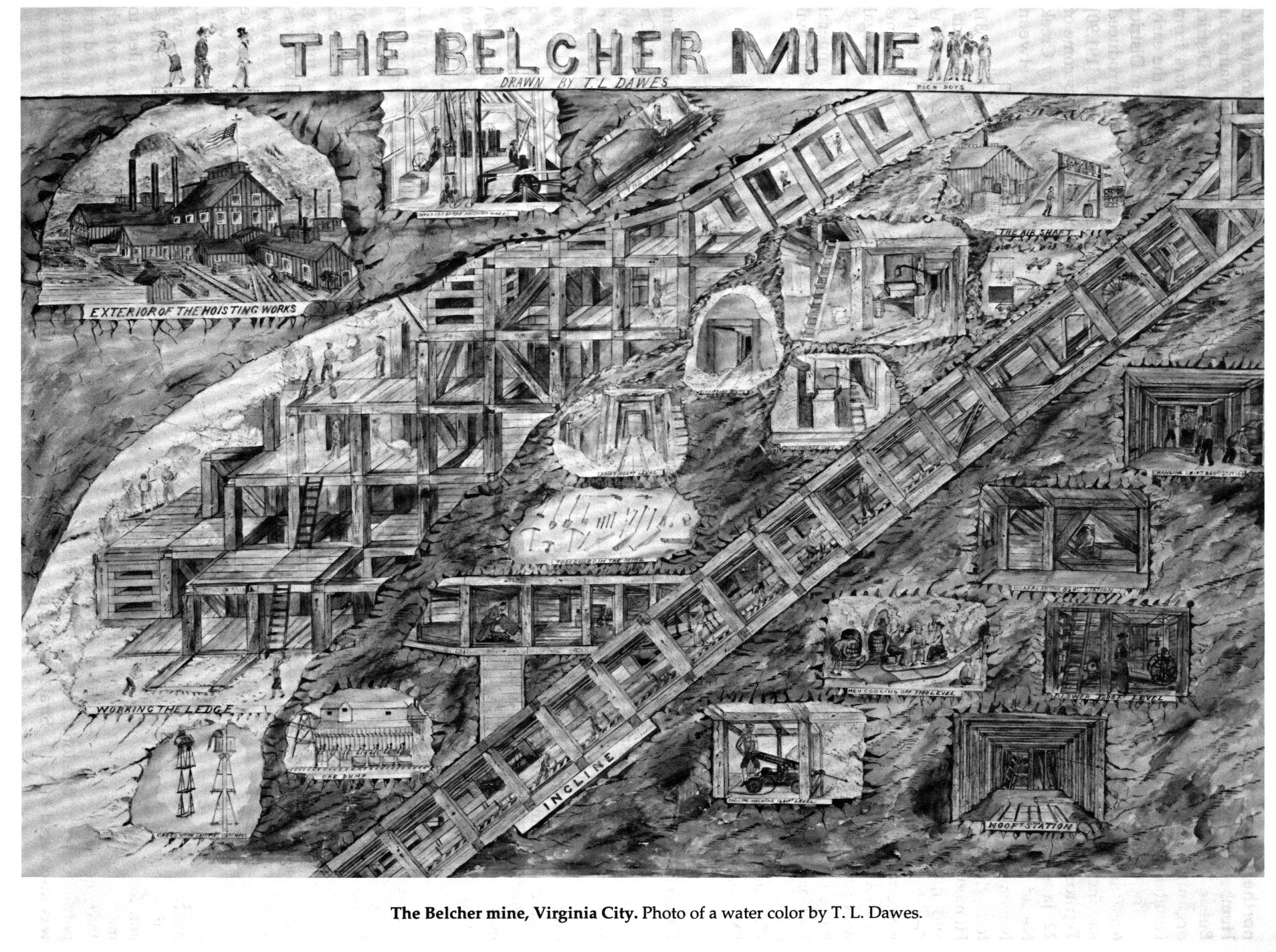
If Virginia City became known for its opera houses and its mansions, Gold Hill became known, within the district itself, for its mines. The Yellow Jacket, Crown Point, Kentuck, and Belcher claims were all staked in 1859, on ground that would take years to reveal how rich it actually was. By the mid-1860s, the Kentuck alone was counted among the most profitable mines on the entire Comstock, and in 1866 it shared a genuine bonanza with its two neighbors underground, a reminder that these mines were not merely adjacent on a map but frequently connected in the rock itself.
In 1871, Crown Point and Belcher crews broke into a shared ore body that came to be called the Crown Point-Belcher Bonanza. The deposit ran directly across the boundary between the two claims, splitting it almost evenly, though Belcher’s side proved somewhat richer. Between them, the two mines eventually produced something on the order of sixty million dollars from that single discovery, a figure that helps explain why Gold Hill mattered to investors in San Francisco who had never seen the town and had no particular reason to care whether its name outlasted Virginia City’s.
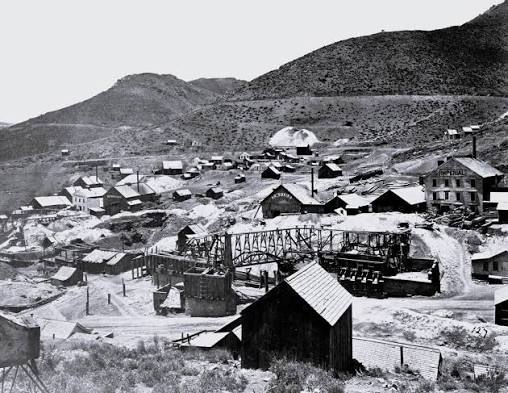
A ridge known locally as the Divide marked the high ground where Gold Hill’s streets and Virginia City’s essentially ran together as both towns grew through the 1860s and 1870s. A visitor walking that ridge in 1875 would have had a hard time saying with certainty which town he was standing in.
Fire Underground
The same underground connections that let the Kentuck, Yellow Jacket, and Crown Point share a bonanza in 1866 turned catastrophic three years later. On April 7, 1869, a fire broke out in the Yellow Jacket’s workings and spread through the interconnected passages into the Kentuck and Crown Point mines, trapping miners far below the surface with no clear route to safety.
Estimates of the dead vary by source, from the mid-thirties to well over forty, a range that reflects how difficult it was, in the days that followed, to account for every man who had gone underground that morning.
It remains the deadliest single mining disaster in Nevada’s history.
The full account of that day, hour by hour, belongs to its own telling elsewhere on this site.
A Newspaper, a Senator, and an Olympic Daughter
Gold Hill had its own newspaper, the Gold Hill Daily News, founded in October of 1863 and published for nearly two decades before folding in 1882. Its most notable editor, Alfred Doten, arrived by way of the rival Territorial Enterprise in Virginia City, crossing over in November of 1867 to work as a reporter before eventually buying the paper outright in 1872 for ten thousand dollars, following the death of its founder. Doten’s own journals, later published by the University of Nevada Press, remain one of the richest surviving records of daily life on the Comstock, written by a man who spent years walking between the two towns this history concerns.
The paper’s history brushed against Nevada politics more than once. In the early 1870s, as two men vied for a seat in the United States Senate, Doten approached one of them, John Percival Jones, hoping for a loan or an outright sale of the paper. Jones was, at the time, a co-developer of the Crown Point Mine and a man with considerably larger ambitions than Gold Hill journalism. He would go on to serve five terms in the Senate and later co-found the city of Santa Monica, California, a long way from the canyon where he had once dug for silver.
Jones’s connection to the town did not end with mining or politics. His daughter, Marion, was born in Gold Hill in November of 1879, while the family still lived there. She grew up to win the United States women’s singles tennis championship twice, in 1899 and 1902, and became the first non-British woman to play at Wimbledon. At the 1900 Olympic Games in Paris, she placed third in both singles and mixed doubles, at a time when the Games gave out no medals at all. The bronze she is now credited with is a distinction assigned by later record keepers, not one she carried home herself. She was inducted into the International Tennis Hall of Fame in 2006, a considerable distance, in every sense, from the mining camp where she was born.
Eilley Orrum’s Boardinghouse and the Town’s Other Women
Some of Gold Hill’s earliest buildings were as modest as the camp itself. One of the first, a log boarding house and restaurant, was built by a Scottish immigrant named Eilley Orrum, years before anyone in the district knew her by the name she would later carry, Eilley Bowers, builder of the mansion that still bears her husband’s name near Washoe Lake. Her Gold Hill years were the least glamorous chapter of a life that would eventually make her one of the wealthiest women on the Comstock, and then, after later mining losses, one of its most cautionary tales.
A different kind of fortune was reportedly made by Sarah Mower Requa, who ran a boarding operation of her own at Gold Hill before her marriage in 1863. One later account of her time there, less rigorously documented than the rest of her biography but persistent enough to be worth mentioning, holds that wealthy miners paid as much as fifty dollars a plate to eat at her table, and that she left the camp with something like fourteen thousand dollars to show for her cooking. Whatever the exact figures, Requa is credited with founding Gold Hill’s small church before going on to a long career of philanthropy in California, work that eventually included founding a convalescent home for soldiers returning from the Philippines.
Decline, Revival, and What Remains
Gold Hill’s population peaked at around eight thousand people in 1877, a number that would have seemed unimaginable to the handful of men panning that first yellow hill less than two decades earlier. The peak did not last. As the Comstock’s easily reached ore ran out through the late 1870s and into the 1880s, mines and businesses closed steadily, and Gold Hill’s population declined along with Virginia City’s. A brief revival arrived in the 1920s, when a cyanide-processing mill built at nearby American Flat made it worthwhile to rework some of the district’s older, previously exhausted ground.
The Virginia and Truckee Railroad, which had served the town since a depot opened there in November of 1869, ceased operations in 1938. Three years later the tracks were pulled up, and the post office closed in 1943, leaving Gold Hill for several decades as little more than a scattering of surviving structures along a canyon road.
Its second life began almost by accident, when a former Marine Corps combat photographer named Bob Gray, long fascinated by the old Virginia and Truckee line, bought a stretch of the abandoned right-of-way in 1976 and began laying track and running a steam excursion train himself. The line reached Gold Hill in 1992, and two years later a historical society formed specifically to preserve the town’s depot, a wooden structure notable for having survived the fire that destroyed much of Virginia City in 1875. Today Gold Hill counts fewer than two hundred residents, its historic core protected within the same federally designated landmark district that covers Virginia City, Silver City, and part of Dayton, a recognition that finally puts Gold Hill’s name in the same official sentence as its more famous neighbor.
Conclusion
Gold Hill’s history keeps circling back to the same basic fact: it got there first, and it has spent every year since arguing, quietly and mostly without success, for equal billing. Its prospectors found the Comstock Lode’s southern ground before the discovery that made the Lode famous. Its mines produced fortunes that built mansions in San Francisco and funded a Senate campaign. Its own newspaper outlasted a rival editor’s ambitions for two decades. And when the district finally received the historical recognition it deserved, Gold Hill’s name appeared in the same sentence as Virginia City’s, but never quite in front of it.
That is not a tragedy. Plenty of towns on the Comstock disappeared entirely, and Gold Hill did not. It survives today, in reduced form, exactly where it started, on the hill that gave it a name before anyone thought to give it credit.
Sources
Primary and Contemporary Sources
Lord, Eliot. Comstock Mining and Miners. Washington: Government Printing Office, 1883.
Angel, Myron, ed. History of Nevada: with illustrations and biographical sketches of its prominent men and pioneers. Oakland: Thompson and West, 1881.
United States Census, 1880. Enumeration District 44, Sheet 167C, Gold Hill, Storey County, Nevada. NARA microfilm publication T9, roll 0759.
Gold Hill Daily News (Gold Hill, Nevada), 1863-1882. Library of Congress, Chronicling America, LCCN sn84022046.
Van Tilburg Clark, Walter, ed. The Journals of Alfred Doten, 1849-1903. 3 vols. Reno: University of Nevada Press, 1973.
Secondary Sources and Modern Scholarship
Ansari, Mary B. Mines and Mills of the Comstock Region of Western Nevada. Reno: Camp Nevada, 1989.
Wurm, Ted, and Harre Demoro. The Silver Short Line. Trans Anglo Press, 1983.
“Gold Hill, Nevada.” Wikipedia.
“Gold Hill Depot.” Wikipedia.
“Gold Hill Daily News.” Wikipedia.
“Gold Hill: Storey County.” Nevada Expeditions.
“Gold Hill Nevada.” Western Mining History.
“Resident Information.” Storey County, Nevada, official website.
“Marion Jones Farquhar.” Wikipedia; and “Marion (Jones) Farquhar (1879-1965).” WikiTree, citing the 1880 U.S. Census.
“Emily Pitchford.” Wikipedia.
“Sarah Mower Requa.” Wikipedia; and “Requa, Ransom, and Remarkable Women.” Walking Piedmont (local history blog; source for the $14,000/$50-a-plate detail only).