By James Randall
By the middle of the 1860s, the richest mines of Virginia City and Gold Hill were becoming victims of their own success. Every new level driven into the Comstock Lode pushed men farther from daylight and deeper into heat, bad air, and water that had to be lifted hundreds of feet by machinery. The deeper the mines went, the more expensive it became simply to keep them open.
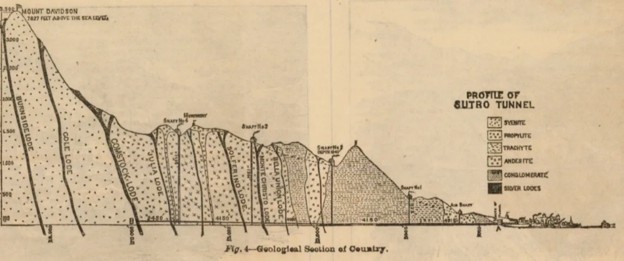
Adolph Sutro believed geography offered a way out. Instead of continuing to pump water upward through the shafts, he proposed driving a tunnel nearly four miles westward from the lower country near the Carson River valley until it struck the Comstock deep beneath the ridge. Water could then run downhill by gravity. But drainage was only the beginning of what Sutro imagined. His tunnel would also carry miners, ore, waste rock, timber, and machinery, improve ventilation, open new ground for exploration, and perhaps provide an emergency route out of the mines.
The plan eventually became one of the largest engineering undertakings in nineteenth-century Nevada. It also became something more complicated: a political fight, an international financing campaign, a test of mine safety, and a business gamble whose timing proved almost as important as its engineering.
The Problem Beneath the Comstock
Water, heat, and ventilation were already serious concerns before the deepest years of Comstock mining. Large steam-powered pumps raised water from the shafts, but each additional level increased the burden. The Nevada Bureau of Mines and Geology notes that the underground water could be very hot, adding to already difficult working conditions.
In 1867, while Nevada officials were urging federal support for the tunnel, the Legislature presented the crisis in stark financial terms. It said the Comstock had produced about $64 million in its first seven years and was then producing roughly $16 million a year, but claimed that about $15.5 million was being spent to obtain that annual production. The same appeal identified accumulated water, poor ventilation, and increasing heat with depth as major threats to continued mining. Because those figures were part of an argument for public support, they should be read as advocacy rather than as a neutral audit. Even so, they show how seriously Nevada’s leaders regarded the problem.
Sutro’s answer was conceptually simple. Virginia City and Gold Hill stood high on the eastern slope of the Virginia Range. The land dropped dramatically toward the Carson River valley. A nearly horizontal tunnel driven from the lower ground could intersect the mines far below their surface openings and let water escape without being pumped all the way to daylight.
More Than a Drainage Tunnel
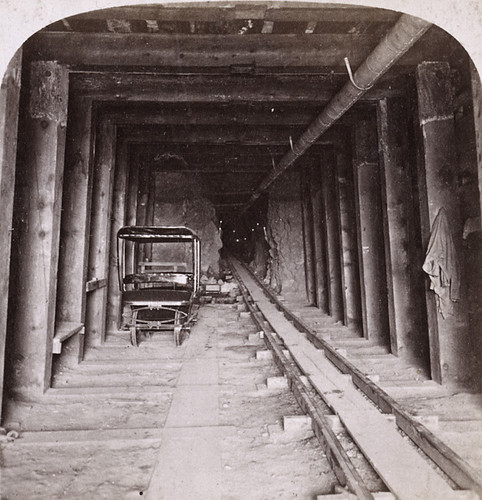
Short histories often describe the Sutro Tunnel as a drain. Sutro’s own 1866 prospectus shows that he had a much larger commercial system in mind. He proposed a tunnel roughly twelve feet square with two tracks, one for traffic in each direction. A drainage channel would run beneath the trackway, and five-ton cars were envisioned for moving material through the tunnel.
The business plan was equally ambitious. Sutro expected revenue not only from drainage but also from transporting ore, miners, waste rock, timber, machinery, and supplies. In effect, he was proposing an underground railroad into the Comstock. If it worked as he hoped, the traditional vertical shafts above Virginia City and Gold Hill would no longer control every movement of men, materials, and water between the mines and the outside world.
Nevada and Congress Back the Idea
Nevada granted Sutro and his associates a fifty-year franchise on February 4, 1865, authorizing a mining and drainage tunnel from the Carson River side of the range toward the Comstock. Congress followed on July 25, 1866. The federal act granted a right of way and authorized a tunnel at least eight feet high and eight feet wide, along with working and ventilation shafts as needed.
Congress also gave Sutro significant land and mineral privileges. He could purchase up to two sections of public land near the tunnel mouth at $1.25 an acre, and, subject to existing claims and the Comstock itself, qualifying mineral veins discovered within 2,000 feet on either side of the tunnel could be purchased at $5 an acre. Mines benefiting from the tunnel were expected to contribute toward drainage under agreements with the tunnel company.
Those provisions help explain why the project soon became more than an engineering proposal. A successful tunnel would create an independent system touching the economics of many major mines. Control of drainage, transportation, access, and newly discovered ground could shift money and influence away from established interests.
Sutro Against the Comstock Establishment
Several important mining companies initially signed agreements supporting the tunnel, but the relationship deteriorated. Sutro came to portray his opponents as a financial ring centered on the Bank of California and its Comstock allies. He even published a pamphlet asking, in its title, why the Bank of California opposed the tunnel.
There were powerful interests on both sides, but the dispute is best understood without reducing it to a simple contest between a visionary and villains. The mine companies had practical reasons for resisting dependence on an outside tunnel company. They faced drainage charges, possible competition in transportation, and the prospect that ore, supplies, and miners might move through a system they did not control. Sutro, meanwhile, was not merely a reformer. His own prospectus anticipated very large profits from the system he was promoting.
That combination makes the controversy more interesting. Sutro could sincerely argue that the tunnel would make mining safer and more efficient while also expecting it to make him wealthy. The two motives were not mutually exclusive.
The Yellow Jacket Fire Changes the Argument
On April 7, 1869, fire swept through the connected Yellow Jacket, Kentuck, and Crown Point workings at Gold Hill, killing dozens of miners. The disaster gave Sutro a new and powerful argument. A deep tunnel connecting the mines could, he and his supporters maintained, improve ventilation and provide another route of escape when a shaft or underground passage became dangerous.
The fire did not create the Sutro Tunnel project. Nevada had chartered Sutro in 1865, Congress had acted in 1866, and he had been promoting the scheme for years. What the Yellow Jacket disaster changed was the emotional and practical force of the safety argument. Mine workers themselves supported the tunnel in part because of the possibility that it could offer another way out of the deep workings.
October 1869: The Mountain Finally Begins to Open
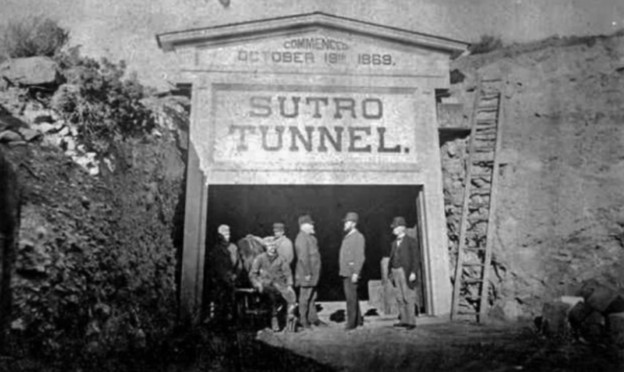
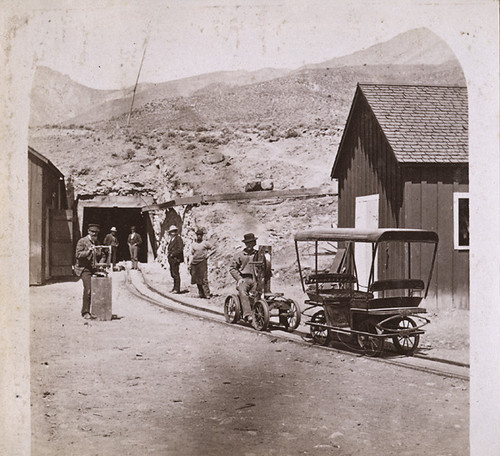
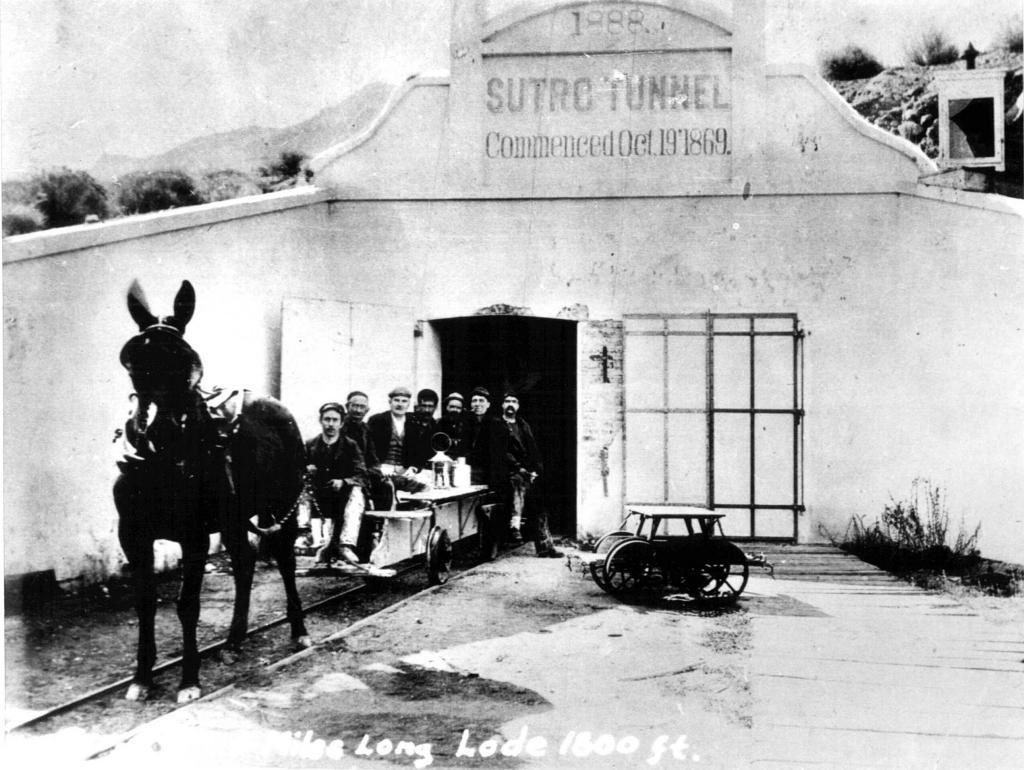
Construction began in 1869. The portal photographs preserve the physical scale of what started there: a timbered entrance cut into an otherwise dry Nevada hillside, rails disappearing into darkness, and a workforce committed to a project that would take years to reach its target.
The work was methodical and dangerous. Crews drilled and blasted rock, timbered the opening, removed broken material, laid track, surveyed the line, ventilated the workings, managed drainage, and sank intermediate shafts so excavation could proceed from more than one working face. Every foot depended on accurate surveying. A small error, repeated over miles, could have carried the tunnel away from the Comstock altogether.
The Cost of a Dream
Sutro’s 1866 prospectus estimated the main tunnel would cost $1,983,616.50. He expected revenue during construction to reduce the amount of required capital to about $1.48 million. Later estimates placed the eventual cost far higher, around $4.5 million before interest and roughly $6.5 million including interest. Those later totals are historical estimates rather than audited modern figures, but the difference is large enough to show how badly the original cost projection missed the eventual burden.
His revenue forecasts were no less ambitious. At a hypothetical production level of 1,500 tons of ore per day, Sutro projected about $3,000 a day from drainage, $1,600 from ore transportation, another $1,600 from carrying miners, $1,000 from waste rock, and $200 from timber and supplies. He projected annual revenue of about $2.16 million, with additional income from water. Under a much larger production scenario, he imagined revenues above $6 million a year and millions more from future land sales.
These figures are best read for what they were: projections meant to attract support and capital. They reveal the scale of Sutro’s ambition, not the actual return the tunnel would later produce.
British Money Beneath a Nevada Mountain
Financing became one of the hardest parts of the project. Sutro promoted the tunnel in Nevada, San Francisco, Washington, New York, and Europe. Stock sales helped get construction under way, but by about 1872 major support was coming from the British banking firm McCalmont Brothers & Company.
That international financing is easy to overlook in a local mining story. British capital was being committed to a long underground passage beneath the Virginia Range in order to reach silver mines in Nevada. The tunnel connected the Comstock not only to the Carson River valley, but to the wider nineteenth-century world of investment and industrial finance.
Congress also subjected the project to unusually close examination. In 1871 an official commission was authorized to investigate it, and the resulting 1872 report and testimony ran to hundreds of pages, with plans and illustrations. The commission considered geology, mine temperatures, drainage, pumping costs, ventilation, safety, engineering feasibility, contracts, expenses, financing, and the relationship between Sutro and the mining companies. Few Comstock projects left so extensive a contemporary documentary record.
The Tunnel Reaches the Comstock
After years of excavation, the main tunnel reached the Savage Mine in 1878. The commonly reported length of the main tunnel is about 20,500 feet, or roughly 3.9 miles. Later north and south lateral workings pushed the overall excavation beyond five miles.
Calling the project finished in 1878, however, is a little too simple. The main tunnel had reached the Comstock, but lateral connections continued. University of Nevada, Reno records indicate that agreements with twenty-four mining companies were signed in April 1879 and that the broader system was essentially completed about two months later.
The achievement was substantial. Men had driven a long, accurately surveyed opening beneath the mountain using nineteenth-century drilling, blasting, timbering, and hauling methods. Water could drain through it, air could move through it, and the tunnel provided another connection to the deep Comstock workings.
The Great Irony: The Mines Had Gone Deeper
The tunnel’s central problem was not that it failed to reach the Comstock. It was that the Comstock had not waited for it.
While Sutro spent years raising money and driving westward, the mining companies continued sinking. By the time the tunnel reached the lode, important workings were already below its drainage elevation. The tunnel could still drain water above its level and assist ventilation and access, but the most ambitious promise of the original scheme had been overtaken by the speed of deep mining.
This distinction matters because it keeps the history from collapsing into either triumph or failure. As an engineering work, the Sutro Tunnel did what a drainage tunnel was supposed to do. It carried water away and served the Comstock for decades. As a business venture, it did not produce anything close to the extraordinary returns Sutro had once forecast, and the Tunnel Company eventually became a financial disappointment as the great mining boom declined.
A Town Built Around the Tunnel
The eastern portal also created a community of its own. The town of Sutro grew around the tunnel works and, according to Nevada’s historical marker, reached roughly 600 to 800 residents at its height. It had a church, a post office, a weekly newspaper, Sutro’s Victorian residence, and other substantial homes.
For years, while Virginia City and Gold Hill lived above the mines, another community existed several miles away because men were boring toward them. The town makes the project easier to understand as a human undertaking. The tunnel was not simply an engineering line on a map. It required housing, families, commerce, management, transportation, and a workforce that lived beside the portal while the heading advanced foot by foot beneath the mountains.
Sutro’s Most Ambitious Prediction
Sutro imagined that the tunnel might eventually alter the geography of the Comstock economy itself. His 1866 prospectus predicted that mills worth $5 million to $6 million might move toward the tunnel entrance, where ore could be delivered more directly. If that had happened on the scale he imagined, the economic center of gravity could have begun shifting downhill from Virginia City and Gold Hill toward the portal settlement.
It did not happen. The mines, the towns, and the larger Comstock economy changed in other ways, and the great bonanza years passed. But the prediction reveals how much more Sutro had in mind than a drain. He was attempting to create a new industrial doorway into the lode.
What the Sutro Tunnel Was, and Was Not
Several later simplifications obscure the actual history. The Yellow Jacket fire did not inspire the original tunnel proposal, although it greatly strengthened Sutro’s safety argument. The tunnel did not save the Comstock from decline. Nor is it accurate to dismiss the entire enterprise as a failure. It succeeded as a drainage and access work even though it disappointed as the enormous commercial system Sutro had once advertised.
The same caution applies to Sutro’s fight with the Bank of California and the large mining companies. There were real concentrations of financial power on the Comstock, and Sutro attacked them aggressively. But his opponents also had concrete economic reasons to resist a private tunnel company that might charge them for drainage and compete for transportation and access. Sutro’s own pamphlets are valuable primary sources for the controversy, but they are advocacy and should be read as such.
Conclusion
The Sutro Tunnel was born from a problem that seemed to grow with every foot the Comstock descended. Water had to be removed, air had to be moved, men and materials had to travel farther, and the cost of reaching silver kept rising. Sutro proposed to turn the mountain itself into part of the solution, cutting a nearly four-mile passage from the lower country into the heart of the lode.
He succeeded in building it. That fact alone places the tunnel among the defining engineering works of the Comstock era. Yet the project’s deeper significance lies in the gap between the world Sutro expected and the one that existed when his tunnel finally arrived. The mines had gone deeper, the great bonanza was fading, and a system designed to reorganize the Comstock economy became instead a useful but financially disappointing piece of infrastructure.
The tunnel’s history is therefore less a story of failure than of timing. Sutro spent years trying to catch the Comstock from below. When he finally reached it, the mining frontier he hoped to transform had already moved on ahead of him.
Sources
Primary and Contemporary Sources
Nevada Legislature. “An Act granting the Right of Way, and authorizing A. Sutro, and his associates, to construct a Mining and Draining Tunnel.” Approved February 4, 1865. Statutes of Nevada.
Nevada Legislature. Concurrent Resolution relating to Adolph Sutro and Joint Memorial requesting federal assistance for the Sutro Tunnel. January 1867. Statutes of Nevada.
United States Congress. “An Act granting to A. Sutro the Right of Way, and granting other Privileges to aid in the Construction of a Draining and Exploring Tunnel to the Comstock Lode, in the State of Nevada.” July 25, 1866. 14 Stat. 242-243.
Sutro, Adolph. The Sutro Tunnel to the Comstock Lode in the State of Nevada: Importance of its Construction, and Revenue to be Derived Therefrom. New York: John A. Gray & Green, 1866.
United States Sutro Tunnel Commission. Report of the Commissioners and Evidence Taken by the Committee on Mines and Mining of the House of Representatives in Regard to the Sutro Tunnel. Washington: Government Printing Office, 1872.
Sutro Tunnel Company Records, NC07. University of Nevada, Reno, Special Collections and University Archives.
Secondary Sources and Modern Scholarship
University of Nevada, Reno, Special Collections and University Archives. “Sutro Tunnel Company Records.” Administrative history and collection guide.
Nevada Bureau of Mines and Geology. “Science of the Comstock: Mining.” University of Nevada, Reno.
Nevada State Historic Preservation Office. Nevada Historical Marker No. 85, “Sutro.”
National Park Service. Biographical material on Adolph Sutro.
Library of Congress. Historic American Buildings Survey. “Sutro Tunnel Entrance, Comstock Mines vicinity, Dayton, Lyon County, Nevada.” HABS NV-10-1.