By James Randall
Every so often, someone had to take the chandelier apart. Not the whole fixture, just its ornament: some six hundred faceted crystal pendants, according to one visitor who counted them, each hung on its own thin strand of gold-toned wire. Cleaning it meant climbing up, unhooking every pendant by hand, washing it, and hanging it back where it belonged. By the middle of the twentieth century, tourists were driving up the mountain from Reno partly to see this thing hanging in place, in the Virginia City saloon everyone simply called the Crystal.
Drawing on a 1992 historical marker, the federal government’s own architectural survey of the building in 1937 and 1940, a magazine photographer’s 1947 negatives, and the Marks family’s own recollections of running the bar for most of the twentieth century, here is what can actually be documented about the Crystal Bar’s chandelier, and where the record runs out.
A Fixture Built for a Boomtown That Didn’t Look Like One
Virginia City’s saloons did not decorate themselves modestly. During the Comstock Lode’s bonanza years, C Street held banks, theaters, and private clubs competing for the patronage of men who had, in some cases, become extraordinarily rich almost overnight. The Washoe Club next door furnished its rooms with Brussels carpeting, French plate mirrors, marble, and chandeliers that contemporaries considered among the finest ever brought to Virginia City. A visitor picturing a rough mining camp of plank floors and sawdust would have been wrong about the town’s wealthiest establishments, and the Crystal Bar’s chandelier belongs to that same competitive extravagance rather than to any later embellishment for tourists.
Grant Israel Opens the Crystal
According to a historical marker erected in 1992 by the Julia C. Bulette Chapter of E Clampus Vitus, and now mounted inside the Virginia City Visitor Center, the Crystal Bar opened for business in 1871 under original owner Grant Israel. Ownership passed to a second proprietor in the early 1880s, and in 1909 William H. Marks became the third owner. The bar has stayed in his family since, run by his son and daughter-in-law from 1955 onward.
The same marker states that the chandeliers are original to the bar and came from France, shipped to San Francisco and carried the rest of the way by rail. That is a plausible story. Wealthy Comstock businesses routinely imported expensive furnishings through San Francisco during this period. But it is a claim made on a plaque installed more than a century after the fact, not on a surviving invoice or shipping manifest, and no such document has surfaced to confirm it. The honest way to put it is that a French origin is the bar’s own long-held tradition, not an independently proven fact.
A Chandelier That Ran on Gas
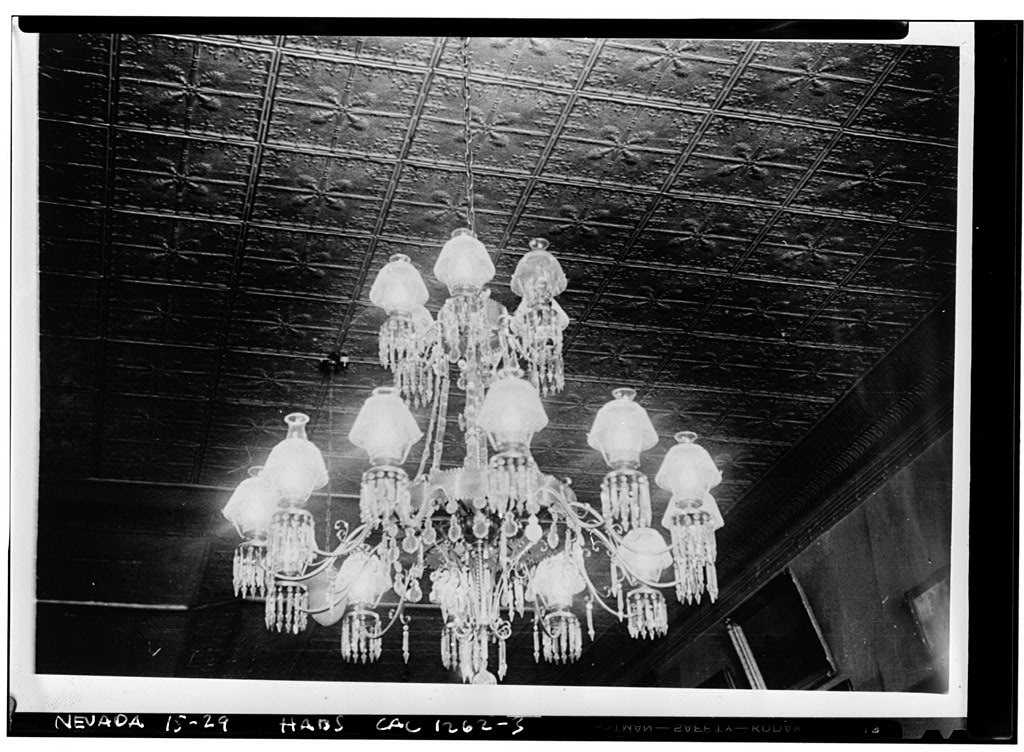
Before it was anything else, the chandelier was a gas fixture. One detailed physical description, attributed to a visitor who examined it closely, records that it had gold-toned tubing and standards, eighteen chimneys, eighteen shades, and eighteen lights, in addition to its several hundred hanging crystals. The chimneys are the giveaway. Glass chimneys were built to shield an open gas flame, not an electric bulb, which places the fixture’s original design solidly in the era before Virginia City wired its saloons for electricity.
That gaslit chandelier would have thrown a very different kind of light than the one visitors see today. Gas flame flickers and pools rather than beaming evenly, and a fixture built to hold eighteen separate flames, each one refracted through hundreds of hanging crystals and reflected again off a saloon full of mirrors and polished glass, would have been genuinely dramatic to stand beneath. Somewhere along the way the fixture was converted to electric current, as most surviving gas chandeliers from this period eventually were, though no precise date for that conversion appears to survive.
An Entire Saloon Learns to Move
The chandelier’s most consequential chapter has nothing to do with light at all. It concerns a move.
At some point, the Crystal Bar changed addresses. According to the Marks family’s own account, passed down and later published in a magazine retrospective, William H. Marks relocated the entire operation, and did not simply open a new bar with new furnishings elsewhere. He took the old one apart and rebuilt it. The bar itself, the back bar, the paintings on the walls, and the crystal chandeliers all came along.
That was not a small undertaking. A chandelier with hundreds of dangling crystal pendants, metal arms, and glass shades is not something a saloonkeeper carries under one arm. Dismantling it, transporting it, and rehanging it in a different building, alongside an entire Victorian bar and its mirrors and fittings, meant that the business essentially moved while its nineteenth-century interior traveled with it. Exactly which year this happened is not something the record settles cleanly. Family recollection places it around 1930; other tour and preservation material gives a later date. What is consistent across the accounts is the basic fact of the move itself, and the specific detail that the fixtures, not just the name, went with it.
One Building, Two Names
This is the point where a curious visitor, or an unwary writer, can easily confuse two different chandeliers.
The Crystal Bar and the Washoe Club have shared the same stretch of C Street for most of their history, which is exactly why their stories tend to blur together. The Washoe Club, the private “Millionaires’ Club” where the Comstock’s wealthiest men once gathered upstairs, and the Crystal Bar downstairs, occupied floors of the same building at different points in that building’s life. When the Crystal Bar and its famous chandelier moved to new quarters, the space it left behind did not stay empty. It was refitted, given the Washoe Club’s name, and hung with its own new chandeliers.
The result is that Virginia City today has two historic saloons, each with its own ornate chandelier, and a shared history tangled enough that even careful local researchers have had to work to keep the two straight. The chandelier most often photographed and called “famous” in the twentieth century is the one that traveled with the Crystal Bar. The Washoe Club’s own surviving fixture has a separate, and equally interesting, story attached to it, involving a companion chandelier destroyed decades earlier in a partial building collapse. That story deserves its own telling rather than a footnote here, but readers should not assume the two chandeliers are one and the same simply because both buildings sit within a block of each other and both saloons have, at different times, gone by overlapping names.
Ice Cream Parlor, Speakeasy
The chandelier’s survival through Prohibition is one of the better-documented and better-told parts of its history. Rather than closing, the Crystal Bar reportedly kept its doors open by selling ice cream to the public while quietly continuing to serve liquor to its regular clientele. The 1992 marker describes the establishment during this period as both an ice cream parlor and a speakeasy, and the Marks family’s own account confirms the same arrangement.
There is something worth sitting with in that image. A chandelier built to advertise Comstock-era wealth and excess spent more than a decade hanging above a soda counter that existed, at least on paper, to sell nothing stronger than a milkshake. Whatever illegal drinking happened beneath it during those years, the fixture itself simply kept burning, indifferent to which side of the law the room below it was technically observing that week.
How the Chandelier Became Famous
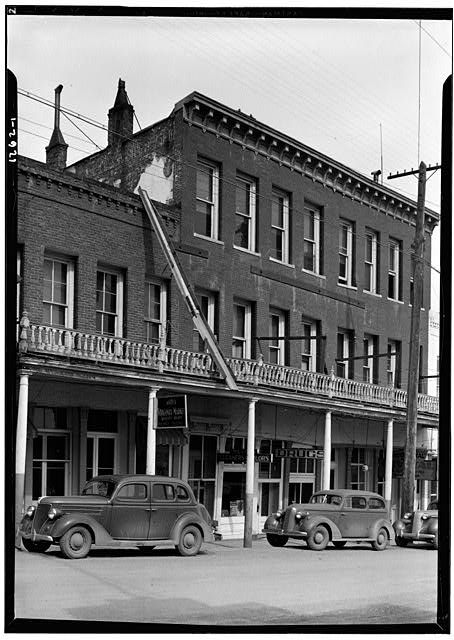
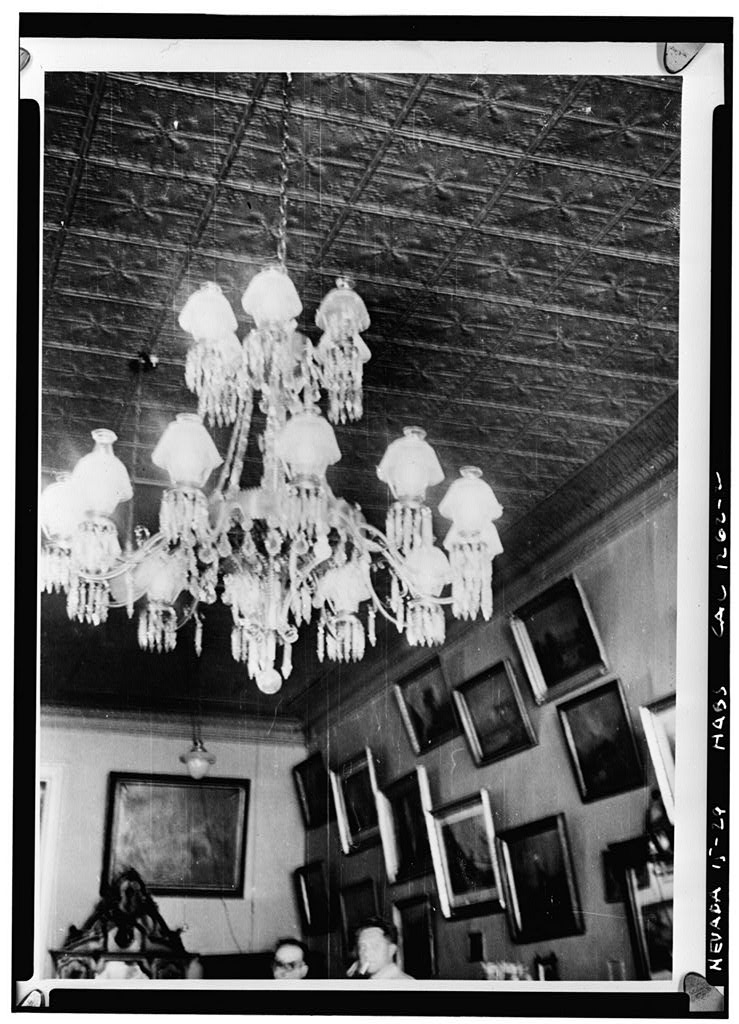
The chandelier’s reputation did not begin with modern tourism. By 1925, at least one visiting writer was already describing it as a well-known local landmark, well before Virginia City had developed anything resembling an organized tourist industry. In 1937, federal photographers working for the Historic American Buildings Survey came through Virginia City to document the town’s historic architecture, and returned again in June 1940 specifically to photograph the chandelier and the building’s embossed tin ceiling in detail. Those images, preserved today by the Library of Congress, are the clearest surviving visual record of the fixture from that period, and they show a saloon crowded with Victorian furnishings, framed paintings, and the enormous many-armed chandelier hanging at the center of it all.
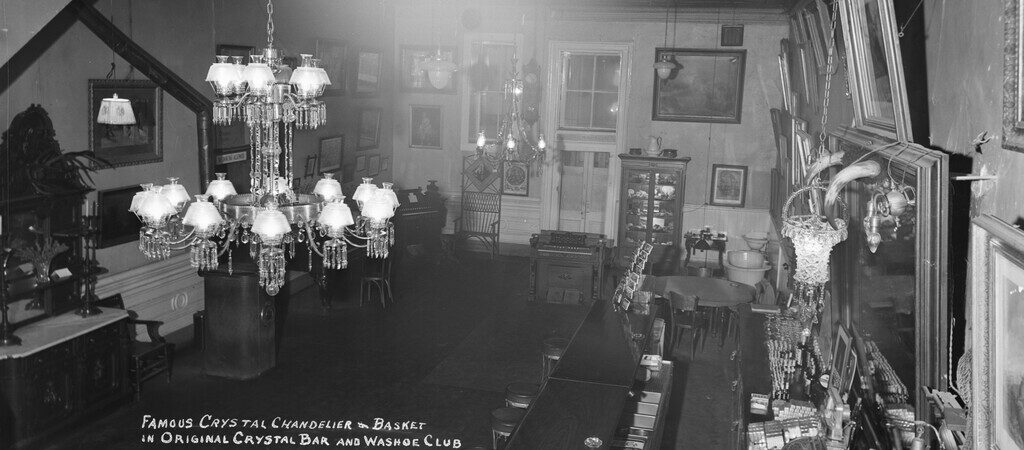
By 1943, the chandelier’s fame had reached Hollywood. A magazine account of actor Ronald Colman’s visit to Virginia City describes him being taken specifically to see it. In 1947, commercial photographer Jervie Henry Eastman made another close study of the fixture for his Eastman’s Originals series, captioning the print “Famous Crystal Chandelier & Basket in Original Crystal Bar and Washoe Club, Virginia City, Nev.,” a title that treats the chandelier’s fame as an established fact rather than a claim needing an introduction. A nearby smaller fixture, which Eastman’s own caption calls “the basket,” appears alongside the chandelier in his photographs, though the surviving record does not describe it in enough detail to say much more about it here. According to a local historian’s later recollection, prominent postwar visitors, including a senior military officer, stopped by the Crystal after World War II as a matter of course, suggesting that by then the chandelier had become something people specifically went out of their way to see rather than happened upon by accident.
What the Chandelier Sold
Here is the larger pattern the chandelier’s story sits inside. After the Comstock’s mining economy collapsed in the late nineteenth century, Virginia City’s population fell from tens of thousands to a few hundred, and the town spent decades looking, sometimes desperately, for another reason for outsiders to make the climb up the grade. Saloonkeepers on C Street eventually found one, and it was not subtlety. Old fixtures, real antiques, and a deliberately embellished version of the mining-camp past turned out to be exactly what visitors wanted to see, more than an authentically plain interior ever could have. Bars decorated themselves as museums of their own history, and tourists came.
The Crystal Bar’s chandelier had a considerable head start on that transformation, since it had already been famous for two decades before Virginia City consciously reinvented itself as a place to visit rather than a place to mine. In that light, the chandelier was never merely decorative. It was one of the first things Virginia City had to sell once there was nothing left to dig out of the ground.
Conclusion
The chandelier that once announced a mining town’s overnight wealth ended up doing something its original owners never intended: it helped keep the town alive once that wealth was gone. It survived Prohibition disguised as ice cream, survived a move that took an entire Victorian saloon apart and put it back together in a different building, and survived a shared address history so entangled that even the building it hangs in eventually took on a name that used to belong to the room next door. None of that was inevitable. Objects this elaborate get scrapped, sold off, or lost far more often than they get carried carefully from one building to the next. This one kept being useful, first as a spectacle for the miners who could afford to drink beneath it, then as a curiosity for the tourists who came looking for exactly what it offered: proof that the richest place on earth had once been real. It hangs there still, on C Street, in the same room federal surveyors once measured and photographed for the permanent record.
About the Research: This article draws on a 1992 historical marker erected by the Julia C. Bulette Chapter of E Clampus Vitus, the federal Historic American Buildings Survey’s 1937 and 1940 documentation of the building, a 1947 photograph and caption by Jervie Henry Eastman, and the Marks family’s own recollections of operating the bar, as relayed in a later magazine retrospective. Where these sources disagree, particularly on the exact year of the Crystal Bar’s move and the precise origin of the chandelier itself, that disagreement is noted in the text rather than resolved by guesswork.
Sources
Primary and Contemporary Sources
Historic American Buildings Survey. Crystal Saloon, Virginia City, Storey County, NV. Survey No. HABS NEV,15-VIRG,26. Exterior photograph by Robert W. Kerrigan, March 1937; interior photographs by N. L. McAfee, June 1940. Library of Congress, Prints and Photographs Division.
Historic American Buildings Survey data sheet for the Crystal Saloon, prepared by W. Bailey, 1959.
Eastman, Jervie Henry. “Famous Crystal Chandelier & Basket in Original Crystal Bar and Washoe Club, Virginia City, Nev.” Photographic negative B-5236, 1947. Eastman’s Originals Collection.
The Crystal Bar historical marker. Erected 1992 by the Julia C. Bulette Chapter 1864, E Clampus Vitus, Virginia City, Nevada.
Family recollections of William H. Marks and his descendants regarding the operation and relocation of the Crystal Bar, as relayed in a later magazine retrospective on Virginia City.
Secondary Sources and Modern Scholarship
Attributed physical description of the chandelier (gold tubing, eighteen chimneys and shades, approximately six hundred crystal pendants), drawn from a visitor’s account of a 1941 visit to Virginia City.
Magazine account of actor Ronald Colman’s 1943 visit to Virginia City and the Crystal Bar.
Local historian’s recollection of prominent postwar visitors to the Crystal Bar.