By James Randall
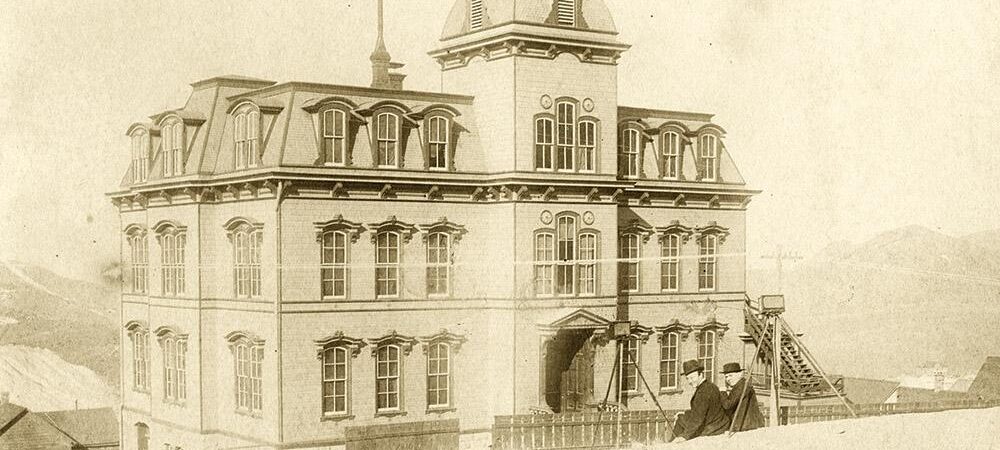
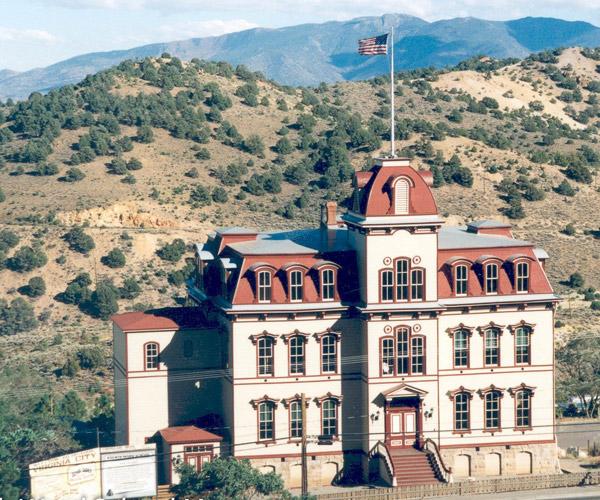
On the southern edge of Virginia City stands a building that seems almost too elaborate to have been a school. Four stories of wood rise beneath a mansard roof, dormer windows project from its upper level, and a prominent tower overlooks the hills of the Comstock. In a city remembered for silver mines, saloons, fortunes, fires, and spectacular failures, one of its most ambitious monuments was built for children.
When Virginia City dedicated the Fourth Ward School on November 28, 1876, the town was making a statement about what it intended to become. The Territorial Enterprise had already called the new school “The finest structure of the kind in Nevada” and predicted that if it was Virginia City’s pride then, the day would come when it would be its glory. Nearly 150 years later, the enormous wooden schoolhouse still stands.
A City That Needed More Classrooms
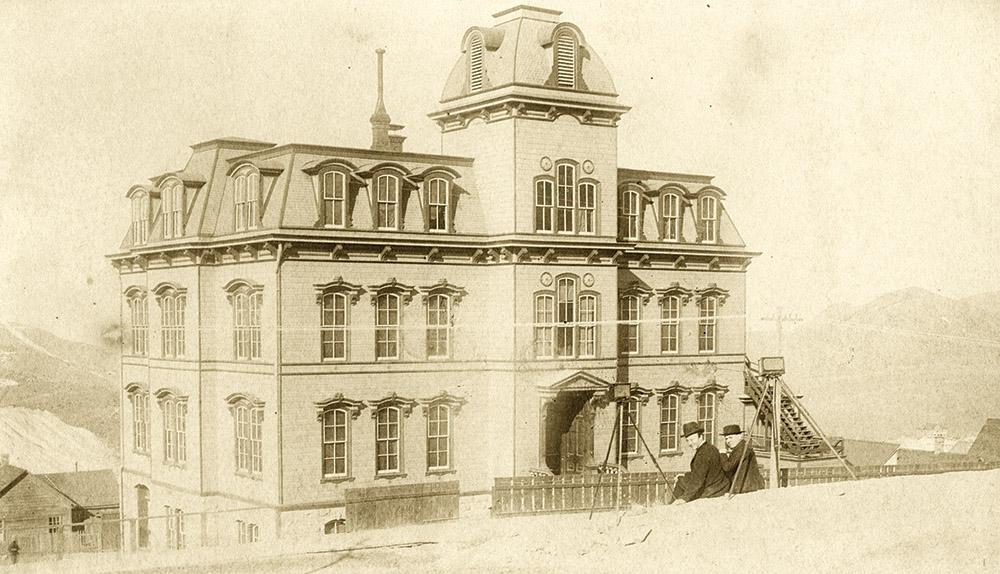
Virginia City of the 1870s was far more than the rough mining settlement often portrayed in popular history. The discoveries of the Comstock Lode had created a substantial city populated not only by miners and businessmen, but by wives, children, teachers, merchants, professionals, and laborers. Public and private schools had become badly overcrowded, and the Fourth Ward School was intended to provide sixteen additional classrooms.
Its construction also coincided with an extraordinary period of rebuilding. The Great Fire of October 1875 had destroyed a large portion of Virginia City. During 1876, new courthouses, churches, hotels, businesses, and residences rose from the ruins. The Fourth Ward School belonged to that same atmosphere of confidence and reconstruction, while also commemorating the nation’s centennial year. Nevada preservation documents describe the building as a civic gift intended to symbolize permanence, dignity, and prosperity.
Before the school occupied the site, however, another building stood there.
Before the School: The Globe Hotel
The Globe Hotel occupied the property before the Fourth Ward School. On June 19, 1876, fire broke out in the hotel’s laundry shortly after noon. The next day’s Daily Territorial Enterprise reported that the flames destroyed roughly fifteen to twenty frame buildings in about forty-five minutes, sweeping the neighborhood between C and D streets.
The newspaper identified John Kinsman as owner of the Globe Hotel, estimated his loss at about $8,000, and reported that the property was insured for $4,250.
The fire was not the Great Fire of 1875. The Enterprise explicitly reported that frightened residents feared the June 1876 blaze might become “a repetition of that of last October.”
The school board subsequently acquired the Globe Hotel lot as part of the property for the new school. Construction reportedly began on July 31, only weeks after the hotel fire. More than a century later, archaeological work beside the school uncovered brick arches, broken dinnerware, and other nineteenth-century remains associated with the old Globe Hotel, providing physical evidence of the site’s earlier life.
Building Something Extraordinary
The new school was designed and its construction supervised by Virginia City architect C. M. Bennett. Knight and McKay served as the general contractors. The Historic American Buildings Survey identifies the structure as a wood-frame building in the Second Empire style, distinguished especially by its mansard roof.
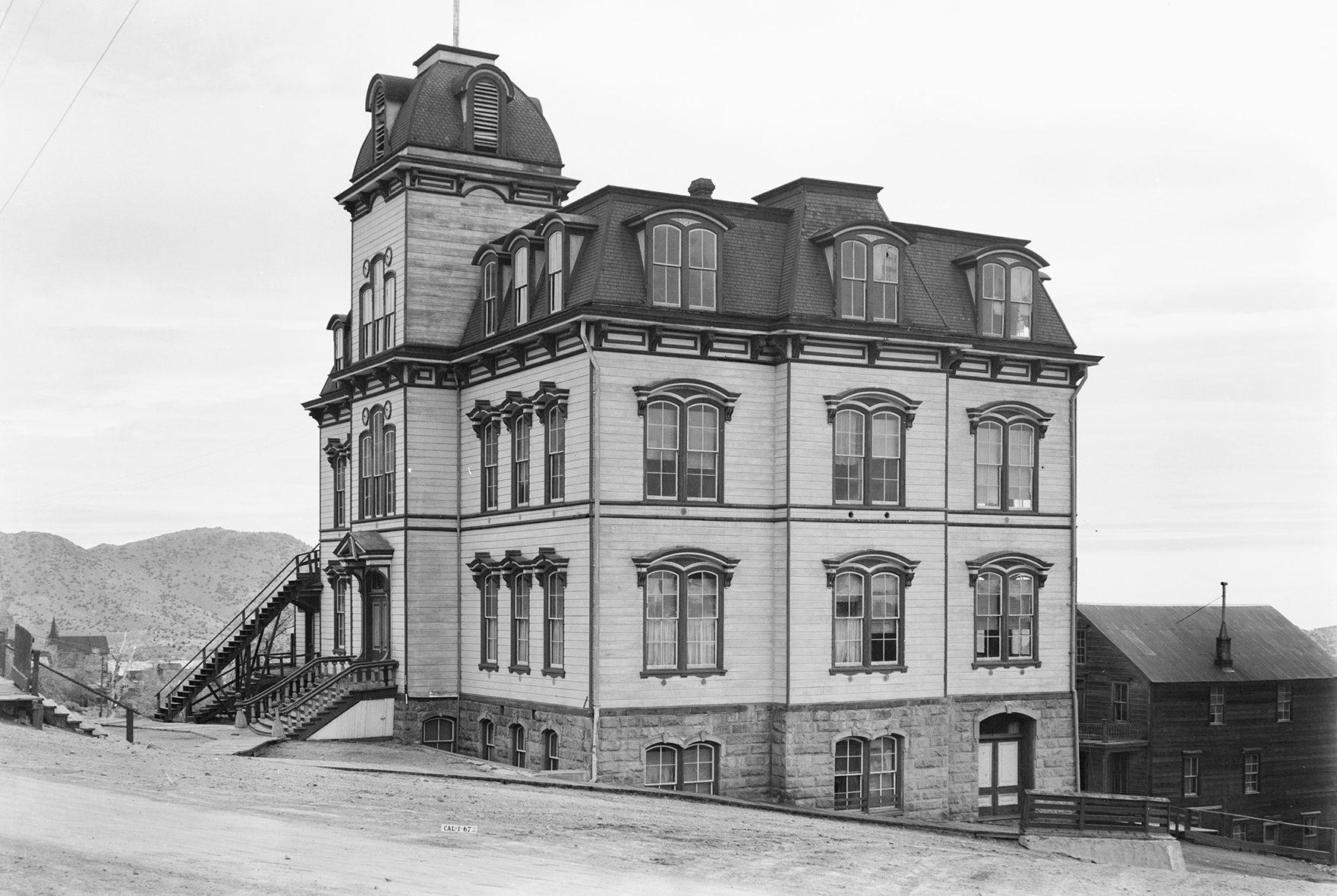
The scale was remarkable. Nevada preservation documentation describes a building of approximately 24,000 square feet, with four stories and sixteen classrooms designed for about 1,000 students. A contemporary Territorial Enterprise account was even more specific, reporting that the sixteen classrooms could accommodate 1,025 grammar and high-school pupils.
The school’s appearance was intended to impress. Its mansard roof created useful space in the upper story while giving the building the fashionable appearance associated with Second Empire architecture. Dormers, brackets, paired windows, elaborate trim, and the central tower made it look more like an important government building or grand hotel than the stereotypical one-room western schoolhouse.
The cost is less certain than some modern histories suggest. The Historic Fourth Ward School Museum states that a project initially expected to cost about $30,000 ultimately cost $54,000, including land and furniture. The federal Historic American Buildings Survey later placed the cost at approximately $100,000 and reported that money came partly from individual subscriptions, mining and business firms, benefits, balls, and raffles supervised by school trustees. Without surviving accounts that reconcile the two figures, the precise total should remain an open question.
A High-Tech School in 1876
What is perhaps most surprising about the Fourth Ward School is not how old-fashioned it appears today, but how modern it was intended to be in 1876.
Its designers paid particular attention to heating, ventilation, plumbing, sanitation, and the health of students. The Territorial Enterprise described a system intended to preserve children’s physical health while encouraging their intellectual development. Each classroom had its own ventilation stack, individual heat register, and window ventilation, with furnaces located below.
Water was piped throughout the building. Preservation records describe indoor flush toilets, drinking fountains, forced-air heating, gas lighting, and a fire-suppression system.
These were not trivial conveniences in 1876. They represented an emerging philosophy of school design in which ventilation, sanitation, temperature, light, and individual classroom organization were considered part of education itself.
The building was therefore more than large. It was technologically ambitious.
Students, Teachers, and the Meaning of an Education
The Fourth Ward School initially served children at several educational levels. Primary students occupied the lower grades, followed by grammar students and pupils in the high-school department. Over time the curriculum expanded, and by 1909 the school offered instruction through the twelfth grade.
The school is credited with an important educational milestone in 1878. Museum and state preservation records identify Anna Herrnleben and Mary O’Farrell as its first two graduates and as the first Nevada students to complete a nine-grade public-school curriculum. Because surviving sources vary somewhat in the spelling of their names and in how the distinction is described, it is safest to state the achievement in those terms rather than call them simply Nevada’s first high-school graduates.
Teaching at Fourth Ward also required considerable academic preparation. Prospective teachers in Virginia City were examined in subjects that included spelling, arithmetic, grammar, algebra, geometry, Latin, science, geography, chemistry, botany, American history, astronomy, and hygiene. The museum notes that a Fourth Ward diploma became valuable enough that its graduates were sought for teaching positions elsewhere in Nevada and California.
The school’s archives still preserve an unusually rich record of the people who passed through its rooms. Collections include student photographs beginning in the 1880s, biographical information on pupils from 1877 through 1899, school ledgers beginning in 1887, graduation announcements, diplomas, report cards, maps, yearbooks, and other records.
“Our Pride Today”
The contemporary reaction to the school reveals how much it meant to Virginia City.
On October 15, 1876, before the building had formally opened to students, the Territorial Enterprise described it as the “Pride of Virginia City.” The newspaper praised the investment in public education and predicted that the new school would become something greater than a useful municipal building. The Fourth Ward School Museum preserves the paper’s prediction:
“If it is our pride to-day, the time is not far distant when it will be our glory as well.”
The school was formally dedicated on November 28, 1876. Students began using it in January 1877.
The speed with which the building rose is itself remarkable. From the reported beginning of construction at the end of July to its dedication in late November, only about four months passed.
When the Comstock Declined
The school had been built for a booming city, but the Comstock’s great mining era could not last forever.
As mining declined, families left Virginia City and school enrollment followed the town’s shrinking population. By the mid-1930s, fewer than 200 pupils remained in a building created to accommodate more than 1,000.
New governmental standards would have required costly improvements, while maintaining the enormous aging structure became increasingly difficult. The final class graduated in 1936, ending approximately sixty years of education within its walls.
A modern school constructed with New Deal assistance replaced it.
The Fourth Ward School then entered what may have been the most dangerous period in its history.
For decades the building stood largely vacant and deteriorating. A wooden structure of its size, exposed to Virginia City’s harsh winters, dry summers, wind, and fire danger, could easily have disappeared.
It did not.
From Abandoned School to Historic Landmark
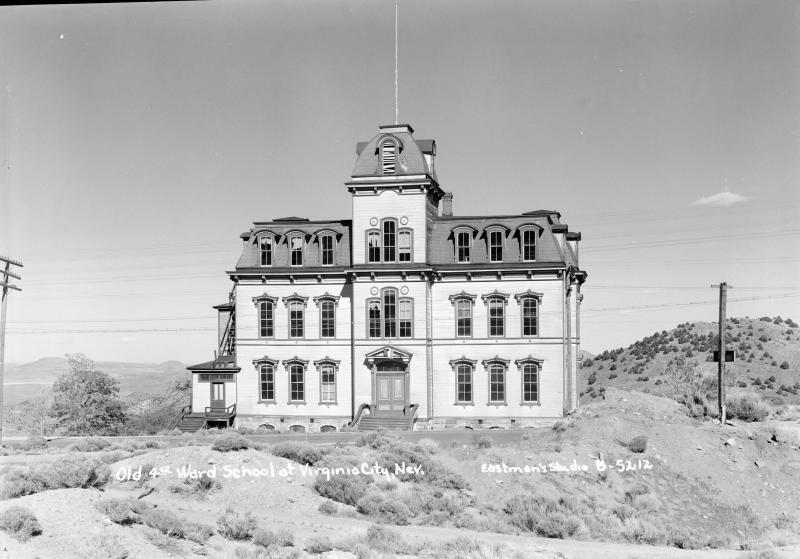
Preservation efforts began in earnest during the 1960s. The Historic American Buildings Survey records restoration work in 1966 and 1967, supported by state funds and volunteer labor. Additional grants and restoration campaigns followed.
The building reopened as a museum in 1986, fifty years after the last class graduated. Since then, millions of dollars in public and private support have gone into structural work, exterior restoration, fire protection, accessibility improvements, reconstruction of architectural features, and preservation of classrooms and collections.
Today the Historic Fourth Ward School Museum and Archives still occupies the building at 537 South C Street. Its exhibits include an original 1870s classroom, alumni photographs and memorabilia, Comstock mining history, printing and journalism exhibits, and archival collections relating to Virginia City and the surrounding mining district.
The school is commonly described as the last surviving four-story wooden Second Empire schoolhouse of its type in the United States. That narrower description is preferable to the broader claim that it is literally the only surviving Second Empire school building of any kind.
More Than an Old Schoolhouse
It is easy to look at the Fourth Ward School today and see an attractive Victorian relic. In 1876, people saw almost the opposite.
They saw something new.
They saw modern plumbing, sophisticated ventilation, gas lighting, large classrooms, individual desks, expanded educational opportunities, and a building substantial enough to suggest that Virginia City expected to endure.
That may be the most important thing the Fourth Ward School tells us about the Comstock. The men and women who built Virginia City did not spend all of their silver wealth on mines, mansions, theaters, and saloons. They also raised families, hired teachers, demanded better schools, and invested heavily in the education of their children.
The mines that made Virginia City famous eventually declined. Many of the buildings constructed during the bonanza years vanished through fire, demolition, neglect, or time. Yet the enormous wooden schoolhouse erected in 1876 remains on South C Street.
The Territorial Enterprise predicted that Virginia City’s pride might someday become its glory.
In the survival of the Fourth Ward School, the prediction proved remarkably durable.
Sources and Further Reading
Daily Territorial Enterprise, June 20, 1876, “A Forty Thousand Dollar Fire.”
Daily Territorial Enterprise, July 4, 1876, report on the new school building and acquisition of the Globe Hotel lot.
Daily Territorial Enterprise, October 15, 1876, contemporary description of the new Fourth Ward School.
Historic American Buildings Survey, Fourth Ward School, Virginia City, Storey County, Nevada, HABS NEV-15-21, Library of Congress.
Historic Fourth Ward School Foundation, CCCHP Historic Preservation Grant Application, Nevada State Historic Preservation Office, 2022.
Susan James, “Short History of Fourth Ward School,” Historic Fourth Ward School Museum.
Historic Fourth Ward School Museum & Archives, Virginia City, Nevada.