By James Randall
On the evening of Saturday, January 19, 1867, Julia Bulette left her cottage at 4 North D Street and walked toward Maguire’s Opera House with the woman who lived next door. That neighbor was Mary Jane Minieri, who used “Gertrude Holmes” as an alias in the district. Before another day had passed, that short distance would place Minieri at the center of the discovery, the identification of stolen property, and the effort to settle Julia’s estate.
Snow lay on the slopes of Mount Davidson. The opera house was presenting The Robbers and Willful Murder, but Julia and Minieri did not see either play. Prostitutes had been ordered to enter through a side door and sit in a designated section. Julia refused the door assigned to her and turned back toward D Street.
By eleven o’clock, the women had returned to their neighboring cottages. Julia said that a man was coming to meet her. They exchanged good night, Minieri entered number 6, and Julia closed the door of number 4. Those are the last facts preserved of Julia Bulette alive.
The crime that followed became one of the most repeated stories in Nevada history. Yet the woman at its center gradually disappeared behind a legend of palaces, carriages, secret wealth, and public adoration. The contemporary newspapers, trial testimony, and probate papers tell a more restrained and more consequential story: a working woman with debts and valued possessions, a close neighbor who knew her well, a circumstantial case built from stolen objects, and a town that eventually found the legend easier to sell than the life.
A Recognized Place on D Street
Virginia City was scarcely eight years old when Julia died, but silver had already transformed the steep eastern face of Mount Davidson into a city of perhaps fifteen thousand permanent residents. Its lettered streets descended the slope. Wealth and public respectability generally rose in the opposite direction.
Julia lived within that geography at 4 North D Street, near Union Street. The cottage had two rooms and stood level with the road at the front, while the mountain fell away beneath its rear floor. Minieri’s house at 6 North D Street stood immediately north. Minieri owned the property Julia rented, supplied her meals, and later described her as a sister. Their daily exchange of rent, food, and assistance suggests a relationship closer than the legal terms “tenant” and “landlady” can express.
The alias matters because the surviving record uses more than one name for the same neighbor. Mary Jane Minieri was known in the district as Gertrude Holmes. Treating “Gertrude” as another woman divides one person into two and obscures the continuity of her role. It was Minieri who accompanied Julia on her final walk, found her body, identified her belongings at trial, and administered her estate.
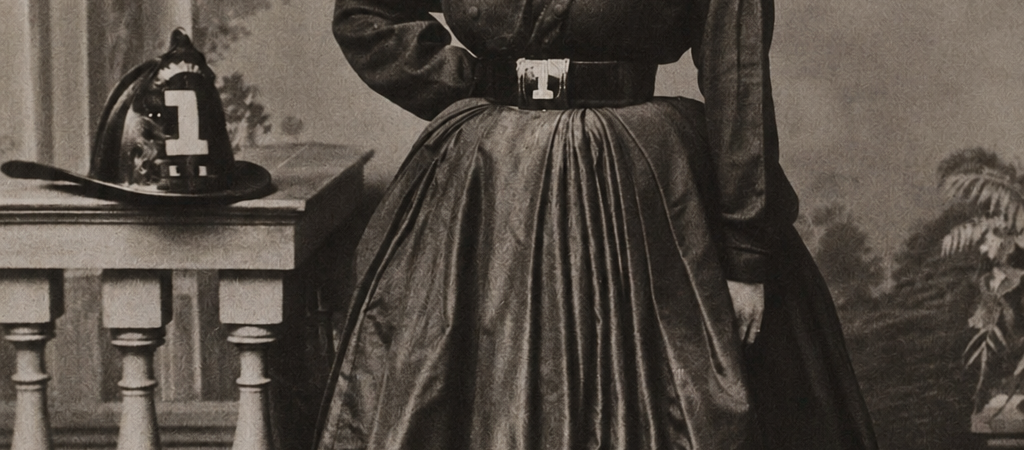
Julia’s own position was similarly easy to simplify and difficult to describe honestly. She supported herself through prostitution, a common but publicly condemned occupation in western mining towns. Contemporary accounts nevertheless credited her with generosity and a substantial circle of friends. Virginia Engine Company Number One made her an honorary member, an unusual recognition for any woman and a striking one for a woman whose profession placed her outside accepted respectability.
No surviving company record explains precisely why the honor was bestowed. Its existence is the evidence. The firemen’s public association with Julia did not erase the town’s social boundaries, but it showed that those boundaries could bend when private regard proved stronger than public convention.
The Morning at 4 North D Street
At about five o’clock on January 20, a carrier for the Daily Territorial Enterprise heard a single scream from the direction of Julia’s house. He continued his route and slipped the morning newspaper beneath the door at 4 North D Street. In a city governed by mine shifts, hoisting machinery, reduction mills, and men moving before dawn, one cry did not necessarily announce itself as a crime.
At eleven o’clock, a Chinese servant entered the cottage to kindle the morning fire. Books and a vase lay scattered across the floor, but he did not enter the adjoining bedroom and left without realizing Julia was dead.
Thirty minutes later, Minieri crossed from 6 North D Street to call Julia to breakfast. The front door was locked, an unusual condition at that hour. She went around to the rear and found Julia motionless on the bed. Her cries brought neighbors, including J. S. Kaneen, and then the police.
The room held the physical remains of resistance. A knotted piece of cedar firewood lay near the bed with wool fibers adhering to it. Two wounds marked Julia’s forehead. A laceration on the back of her left hand suggested an attempt to defend herself. Physicians found the fatal evidence on her neck and concluded that she had been strangled and smothered.
The key remained in the lock on the inside of the front door. Investigators believed the assailant had left through the rear, where the slope and the open space beneath the raised cottage offered concealment from D Street. Valuables remained in the house, but distinctive clothing, jewelry, and personal objects were gone.
The murder scene could establish violence and theft. It could not name the person responsible.
A Funeral and an Estate
Virginia Engine Company Number One treated Julia as a member in death. The firemen took part in the funeral procession through winter mud and cold to Flowery Hill Cemetery. Contemporary reporting described a woman widely known and mourned, though later accounts enlarged the procession and its symbolism beyond what the evidence can securely carry.
Within forty-eight hours, Minieri petitioned to administer Julia’s estate. Lizzie Moore and Eliza Lauren, both women from the same district, pledged their own property as security for her bond. Their names survive because the law required them to place material worth behind their confidence in Minieri’s honesty.
Seventy-one probate papers survived the Great Fire of 1875. They offer a firmer portrait than the legend that grew afterward. Julia rented a two-room cottage. She owned attractive furniture, an extensive working wardrobe, and jewelry of genuine value. She also owed rent, board, medical expenses, and money to suppliers. The estate was respectable but not rich, and it proved unable to pay every creditor in full after funeral, prosecution, and administrative expenses were added.
One claim recorded the domestic arrangement at the two addresses with unusual clarity: “Balance due Mary Jane Minieri for rent and board.” The entry is prosaic, yet it confirms the connection between 4 and 6 North D Street more securely than any later romantic story.
The inventory also created a documentary record of Julia’s possessions. That record would matter when the missing objects began returning to public view.
The Silk That Reopened the Case
For four months the investigation failed. A man named A. J. Gough was arrested and released after witnesses placed him elsewhere throughout the night of the murder. Newspapers announced the arrest more readily than the exoneration.
The case turned in May after a second intrusion. On May 2, Martha Camp awakened in her room less than two blocks from Julia’s former home and saw a man crouched behind her bed with a dagger. She escaped across the mattress and out the front door. Beneath the bed, investigators found an iron pestle fitted with a rope loop. Weeks later, Camp saw the man on a Virginia City street and identified him to police. He was John Millain, a French laundryman.
Camp’s identification supplied a suspect, but stolen property supplied the case.
Millain had sold an expensive silk dress pattern to Mrs. Cazentre in Gold Hill. He claimed that it belonged to a destitute widow whose husband had died in an Ophir mine accident. The story suited a mining district that produced widows with terrible regularity. Cazentre believed it until customers in her restaurant discussed the items stolen from Julia and mentioned French silk with a distinctive border.
She carried the cloth to Virginia City. Rosener and Company, the merchants who had sold it to Julia shortly before the murder, identified the pattern. Cazentre then identified Millain as the seller.
Police Chief Edwards traced Millain’s trunk to M. Ardant’s bakery at D and Union Streets, roughly one hundred feet from Julia’s cottage. When Edwards opened it, the objects inside reconstructed the theft: coral earrings, jet ornaments, a gold chain, gold sewing implements, engraved sleeve buttons, marked handkerchiefs, a sable cape and muff, silk mantles, a silver cup, and Julia’s gold hunting watch.
The witnesses knew these articles in intimate ways. Minieri identified the silver cup she had given Julia and a hole in a dress she had sewn herself. Merchants recognized goods they had sold or made. Annie Smith identified a watch she had lent Julia on the afternoon before the murder by the small snake engraved inside its case. Millain had pawned it under false initials.
He had spent months placing pieces of the evidence into other people’s hands. His stories changed with the object and the buyer, but the ownership of the property remained remarkably stable.
A One-Day Murder Trial
Millain’s trial opened on June 26, 1867, before Judge Richard Rising. No witness could testify to seeing him kill Julia. The prosecution therefore had to prove that the circumstances excluded a reasonable account of innocence.
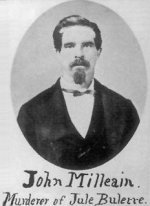
The medical testimony established the manner of death. The merchants and neighbors established ownership of the recovered property. The prosecution then joined possession to conduct: Millain had offered false explanations, sold objects gradually, pawned a borrowed watch under another name, and stored the remainder close to the scene.
His court-appointed attorney, Charles E. DeLong, contested the case with seriousness and skill. Possession of stolen property, he argued, was not the same as proof of murder. The unlocked trunk, with a cloth bearing Millain’s name among its contents, could suggest foolishness rather than concealment. DeLong called his client “a pitiable fool rather than a murderer,” adding that the law did not hang pitiable fools.
The argument identified the case’s enduring difficulty. The property proved theft and deception with extraordinary force. The act of murder still had to be inferred.
The jury returned shortly before midnight with a verdict of guilty of murder in the first degree. One juror had initially favored manslaughter, but the panel was sent back until it reached agreement. Rising imposed the sentence required by law. DeLong appealed, and the execution was stayed while the Nevada Supreme Court considered whether the jury instructions had properly stated the standard for circumstantial evidence.
The court divided. Justice Lewis dissented, finding the instructions insufficiently exact for a capital case. The majority affirmed the conviction. Millain was resentenced to die on April 24, 1868.
The Confession That Did Not Confess
On the day before the execution, DeLong published an account Millain had dictated during confinement. It has long been called his confession, though it was neither signed nor approved in final form by Millain and did not confess to killing Julia.
Millain named men called Douglass and Dillon and claimed that they recruited him for an unspecified nighttime job. He said that others led him beneath Julia’s cottage, gave him wine that left him stupefied, placed him at the foot of the steps with a cocked revolver, and entered the house. From outside, he heard a smothered exclamation. Only afterward, when the men emerged with property and ordered him to take it, did he claim to understand that Julia had been killed.
The account conceded participation while relocating agency. He was given the wine, handed the weapon, assigned the watch, and burdened with the stolen goods. Yet a man too impaired to understand the plan was an unlikely choice to guard it with a loaded revolver. None of the alleged accomplices could be confirmed. Millain remembered precise dialogue when it helped the story and became vague where a verifiable name might have opened another inquiry.
Even if accepted in full, the account did not describe a bystander. An armed lookout during a murder remained part of the crime. The narrative might have altered the moral division of guilt, but it did not erase Millain’s role.
Hanging Day in Virginia City
On April 24, 1868, spectators crowded B Street, windows, balconies, housetops, fences, and the road leading north to the scaffold. Special deputies and the National Guard escorted Millain through a corridor of bayonets. The procession included priests, physicians, reporters, a coffin, and thousands moving toward a natural ravine near the Jewish burial ground.
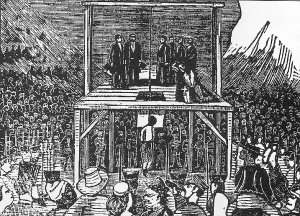
Mark Twain witnessed the execution and later wrote about the unbearable suspense of waiting for the trap to fall. Millain remained composed. From the scaffold he read a prepared statement in French, accused Chief Edwards of false testimony, criticized his defense, and blamed poverty, prejudice, public excitement, and the testimony of prostitutes for his fate. He also forgave those he believed had wronged him, thanked the officers and charitable visitors who had treated him well, and denied the murder to the end.
After the noose and black cap were fitted, the trap opened. Physicians watched for nearly twenty-five minutes before pronouncing him dead. His body was taken to the Catholic Cemetery, where no identifiable marker survives.
The execution completed the legal story. It did not settle the historical one. The evidence proved that Millain possessed and disposed of Julia’s stolen property, lied about its origin, and acknowledged a role in the events surrounding her death. Whether he killed her with his own hands or guarded the cottage while another man did so remains entangled with an account that could not be tested after his death.
How a Tenant Became a Queen
The legend of Julia Bulette grew after witnesses disappeared and records burned or were neglected. George Lyman’s 1934 Saga of the Comstock Lode transformed her cottage into “Julia’s Palace” and supplied a gilded carriage and secret fortune. Later writers repeated the details without returning to the probate papers.
Those papers describe something else. Julia was a tenant at 4 North D Street. She owned valuable clothing, furniture, and jewelry, yet her estate could not meet all its obligations. Susan James and Guy Rocha later tested the popular story against the documentary record and found no palace, no carriage, and no hidden wealth.
The legend expanded in other forms. A Virginia & Truckee club car received the misspelled name “Julia Bullette.” Television recast her story for audiences already trained to expect a certain West. By 1959, a Virginia City bar owner had installed a coin-operated telescope and pointed it toward a fenced grave identified as Julia’s. Her actual burial place lay elsewhere on the hillside.
The false grave did what a good attraction is designed to do. It ended uncertainty at the price of truth. Visitors looked where they were told and believed they had found her.
Conclusion
The murder of Julia Bulette is often told as a frontier sensation, with a famous prostitute, a trunk of stolen jewels, a condemned Frenchman, and Mark Twain at the scaffold. The surviving record is richer when its scale is reduced.
At 4 North D Street lived a tenant who paid rent and board, bought champagne for business, required medical care, owned objects her friends could identify, and held an unusual place among Virginia City’s firemen. At 6 North D Street lived Mary Jane Minieri, known in the district by the alias Gertrude Holmes, who shared Julia’s last walk, crossed the few steps between their doors the next morning, and spent more than a year administering what remained.
Those addresses restore a human proportion that the palace and false grave remove. Julia’s documented life does not need the legend’s carriage or secret fortune. On her last night, she refused the side door. Long afterward, Virginia City found other ways to direct where strangers looked.
Sources
Primary Sources
Daily Territorial Enterprise, January 19 and 22; May 25, 26, 28, and 31; June 6, 11, 18, and 27; July 6; August 1; September 3, 1867; January 5; February 28; March 31; and April 25, 1868.
Gold Hill Daily News, January 22; May 3, 25, and 30; June 3, 5, 28, and 29; September 2, 1867; April 14 and 22, 1868.
Storey County District Court. Murder Trial of John Millain. Trial transcript, June 26, 1867. Storey County Probate Records. Estate of Julia Bulette, 1867 to 1868. State v. Millain, 3 Nev. 409 (1867).
Life and Confession of John Millian (Properly, Jean Marie A. Villain), Convicted as the Murderer of Julia Bulette, as Given by Him to His Attorney. Virginia City: Lammon, Gregory & Palmer, 1868.
Twain, Mark. Letter to the Chicago Republican, May 31, 1868. Carson Daily Appeal, April 25, 1868; Evening News, April 24, 1868; Virginia Daily Union, January 21, 1867.
Later Research and Interpretation
Cerveri, Doris. “Old Documents Tell Part of Julia Bulette Story; Much Left in Dark.” Reno Gazette-Journal, June 16, 1972. James, Ronald M. The Roar and the Silence: A History of Virginia City and the Comstock Lode. Reno: University of Nevada Press, 1998. James, Susan. “Julia Bulette’s Probate Records.” In Uncovering Nevada’s Past, edited by John B. Reid and Ronald M. James, 55 to 59. Reno: University of Nevada Press, 2004. James, Susan. “Queen of Tarts.” Nevada Magazine, September/October 1984, 47 to 53. Lyman, George D. The Saga of the Comstock Lode. New York: Charles Scribner’s Sons, 1934. Rocha, Guy Louis. “Red Light Legend and Lore of Julia Bulette.” Reno Gazette-Journal, April 21, 2001. Flinchum, Robin. “Virginia City: A Mysterious Murder on the Comstock.” Nevada Magazine, January/February 2017.