In the middle decades of the nineteenth century, before railroads conquered many of the West’s long-distance routes, a good stagecoach driver could become something close to a celebrity. Passengers placed their lives in the hands of men who guided four or six horses over mountain grades, around precipitous curves, through mud and snow, and occasionally into the path of highwaymen.
Among the best known was a compact, hard-driving Californian called Charley Parkhurst.
Charley chewed tobacco, spoke in a rough voice, handled horses with exceptional skill, and wore a patch over the left eye. A kick from a horse had cost Parkhurst the sight in that eye and supplied the nickname by which the driver became famous: One-Eyed Charley, or sometimes Cockeyed Charley. California State Parks describes Parkhurst as one of the outstanding western “Jehus,” a nineteenth-century nickname for stage drivers, and records Parkhurst driving routes from Sacramento to Placerville, Stockton to Mariposa, Oakland to San Jose, and San Juan Bautista to Santa Cruz.
For decades, passengers and fellow drivers knew Charley as a man.
Only after Parkhurst died did they learn otherwise.
A Life Built Around Horses
Much of Parkhurst’s early life remains difficult to reconstruct with certainty. Most accounts place the birth around 1812 in New England, with New Hampshire frequently given as the birthplace. Later accounts say Parkhurst spent part of childhood in an orphanage, ran away while young, and found work around horses.
What is much clearer is that by adulthood Parkhurst was living publicly as a man and had developed an unusual talent for handling horses.
Parkhurst eventually came west during the California Gold Rush era. The expanding mining country created an enormous demand for transportation. People, mail, express shipments and money had to move between rapidly growing towns, and the stagecoach became one of the indispensable pieces of the new western economy.
Driving one was skilled and dangerous work.
A driver sat above the coach controlling multiple horses with reins stretched across both hands. A mistake on a steep grade or sharp turn could overturn a coach. Roads could become nearly impassable after storms. Teams could bolt. Robbers sometimes waited along isolated stretches.
The best drivers became known simply as “whips.”
Charley Parkhurst became one of the best.
California State Parks records Parkhurst driving for almost thirty years and describes the driver as a familiar figure on California roads until about 1868. One historical description remembered a “stout, compact figure,” sun-browned skin, a beardless face and bluish-gray eyes.
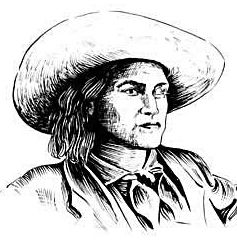
That distinction is worth preserving. The research found that the familiar image is widely identified as Parkhurst, but its original provenance has not yet been firmly established.
The Horse Kick That Created a Legend
One of the best-supported stories about Parkhurst concerns the missing eye.
A horse kicked Charley in the face, destroying the sight in the left eye. Thereafter the black eye patch became part of Parkhurst’s recognizable appearance, as did the nickname One-Eyed Charley.
Parkhurst continued driving.
That alone says something about the physical demands of the profession. Depth perception and the ability to judge horses, road conditions and approaching obstacles were vital, yet Parkhurst continued handling large teams on difficult roads.
Later stories embellished Charley’s reputation further. One of the best known concerns a highwayman called Sugarfoot, who supposedly robbed Parkhurst’s coach. When the robber attempted another holdup, the story goes, Charley was waiting and shot him.
California State Parks recounts the Sugarfoot episode, but the story is not presently supported by the kind of contemporary newspaper account that would make every detail certain. It is best treated as an old Parkhurst story with historical support, rather than as an unquestionable eyewitness fact.
The distinction matters because Parkhurst’s life attracted legends almost as readily as the Comstock’s did.
One-Eyed Charley and the Road Toward the Comstock
Parkhurst belongs on a Virginia City history site, but not quite for the reason sometimes claimed.
The discovery of the Comstock Lode created an enormous movement of people and goods across the Sierra. Placerville became one of the principal California gateways toward western Nevada. Coaches traveled east toward the Lake Tahoe and Carson Valley region, and connecting routes carried passengers onward to Carson City and Virginia City.
Parkhurst is documented as driving the Sacramento-to-Placerville route, placing Charley at the western end of the transportation system through which enormous numbers of travelers moved toward the Comstock.
Parkhurst was also remembered alongside Hank Monk, the stage driver whose connection to Carson City and Virginia City is much more firmly documented. An early account of Parkhurst placed Charley among a celebrated group of western drivers that included Monk.
But here the history requires restraint.
Later Nevada accounts have called Parkhurst a Comstock stage driver, and modern histories have connected Charley with the Pioneer Stage Company and the roads leading toward Virginia City. Yet no contemporary timetable, payroll, passenger account, stage-company record or newspaper article has yet been located that proves Parkhurst personally drove a regular stage into Virginia City. The strongest institutional source, California State Parks, documents several Parkhurst routes but does not list Virginia City among them.
So Parkhurst should not be called “Virginia City’s famous stagecoach driver.”
The more defensible connection is also an interesting one: One-Eyed Charley belonged to the transportation world that linked California with the mining districts of the Sierra and the Comstock, and drove the Sacramento-Placerville road that formed part of the great western approach toward Nevada.
Was Charley a Wells Fargo Driver?
Another familiar claim deserves similar caution.
Parkhurst is often described simply as a Wells Fargo driver. Wells Fargo certainly played a major role in the western express business, and stage companies regularly carried Wells Fargo shipments and strongboxes. But carrying Wells Fargo property did not necessarily make a driver a direct Wells Fargo employee.
The stronger evidence documents Parkhurst working for stage companies operating within the transportation and express system in which Wells Fargo participated. Until an employment record establishes more, that is the safer description.
The Secret Charley Took to the Grave
By the late 1860s, Parkhurst was withdrawing from regular stage driving. Charley later operated a stage station and saloon between Santa Cruz and Watsonville and became involved in ranching, lumbering and other pursuits.
Ill health followed. Parkhurst suffered from rheumatism and cancer involving the mouth or tongue and died near Watsonville, California, in late December 1879. Sources differ slightly on whether the death occurred December 28 or 29.
Then came the discovery that transformed the old driver’s obituary into national news.
When Parkhurst’s body was prepared for burial, those present discovered that Charley had been born female.
This was not a legend invented decades later. Contemporary newspapers reported it almost immediately.
By January 1, 1880, newspaper reporting on the discovery had begun. On January 3, the Savannah Morning News carried the story thousands of miles from California. Carson City’s Morning Appeal published “The Death of Charley Parkhurst” on January 4, and the Digital Transgender Archive identifies both Parkhurst and Hank Monk as subjects of that Nevada account.
Within days, Charley Parkhurst’s private life had become national news.
The surprise apparent in those newspaper reports is also evidence of how completely Parkhurst had lived publicly as a man. Friends, passengers, business associates and neighbors had known Charley for years without the truth becoming common knowledge.
Parkhurst left no known personal explanation.
It is therefore risky to impose motives that the surviving evidence cannot establish. Perhaps living as a man opened occupations and independence largely denied women of the period. Perhaps Parkhurst’s reasons went considerably deeper. Modern terminology can offer possible interpretations, but Charley left no known letter, diary or statement telling us how Parkhurst understood that identity.
History can document how Charley lived. It cannot confidently tell us why.
Did One-Eyed Charley Vote for President?
Another extraordinary piece of the Parkhurst story appears on Charley’s grave marker.
Parkhurst was registered to vote in California in 1867, at a time when California women did not have voting rights. The presidential election the following year pitted Ulysses S. Grant against Horatio Seymour.
From this has grown one of the most repeated claims about One-Eyed Charley: that Parkhurst became the first woman to vote in a presidential election in the United States.
There is a problem.
The surviving evidence establishes voter registration. Registration does not by itself prove that Parkhurst actually went to the polls and cast a ballot in November 1868.
The distinction has largely disappeared from the legend.
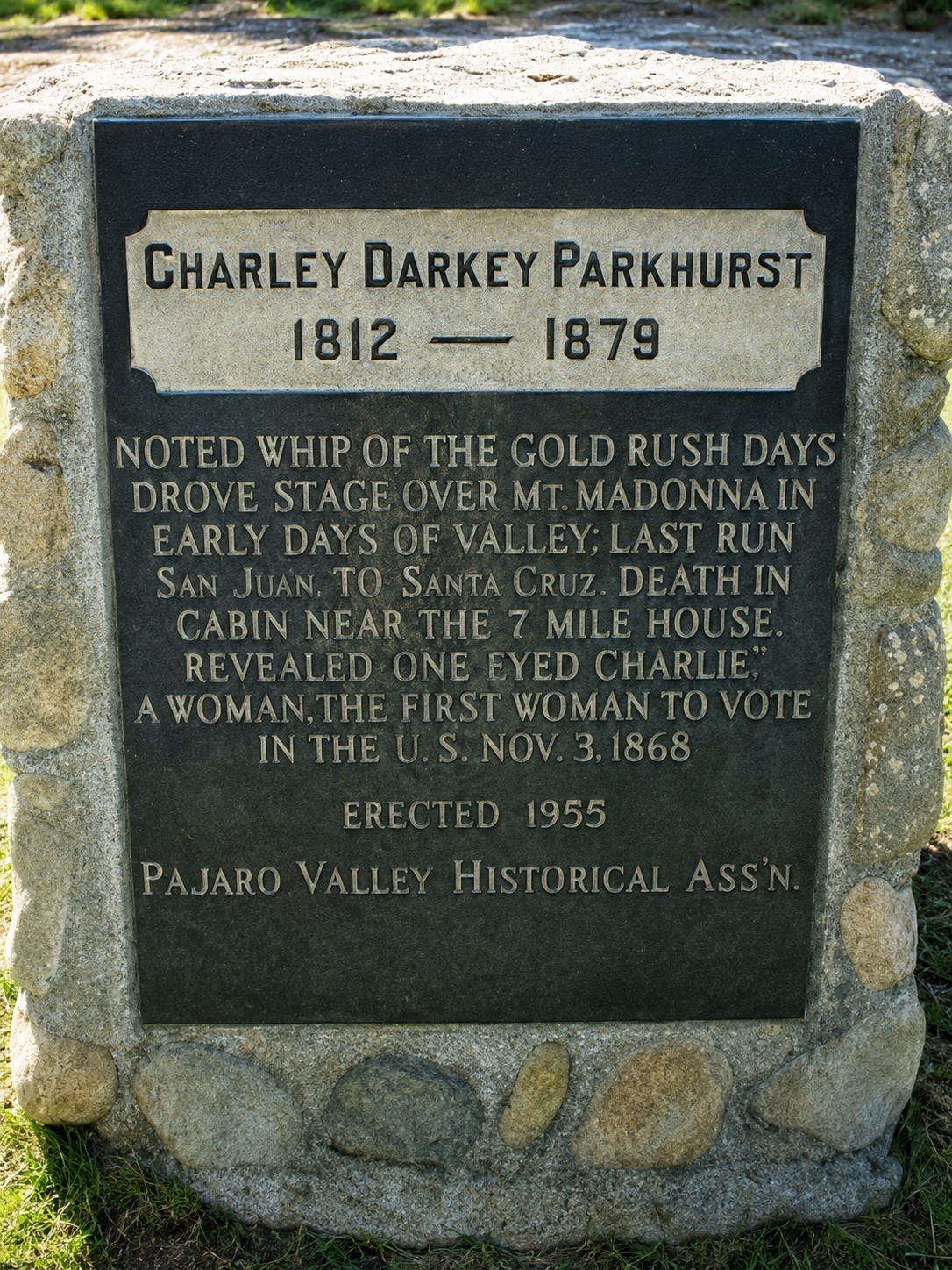
The marker itself is valuable precisely because it shows how Parkhurst came to be remembered. A monument erected by the Pajaro Valley Historical Association records the longstanding first-woman-to-vote tradition.
It is history and memory standing side by side.
A Nevada Newspaper Remembers Charley
There is a final reason Parkhurst belongs within the wider story of Virginia City and the Comstock.
When the secret became public, western Nevada recognized the name.
The Morning Appeal in Carson City published its Parkhurst account on January 4, 1880. The Digital Transgender Archive’s surviving catalog entry specifically links the story with both Charley Parkhurst and Hank Monk.
Parkhurst may not yet be proven to have held the reins of a regular Virginia City coach, but Nevada readers knew the world Charley represented. It was the world of the great western stage drivers, men perched high above teams of horses, carrying passengers toward mining towns before the railroad made many of their routes obsolete.
Charley Parkhurst had been one of the best.
And then, only in death, the West discovered how little it had really known about One-Eyed Charley.
References
California Department of Parks and Recreation. Kathi Bristow, “Those Daring Stage Drivers,” 2008. California State Parks. Documents Parkhurst’s stage routes, appearance, eye injury, reputation as a driver and the Sugarfoot story.
Digital Transgender Archive. “The Death of Charley Parkhurst,” Morning Appeal, Carson City, Nevada, January 4, 1880. Catalog identifies Charley Parkhurst and Hank Monk as subjects.
Digital Transgender Archive. Newspaper and Periodical Clippings, Pre-1900, Charley Parkhurst collection. Includes contemporary reports beginning January 1, 1880 and subsequent newspaper coverage around the United States.
Pajaro Valley Historical Association. Charley Darkey Parkhurst headstone, Pioneer Cemetery, Watsonville, California. Erected 1955.