The Comstock Never Belonged Only to the Men
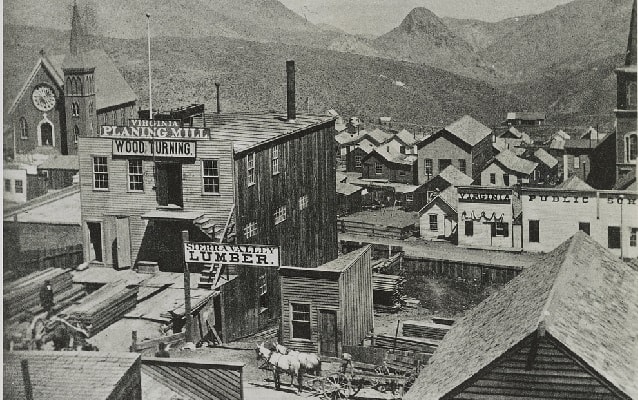
Walk down C Street today and the story you hear is usually about silver barons, gunfights, and fortunes made underground. But Virginia City was never only a man’s town. Women built it too, with mining claims and wedding rings, with needle and thread, and sometimes with nothing but stubbornness and a boardinghouse full of strangers.
Their stories rarely get top billing. That is a mistake. The Comstock produced women whose lives moved from wealth to ruin, from grief to reinvention, and from obscurity to legend, often within a single decade.
The Millionaire Who Died Poor
No story captures the instability of the Comstock better than that of Eilley Bowers.
She arrived from Scotland before the boom, when Virginia City was still little more than a rough camp on a mountainside. She ran boardinghouses and bought up small mining claims near Gold Hill, the unglamorous work of a woman with no fortune and no husband to fall back on. In 1859 she married Lemuel “Sandy” Bowers, whose adjacent claims turned out to hold some of the richest ore on the mountain. Almost overnight, a boardinghouse keeper became one of the Comstock’s first millionaires.
Eilley and Sandy built a mansion in Washoe Valley and toured Europe like American royalty. It should have been the happy end of her story. Instead it was only the middle.
Two of her children died in infancy. Sandy died in 1868. The mine that had made them rich began to fail, the way Comstock mines so often did once the easy ore ran out. Eilley tried turning the mansion into a resort, but debt swallowed the effort, and she eventually lost the property altogether.
What she did next is the part most tourism sites skip. She reinvented herself as the “Washoe Seeress,” reading fortunes from a crystal ball in Virginia City and Reno. Whether or not she actually predicted the catastrophic 1875 fire that gutted much of Virginia City, people believed she had, and her reputation grew from it. For a while, fortune telling gave her a livelihood that mining no longer could.
It did not last. By the turn of the century Eilley was destitute, spending time in a county poorhouse before Nevada officials raised roughly thirty dollars to send her to California, where she died in an Oakland charitable home in 1903.
Millionaire. Mine owner. Widow. Seeress. Pauper. Few lives anywhere trace a wider arc, and hers happened entirely within one mountain town.
From Widow’s Wages to a Hospital’s Cornerstone
Marie Louise Bryant Mackay is usually remembered as the wife of John Mackay, one of the Comstock’s legendary Silver Kings. That framing sells her short.
Before that marriage, Marie Louise had already been widowed once and had to support herself. Research into Virginia City’s Daughters of Charity indicates she taught at the sisters’ school after her first husband’s death. Wealth changed her circumstances, and she used it deliberately: she purchased and donated the land for St. Mary Louise Hospital, which opened in Virginia City in 1876 as one of the most advanced medical facilities in Nevada at the time.
A woman once dependent on her own labor to survive became wealthy enough to build a hospital for the miners and poor residents of the town where she had once struggled. The Comstock’s fortunes flowed in strange directions, and sometimes they flowed back toward the people who needed them most.
The Boardinghouse Keeper Who Became a National Sensation
Laura Fair’s Virginia City years start out sounding like quiet resilience. Widowed young with a daughter to raise, she found steady footing running a boardinghouse and investing in silver mines.
Then her life turned into something else entirely. Fair became involved with a married California attorney, Alexander Parker Crittenden, in an affair that stretched on for years. She later maintained he had promised to leave his wife for her. In 1870, after Crittenden reconciled publicly with the wife he’d never left, Fair confronted him aboard a San Francisco Bay ferry and shot him to death in front of her.
The trials that followed became a national sensation, tangled up in adultery, insanity, and the era’s brutal double standard, under which men were often excused for killing unfaithful lovers while women faced far less mercy. Fair was convicted, won a new trial, and was ultimately acquitted. A Virginia City businesswoman had become the center of one of the most talked-about murder cases in the country.
The Widow Who Wrote It All Down
If you want to hear what Virginia City actually sounded like, Mary McNair Mathews left behind the closest thing to a firsthand tour.
She arrived from New York in 1869, not chasing silver but chasing answers, after her brother died in Virginia City under circumstances she found suspicious. She meant to stay briefly. She stayed almost a decade, supporting herself by sewing, taking in lodgers, running businesses, opening a school, and eventually investing in mining stocks and real estate. She also worked on behalf of the unemployed and took up causes like temperance and early opposition to child abuse.
In 1880 she published her own account, Ten Years in Nevada: Or, Life on the Pacific Coast, now digitized in full by the Library of Congress and in the public domain. Mathews represents the thousands of women who never became queens of the Comstock but built real lives there anyway, through sheer persistence.
The Woman Buried Beneath Her Own Legend
Julia Bulette is the name most visitors already know, but the legend has grown well past the woman. Modern research, particularly the work of historian Marion Goldman, suggests twentieth-century writers inflated Bulette into an extraordinarily wealthy “queen” of Virginia City’s sex trade. The evidence instead places her closer to the middle tier of that economy. She died in debt, while other, richer madams, such as Jessie Lester, accumulated genuine fortunes.
That correction makes her more human, not less. She was an English-born woman living independently in a town where prostitution ranged from luxurious parlor houses to one-room cribs offering almost nothing. Her brutal murder in January 1867 drew enormous newspaper coverage, and Virginia City has been selling the resulting legend ever since. The more honest question is not who Julia Bulette became in legend, but who she actually was before the town turned her into one.
The Women the Census Remembers, Even When History Forgets
Some of the most striking Comstock lives left almost no trace beyond a few lines in the 1880 census, the source historian Ronald James built much of his research around.
Augusta Ackhert, a 39-year-old German immigrant widow on C Street, supported herself and her children by working in a candy store and taking in lodgers, among them an African American family of seven. There is no scandal in her story and no fortune, only the ordinary, exhausting work of survival, which is precisely why her life matters.
Ty Gung, a Chinese mother in Virginia City’s Chinatown, kept house and cared for her infant daughter while her husband, a cook, sat unemployed for nine of the previous twelve months. Historians caution against the old assumption that Chinese women in Virginia City were automatically connected to prostitution. Census records show them as wives, mothers, and heads of households, navigating a town that offered them discrimination and narrow opportunity.
Emma Earl, a miner’s wife, worked as a dressmaker to supplement household income, a quiet reminder that even the famous four-dollar mining wage rarely meant real security.
Set beside Eilley Bowers, Augusta Ackhert’s story reveals something the tourist plaques rarely say outright: Eilley eventually died poorer than Augusta had ever been. Wealth on the Comstock arrived spectacularly, and it could vanish just as fast.
A Town Built on More Than Silver
Virginia City’s popular image runs toward saloons, shootouts, and silver barons. The women who lived there tell a fuller story, one built from boardinghouses and mining claims, hospitals and crystal balls, courtroom sensations and quiet survival on C Street.
Some of them became legends. Most simply endured, working, raising children, and rebuilding their lives however the Comstock required. Together, their stories are as much a part of this mountain’s history as any vein of silver ever pulled from it.
Sources: Ronald M. James, “Women of the Mining West: Virginia City Revisited,” Nevada Historical Society Quarterly 36 (Fall 1993); Mary McNair Mathews, Ten Years in Nevada (1880), Library of Congress; Marion S. Goldman, Gold Diggers and Silver Miners; Smithsonian National Museum of American History, “Mining Charity”; Nevada Women’s History Project.