By James Randall
The Great Fire of 1875, the struggle to survive, and the city rebuilt from ash
Before sunrise
In the darkness before sunrise on October 26, 1875, the fire bells of Virginia City began to ring. Residents who stepped into the cold found the wind already moving hard down the eastern slope of Mount Davidson. On A Street, between Taylor and Union streets, a small lodging house was burning. Within minutes, flame had crossed the narrow spaces between buildings and taken hold of the dry wooden city.
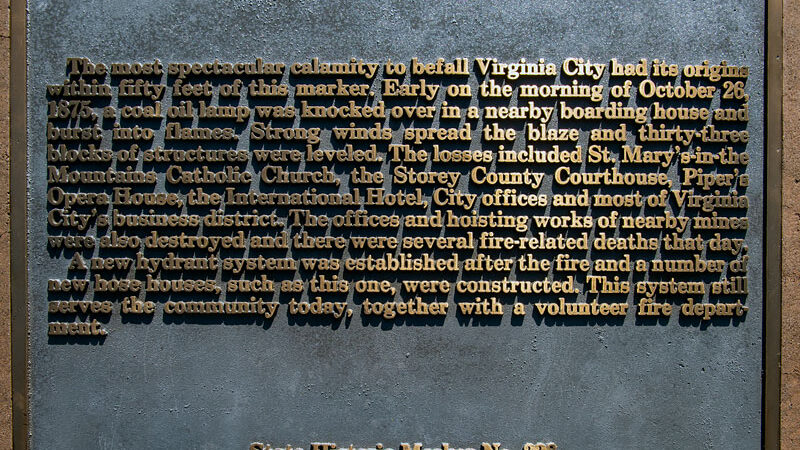
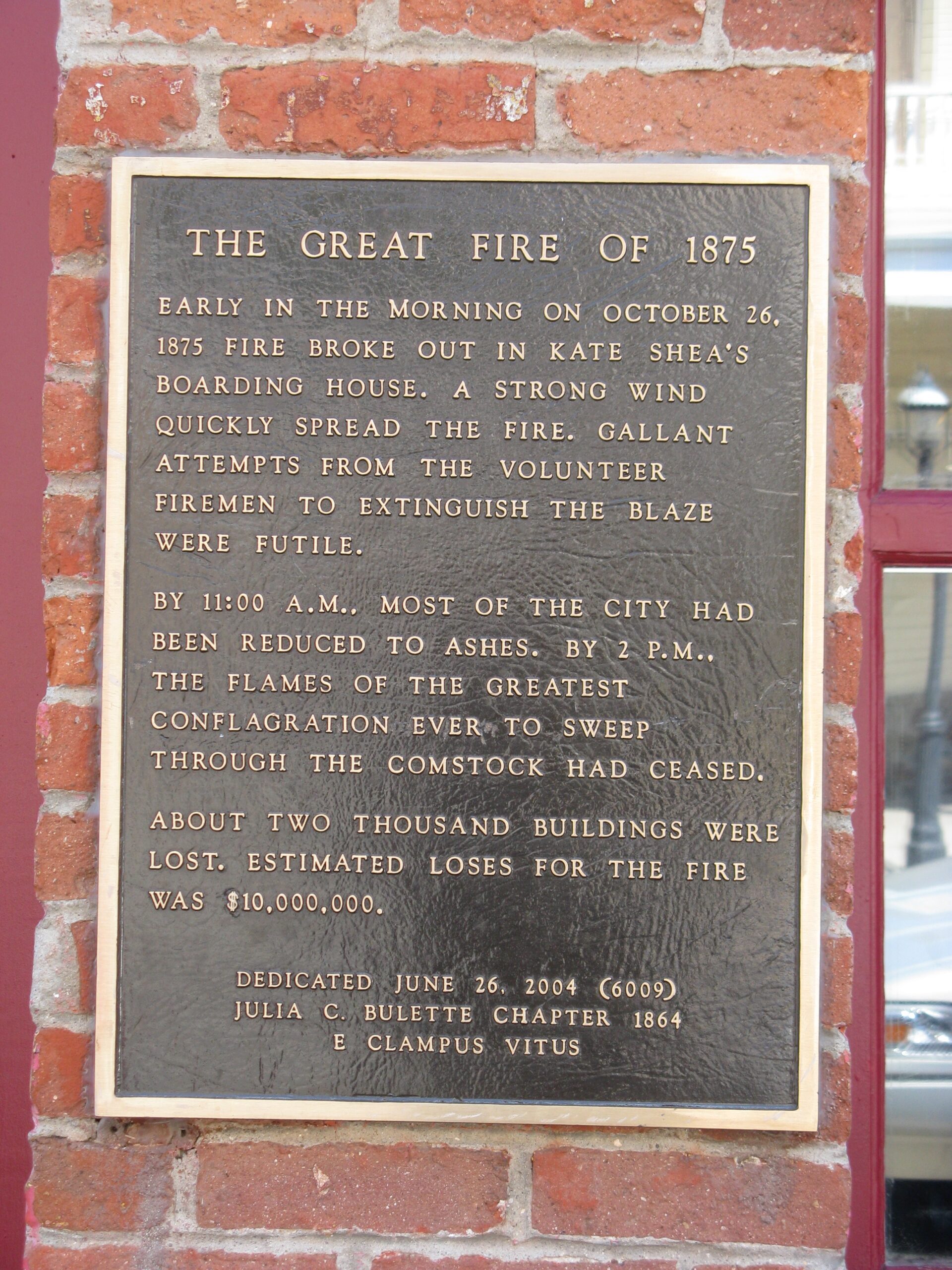
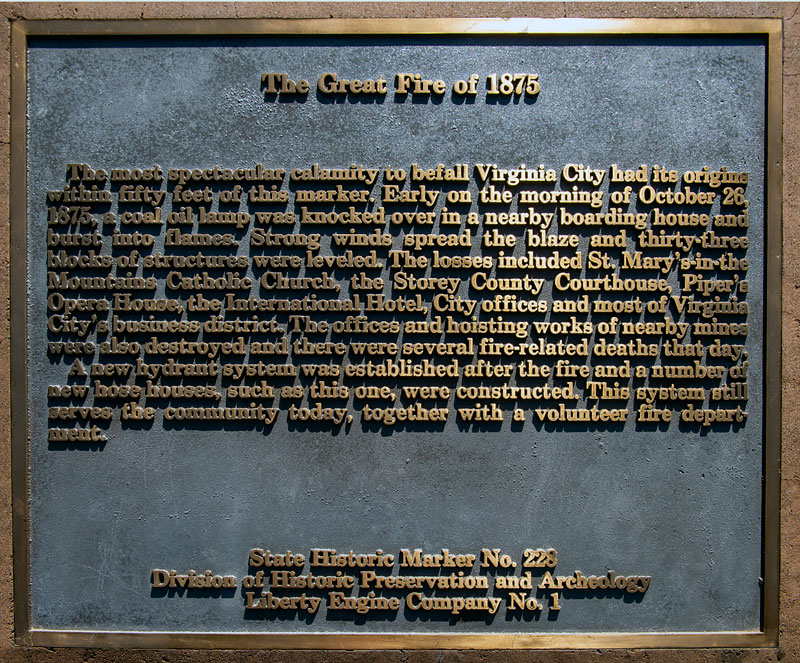
The first detailed account, sent from Virginia City the next day and published in the Sacramento Daily Union, placed the alarm at about 5:30 in the morning. A neighbor had noticed a light in the lodging house kept by Kate Shay, entered, and found a nearby room burning. He believed that a candle had been left alight. Later histories changed the cause to a coal-oil lamp knocked over by rowdy miners. That version appears on Nevada’s historical marker and in modern fire department histories, but the immediate report does not support it. The honest conclusion is narrower: the fire began inside the A Street boardinghouse, probably through careless use of an open flame, and the exact act that started it remains uncertain.
The uncertainty matters. Disasters attract simple origin stories because a single lamp, candle, or careless person is easier to remember than a city built for speed, profit, and constant expansion. Virginia City had endured major fires before 1875. Its steep streets were crowded with wooden dwellings, lodging houses, saloons, stables, shops, churches, offices, theaters, and the surface works of mines. Even many brick buildings contained combustible floors, roofs, partitions, furnishings, and stock. Fire was not an unforeseen danger. It was a condition of life on the Comstock.
A city in the path of the wind
Virginia City was then near the height of the Big Bonanza. The larger Comstock district held roughly 25,000 people by 1874, according to the National Park Service, and the town’s commercial life was dense and cosmopolitan. The same geography that made the place spectacular made it vulnerable. Streets ran across a steep mountainside. Buildings pressed close together. Mine timbers, lumber yards, wooden sidewalks, fences, outbuildings, stored fuel, and household goods offered the wind a nearly continuous line of fuel.
The volunteer fire companies responded quickly. Engine Company No. 4 and a Babcock extinguisher reached the boardinghouse, but the early fire had already escaped. The contemporary correspondent wrote that within about fifteen minutes more than twenty buildings were burning. The wind drove flame and embers eastward and northward, while heat forced crews to abandon one position after another. Water pressure and supply could not match the rate at which the fire created new fronts.
Virginia City’s firefighters were brave, experienced, and intensely proud of their companies. That pride had a darker side. Earlier companies competed for the honor of getting first water on a fire, and rivalries sometimes became violent. The Great Fire overwhelmed every company at once. The next day’s account specifically reported Eagle No. 3 and Knickerbocker No. 5 lost. A later Storey County fire history says only Young America No. 2 and Monumental No. 6 emerged with their equipment intact.
From A Street to the business district
The fire spread across A, B, and C streets and into the civic and commercial heart of the city. The Storey County Courthouse, city offices, the International Hotel, mine offices, and Piper’s Opera House were lost. Piper’s destroyed theater was the former Maguire Opera House at D and Union streets, not the 1885 opera house that visitors know today. That distinction is easily blurred because John Piper rebuilt more than once.
Officials and residents tried to save what could be carried. Many Storey County records were removed before the courthouse burned. Prisoners were transferred first to a station house and then, as the fire advanced, to an old mine tunnel. They were later held in the Philadelphia Brewery under armed guard. The odd journey from courthouse jail to tunnel to brewery captures the improvisation of the morning better than any grand claim about frontier resilience.
Explosives from the mines were used to make firebreaks. Giant powder blasted the Catholic church apart, leaving only its bare walls standing. Chief of Police White later blew up Piper’s Opera House and had a building at Union and E streets torn down, but the fire advanced. Dynamiting could remove fuel, but it could not control windborne embers.
Fire above the shafts
By about 9:30 a.m., the danger had reached the great mines. Men were ordered out. The hoisting works of the Consolidated Virginia and Ophir mines burned, followed by damage to other surface works and mills. The threat was not only to buildings. If fire descended through a shaft, it could ignite miles of underground timber and trap workers below.
Crews filled cages with earth and used them to bulkhead the Consolidated Virginia and Ophir shafts. At the Ophir, fire burned down two tiers of timbering before water checked it. All miners were reported to have escaped. The episode is one of the day’s most consequential facts, yet it is often buried beneath stories about famous buildings. Thousands of livelihoods depended on the mines, and a prolonged underground fire could have turned a city disaster into an industrial catastrophe of far greater duration.
The fire also damaged the Virginia and Truckee Railroad. Loaded wood cars burned, and the timbers of a railroad tunnel caught fire and collapsed. Still, the railroad soon became part of the relief system, carrying displaced people away without charge and asking connecting lines to reduce their fares.
The neighborhoods below
The flames continued downhill into Virginia City’s Chinese quarter. The National Park Service describes this Chinatown as one of the earliest urban Chinatowns in Nevada, home at its height to between 1,500 and 2,000 Chinese immigrants. Its one and two-story wooden buildings held laundries, noodle parlors, herb shops, mercantiles, businesses, and lodgings. The Great Fire destroyed the neighborhood. It was rebuilt, but it never fully recovered.
That loss deserves more than a passing line. Chinese residents had helped build the region’s water, transportation, service, and commercial systems, yet contemporary disaster reports tended to describe Chinatown as a place on a map rather than a community of named people. The imbalance is part of the evidence. Newspapers listed banks, hotels, mine companies, and prominent property holders in detail while leaving many laborers, tenants, sex workers, boardinghouse residents, and Chinese families anonymous.
The same silence surrounds the unnamed woman whose remains were found in the ruins of a D Street house associated with the red-light district. Initial dispatches named two male victims. By the following day, searchers had found her remains and those of another man, believed to be Martin Slusher of Southern California. The safest contemporary count is therefore at least four reported deaths as the ruins were searched. Later summaries that give a single, neat total flatten the uncertainty of recovery work.
The flight from the flames
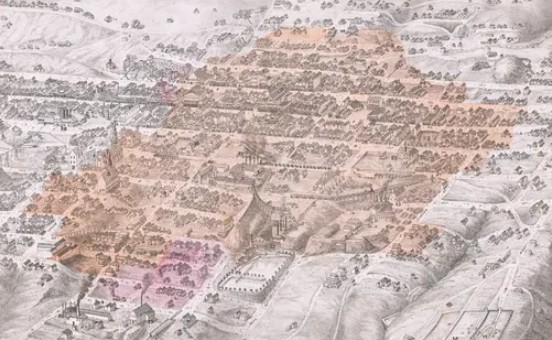
By late morning the main force of the fire had spent itself, though scattered burning continued into the afternoon. A contemporary estimate placed the burned district at roughly three-quarters of a mile long and half a mile wide, principally between Taylor Street on the south, Carson Street on the north, Stewart Street on the west, and Chinatown on the east, with several extensions beyond. Nevada’s official marker summarizes the destruction as thirty-three blocks. Later accounts commonly say that two-thirds of Virginia City and more than 2,000 structures were lost.
The human geography of the disaster stretched beyond the burn line. Residents hauled trunks, bedding, chairs, pictures, clothing, and business stock into the streets, only to watch many of those possessions ignite when the fire changed direction. Wagons were scarce. Some teamsters demanded high prices. People fled toward Geiger Grade or climbed onto bare ground with whatever they could carry. One report described framed pictures propped against telegraph poles and furniture scattered among the rocks.
A turn in the weather added to the misery. Snow and cold rain reached the hills, where displaced residents made rough camps and sagebrush windbreaks. Contemporary estimates are more conservative than the numbers repeated in many later commemorations: about 3,000 people were described as lacking food, beds, shelter, or money, and another report put the number without roofs at roughly 3,700. Claims of 8,000 or 10,000 homeless appeared later and are difficult to reconcile with the detailed dispatches.
The financial totals also grew in retelling. The Sacramento Daily Union published a property-by-property subtotal that reached $6.246 million, including an allowance for personal effects, and reported only $859,700 in known insurance. Its rounded estimate was $7 million. Later histories often give $10 million or $12 million. The contemporary figures are imperfect, but they are closer to the claims, inventories, and ruins from which an estimate could be made.
Relief by rail, schoolhouse, and kitchen
Help began arriving before the ashes were cold. Carson City sent cooked provisions for about 2,500 people. By the following day, about 3,500 people had been fed through the First and Third Ward schoolhouses. Gold Hill opened public buildings and schools to women and children and found space for men in hoisting works. Reno and other communities sent food and clothing while relief committees organized supplies and residents searched for family members and places to sleep.
News of the disaster traveled fast over the wires, reaching papers thousands of miles away within two days. Coverage as far off as Cleveland described families camping out in the cold, streets patrolled by the military, and losses estimated at seven and a half million dollars, figures that reflected how quickly the story spread beyond Nevada and how unevenly the numbers were reported from one paper to the next.
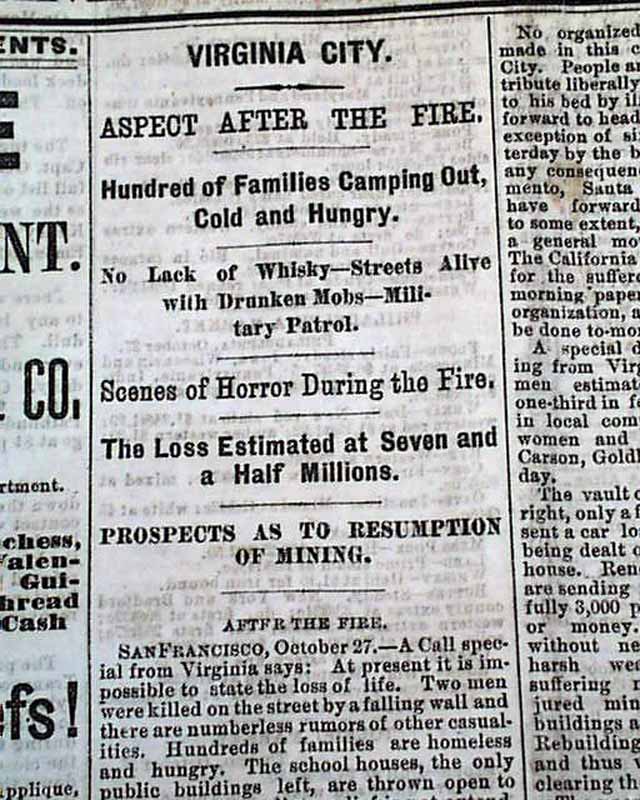
The language of those reports reveals both generosity and hierarchy. Women and children were directed toward schools and public rooms, while men were expected to sleep in industrial spaces or outside. Hundreds were said to be inadequately clothed. Chinese residents appear far less often in descriptions of organized relief, leaving an important question that the surviving newspaper coverage does not answer well: how evenly did assistance cross lines of race, occupation, reputation, and property ownership?
Institutions restarted in miniature. Telegraph operators established service in schoolhouses. The post office reopened with a tea box cut with a slot for letters. The Bank of California resumed work from a broker’s office. The Territorial Enterprise produced a tiny sheet, and the Evening Chronicle followed with a half-sheet. These were not merely quaint gestures. Mail, money, news, and telegraphy told residents and distant investors that Virginia City still functioned.
Rebuilding before the ruins cooled
Reconstruction began almost immediately. Men cleared debris and shut broken utility lines. O. C. Steele raised the first reported shanty, half saloon and half butcher shop. Owners promised to rebuild, but John Mackay warned that no ore would be hoisted before spring, leaving 2,500 miners unemployed. Contemporary estimates placed the likely exodus at 4,000 to 5,000 people.
The rebuilding changed the streetscape that visitors now regard as historic Virginia City. The Storey County Courthouse, St. Mary in the Mountains, the Fourth Ward School, the Miners’ Union Hall, and rows of Italianate houses date from 1876 or the years that followed. The present Piper’s Opera House belongs to a later 1885 rebuilding. Much of what looks like the city’s original boomtown fabric is, more precisely, the architecture of recovery.
One lesser-known story turns that recovery into a bitter joke. The Knights of Pythias lost its regalia in a Virginia City fire on September 11, 1875. The lodge obtained replacement regalia from a defunct lodge at Genoa. Six weeks later, the Great Fire destroyed the replacement set too. The existing brick Knights of Pythias and Miners’ Union buildings became part of the post-fire streetscape. Upstairs in the new Miners’ Union Hall, a public library founded in 1877 eventually held about 2,200 volumes and was free to union families.
What Virginia City learned
The clearest lesson was institutional. A collection of proud volunteer companies could not compensate for inadequate water, lost equipment, weak coordination, and a fire moving faster than crews could redeploy. After the disaster, Virginia City established a new hydrant system and built hose houses. Storey County’s fire history says the city organized a paid department, combined surviving equipment, bought horse-drawn hose carts, adapted a sleigh for winter hose transport, and built a firehouse with a watch tower. Earlier detection, centralized command, reliable water access, and mobile apparatus became parts of one system.
The second lesson was architectural, though it was applied unevenly. Brick and stone offered better resistance than closely packed wood, and the rebuilt civic center used more masonry. The 1876 courthouse and St. Mary’s remain the most visible examples. Yet brick facades did not make interiors, roofs, or neighboring blocks fireproof. Wood remained necessary, affordable, and abundant. Piper’s post-fire theater burned again in 1883, and another was completed in 1885. The lesson was learned, but economics limited how completely it could be followed.
The mines learned to treat the surface and the underground as a single fire problem. Hoists, shaft houses, timbered openings, power, communication, and evacuation procedures were interdependent. The filled cages and bulkheads of October 26 were improvised defenses. Their success showed the value of isolating shafts quickly and getting every worker above ground before defending property.
The city also learned the importance of continuity. Saving county records, reopening communications, printing small newspapers, feeding people through schoolhouses, and using the railroad for evacuation helped turn a mass of survivors into a functioning community. Recovery depended as much on information and trust as on lumber and brick.
What the fire did not teach equally
The Great Fire did not produce a single recovery shared by everyone. Mine companies and major institutions could draw on capital, credit, rail connections, and political influence. Tenants, laborers, women running marginal businesses, people in the red-light district, and Chinese residents had fewer protections and left thinner paper trails. Chinatown was rebuilt but never regained its former strength, affected by the fire, declining mining, financial turmoil, and intensifying anti-Chinese exclusion.
Nor did rebuilding erase the underlying volatility of a mining economy. Virginia City rose rapidly because investment, labor, timber, machinery, and ore were concentrated in one place. The same concentration magnified disaster. The city rebuilt during the Bonanza, but the Comstock’s richest years were already finite. Fire resilience could preserve a community; it could not replenish an ore body.
The most useful way to remember October 26, 1875, is therefore not as a morality tale about one careless lamp. It was a systems failure exposed by wind: combustible construction, limited water, fragmented equipment, steep terrain, and an economy packed tightly around deep shafts. Its survivors answered with hydrants, hose houses, a reorganized department, masonry buildings, emergency relief, and astonishing speed. They also left questions about who received help, whose losses were counted, and whose names disappeared into the ash.
Virginia City today is, in large measure, the city that came after the fire. Its courthouse, church, union halls, houses, and theater are not simply remnants of the Comstock boom. They are evidence of what the town chose to rebuild, what it could afford to protect, and what it learned only after a cold October wind turned a boardinghouse flame into thirty-three blocks of ruin.
References
Primary and near-contemporary sources
‘The Burning of Virginia City.’ Sacramento Daily Union, October 28, 1875. Open source The central source for the chronology and immediate estimates.
Koch, Augustus. Birds Eye View of Virginia City, Storey County, Nevada. San Francisco: Britton, Rey & Co., 1875. Open source Library of Congress digital ID g4354v.pm004690; public-domain scan.

Britton & Rey. Bird’s-Eye View of Virginia City, Nevada. San Francisco: Britton & Rey, 1875. Lithograph illustrating Virginia City just a few months prior to the fire of October 1875.
Historic American Buildings Survey. Miners’ Union Hall, Virginia City, Nevada. HABS NEV,15-VIRG,19-. Open source Includes building history and the twice-burned Knights of Pythias regalia.
Institutional and scholarly sources
Nevada State Historic Preservation Office. ‘The Great Fire of 1875,’ State Historical Marker No. 228. Open source
National Park Service. ‘Virginia City Historic District, Nevada.’ Open source
National Park Service. Virginia City Historic District National Historic Landmark documentation, 1975. Open source
National Park Service. National Register nomination for Piper’s Opera House, 1997. Open source
Storey County Fire Protection District. ‘Our History.’ Open source
Quinn, Katrina J. ‘The Life Cycle and Conventions of Nineteenth-Century Breaking News: Disaster Reporting of the 1875 Virginia City Fire.’ American Journalism 35, no. 3 (2018): 298-314. Open source
James, Ronald M. The Roar and the Silence: A History of Virginia City and the Comstock Lode. Reno: University of Nevada Press, 1998. Open source
James, Ronald M. Virginia City: Secrets of a Western Past. Lincoln: University of Nebraska Press, 2012. Open source
University of Nevada, Reno. ‘Archaeologists Investigate Civil War-Era Opera House,’ 2008. Open source
UNLV Special Collections and Archives. ‘Aerial Photograph of Virginia City, Nevada, 1870-1875.’ Open source