By James Randall
The story that survives in most tellings is simple. A night-shift miner left a candle burning against a timber, eight hundred feet below Gold Hill, and by morning thirty-five men or more were dead. It is the version repeated in guidebooks, historical markers, and casual retellings of the Comstock’s worst mining disaster. It is also, on the evidence, considerably less certain than it sounds.
What actually happened on April 7, 1869, inside the interconnected Yellow Jacket, Kentuck, and Crown Point mines was a catastrophe built from more than one bad decision and more than one open question, several of which the men who lived through it never fully resolved.
The Morning of April 7
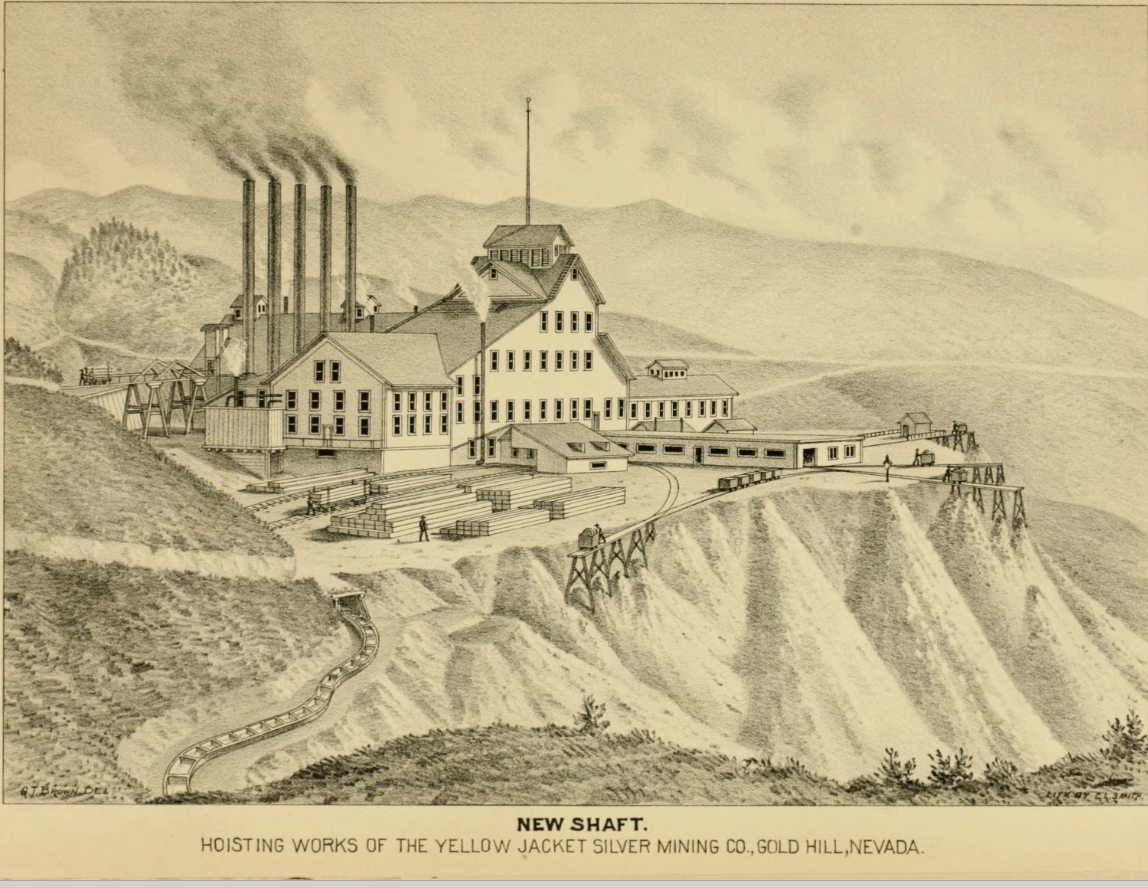
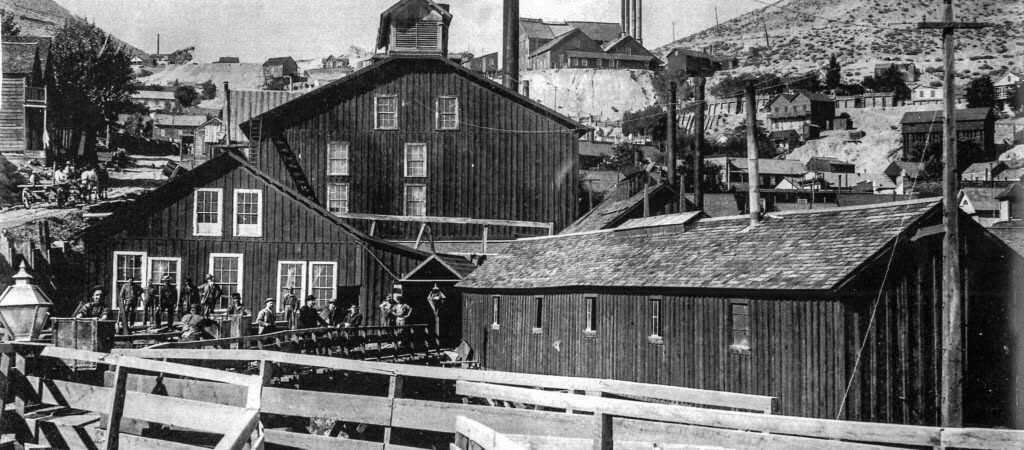
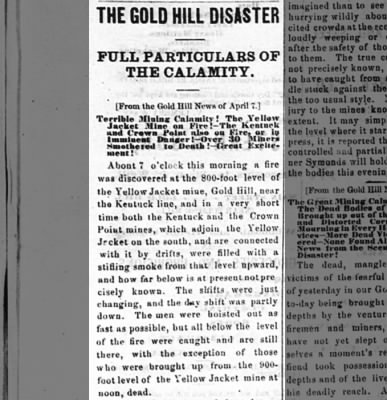
At approximately 7:00 a.m. on Wednesday, April 7, 1869, fire was discovered on the Yellow Jacket’s 800-foot level, roughly two hundred to two hundred fifty feet south of the main shaft and close to the boundary with the Kentuck. Underground drifts connected the Yellow Jacket to the Kentuck, which in turn connected to the Crown Point.
The timing could hardly have been worse. A shift change was under way. The night crew had largely left the mine, while members of the day crew were already being lowered into all three workings. The Gold Hill Daily News reported that the day shift was already “partly down” when the danger became apparent.
Smoke moved quickly through the connected drifts. The air current ran down the Yellow Jacket and toward the Kentuck and Crown Point, turning passages that normally carried fresh air into conduits for smoke. Men working below the fire were in particular danger, since their only route to the surface passed through the contaminated levels above them.
The surface scene turned chaotic within minutes. Gold Hill’s fire companies responded, followed by companies from Virginia City. Hose and water were sent down the shaft, and blowers were pressed into service in an attempt to force breathable air to the men still below. Thousands gathered around the works while wives and children waited for word.
Some men escaped. Many did not.
One of the most harrowing episodes involved brothers Richard and George Bickle, who managed to reach a cage in the Crown Point. George was overcome by gas while holding onto his brother. During the ascent, Richard’s body struck the shaft timbers and was catastrophically injured. George reached the surface unconscious and died soon after. Contemporary newspapers reported the episode within days.
The larger pattern that emerged from the wreckage was that most of the deaths were caused by smoke and poisonous combustion gases rather than by fire itself. A correspondent who examined the recovered bodies later noted that some of the victims did not even have singed hair or whiskers.
Was a Careless Candle Really the Cause?
The traditional explanation holds that someone on the night shift left a burning candle against a timber and forgot it. Newspapers repeated the theory almost immediately, and later histories converted it, over time, from theory into settled fact.
Contemporary observers were not so sure.
On April 11, correspondent Alf Doten wrote that the fire’s origin remained unexplained, apart from the standing theory that a lighted candle had been carelessly left against wood. He also reported conflicting stories of an underground explosion. Later, after testimony was taken at the coroner’s inquests, Doten went further and directly challenged the candle theory: the sworn evidence, he wrote, indicated there had been no candles in the vicinity of where the fire supposedly began. Doten suspected that blaming an unnamed miner was a convenient explanation, since the dead could not defend themselves and newspapers were reluctant to point toward mine management.
None of this establishes that management caused the fire. But it does mean the fire’s cause should not be stated as settled fact. The more defensible formulation is that the fire was commonly attributed to a miner’s candle, but its precise ignition source was never conclusively established.
The Mysterious “Explosion”
Many accounts describe an explosion following the initial fire, variously blamed on blasting powder, “foul gas,” or firedamp. One report held that three cage loads containing some sixty kegs of Santa Cruz blasting powder had been lowered into the Yellow Jacket on April 6, the day before the disaster, and that respectable witnesses could corroborate seeing the powder descend.
Mine officials strongly disputed the implication. A subsequent investigation reported that powder remaining underground, including six and a half kegs on the Yellow Jacket’s lower level, was recovered intact; powder stored in the Kentuck had not exploded either.
Doten offered a different explanation worth taking seriously. Testimony at the inquest indicated the fire had likely been burning for four or five hours before it was discovered. As the square-set timbers supporting the ground above burned away, a mass of waste rock collapsed into the workings. The sudden displacement of air from that collapse could have produced the pressure wave that survivors interpreted as an explosion, a reading that also fits the physical evidence: many of the dead had suffocated without being burned. Modern claims that the disaster was a methane explosion are not well supported by the contemporary record.
Was There Advance Warning?
This may be the most overlooked aspect of the disaster. Comstock journalist Dan De Quille later wrote that some miners claimed to have detected the smell of smoke as early as roughly 3:00 a.m. The night shift left around 4:00 a.m.; the day shift began descending around 7:00. Doten’s contemporary account adds weight to this timeline: testimony at the coroner’s inquest indicated the fire had been burning four or five hours before the alarm was fully raised, meaning it may have started well before 3:00 a.m.
Those reports raise an uncomfortable question: why were miners lowered into the interconnected workings if smoke had already been detected? No evidence has surfaced proving that Yellow Jacket management received a definite warning and deliberately ignored it. But there is enough evidence to say that warning signs may have existed underground well before the day shift descended, and that possibility deserves more attention than it typically receives. No systematic procedure existed in 1869 for halting a shift change on the strength of unexplained smoke, a gap that modern mine-safety practice would treat as unacceptable.
What Made the Fire So Deadly
The fire itself may have started small. The environment it burned in made it catastrophic, for several compounding reasons.
The mine held an enormous quantity of wood. Philip Deidesheimer’s square-set timbering system, which made mining the Comstock’s vast and unstable ore bodies possible, filled the workings with heavy timber cribbing to support the ground as ore was removed. It was an engineering triumph that also created an immense underground fuel supply; one observer compared a major Comstock mine to an underground town containing more combustible lumber than many surface communities.
Empty stopes had also been packed with waste rock, supported by the same burning timbers. Once the timbers weakened, the rock collapsed into the workings, obstructing access to the fire, burying burning material, altering ventilation, and blocking firefighters from directing water effectively. Firefighters reported that flames worked upward through timbered ground while collapsing debris repeatedly blocked their approach.
The interconnection of the three mines, ordinarily a benefit for ventilation, became lethal during the fire, carrying smoke and gas from the Yellow Jacket into the Kentuck and Crown Point. It is the central lesson of the disaster: a ventilation route can become a smoke route once fire enters the system. The same fresh-air currents that helped miners breathe also fed the fire, the way a draft feeds a fireplace, leaving mine officials with an impossible choice between ventilating the workings to keep trapped men alive and restricting airflow to smother the flames. Eventually the shafts and drifts were sealed and steam was forced underground in an attempt to choke out the fire.
Finally, there was no independent escape system. Miners depended entirely on shafts and hoisting cages; if smoke or fire cut a man off from the shaft, no secondary tunnel existed to lead him safely to the surface. That deficiency became one of the strongest arguments for Adolph Sutro’s proposed drainage and ventilation tunnel in the years that followed.
These were not hazards unique to the Yellow Jacket. Enormous quantities of square-set timber, open candle flames, blasting explosives, deep and interconnected workings, and limited emergency escape routes were common across the Comstock. The danger reasserted itself in September 1873, when another fire and explosion struck the Yellow Jacket around its 1,300-foot level, killing six men. The 1869 disaster was not a freak event confined to one mine; it was an extreme expression of a structural risk built into nineteenth-century Comstock mining as a whole.
An Ordinary Working Day
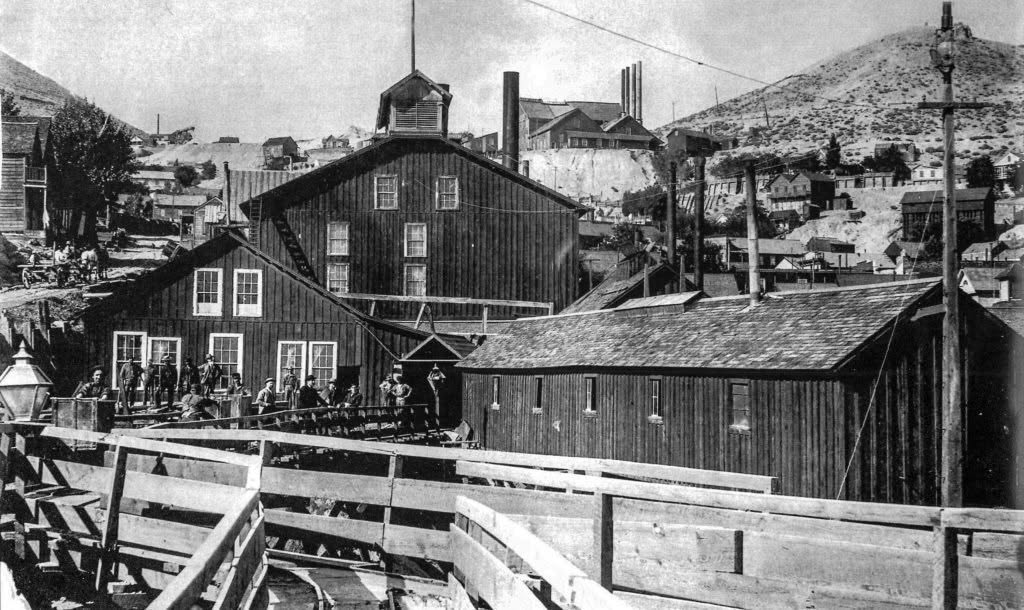
For a Yellow Jacket miner, the contrast between wages and conditions was stark. Gold Hill miners had won wages of roughly four dollars a day, excellent pay for the period, and by 1867 the Gold Hill Miners’ Union was strong enough to hold mining companies to that minimum. The money came with extraordinary risk. A miner descended hundreds of feet on a small cage into a maze of drifts, crosscuts, winzes, stopes, ore chutes, ladders, and timber sets, drilling and blasting rock, shoveling ore and waste, and maintaining passages lit mainly by candle or lamp. As the mines deepened, temperatures rose; portions of the Comstock eventually reached well above 100 degrees Fahrenheit.
The aftermath of the 1869 fire made those conditions even more vivid. With normal ventilation blocked, the company employed roughly 400 miners on eight-hour shifts, reportedly twice its previous workforce, in part because men could tolerate the fouled atmosphere for only limited stretches. Conditions later grew so severe that the workforce fell to about sixty men. Miners repeatedly fainted from heat and bad air; one reportedly remained unconscious for three hours. Workers carried bottles of hartshorn and bay rum to revive themselves when overcome, and in one small, telling incident, a bottle of hartshorn grew so hot underground that it burst and knocked its owner down, briefly setting off another panic.
How Long Did the Fire Burn?
Far longer than is generally understood. Newspapers initially predicted the fire might be extinguished overnight. It was not. By April 23, it was still burning and inaccessible in portions of the Kentuck-Yellow Jacket workings, with water and steam applied alternately. Months later, smoke and poisonous gas still emerged whenever barricades were opened; a July report described the fire as smoldering “like a charcoal pit” more than three months after it began. A visitor writing a year later found the fire still only partially extinct, with charred timbers and cave-ins continuing to complicate work underground. April 7 marked the beginning of the fire, not its end.
How Many Died?
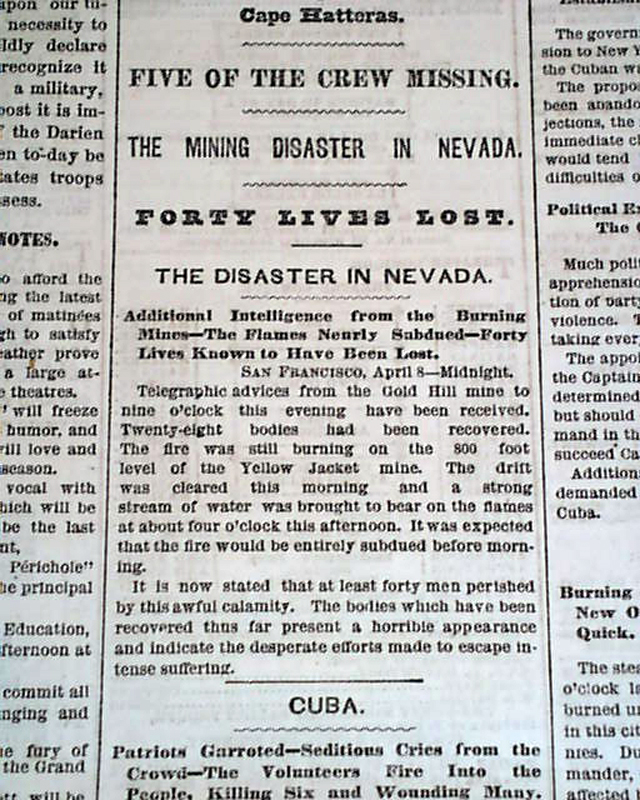
This is surprisingly difficult to answer with precision. Modern Nevada sources generally state more than thirty-five deaths, often noting that eleven bodies were never recovered. A reconstruction based on Comstock newspaper records identifies thirty-seven men killed in the April 7 disaster, plus William Williams, who died April 19 during recovery operations. Dan De Quille later gave a total of forty-five.
The likeliest explanation for the spread is uncertainty over missing men, deaths that followed in the weeks after the fire, and the limits of nineteenth-century record-keeping. The fairest statement the evidence supports is that at least thirty-five miners died, with contemporary and later accounts placing the toll as high as forty-five, and that some victims were never recovered.
The Financial Cost
The human loss dwarfs the financial figures, but the economic consequences were substantial. The Yellow Jacket had been highly prosperous immediately before the fire; a mining journal reported the company had declared roughly $840,000 in dividends during its preceding prosperous stretch. A $120,000 dividend was rescinded after the fire, and Yellow Jacket stock fell about $200 per foot. The company subsequently levied a $10-per-share assessment totaling $240,000, which, combined with the rescinded dividend, amounted to a reversal of roughly $360,000 for shareholders, a very large sum in 1869.
Early estimates badly underestimated the physical damage. One correspondent initially predicted the mine could be repaired for a few hundred dollars and several days’ work, an estimate Doten later ridiculed as events revealed the scale of the underground problem. Production losses compounded the damage: at the time of the fire, the Yellow Jacket reportedly had some 5,000 tons of $27-per-ton ore exposed on its 900-foot level, while the Kentuck had roughly 12,000 tons of $30 ore exposed between the 700- and 900-foot levels.
What Happened to the Miners’ Families
The response to the disaster was one of its more admirable chapters. Relief subscriptions arrived from Nevada and California almost immediately, and the relief fund soon reached $10,698, including $3,225 raised in California. Piper’s Opera House in Virginia City held a major benefit, with actors donating their services, the theater provided free of charge, and patrons buying multiple two-dollar tickets simply to contribute. The Yellow Jacket company itself later voted $2,500 for the families of the dead.
The disaster revealed something true about Comstock society more broadly: however much the mining companies were corporate enterprises headquartered partly in San Francisco, an accident underground instantly became a community catastrophe above ground.
Was Anyone Held Responsible?
No one appears to have been criminally punished or legally held responsible for causing the fire. Coroner Symons conducted inquests into at least twenty-one of the deaths, and questions of responsibility were explicitly considered, but the juries found nothing sufficient to attach criminal blame to any individual. A rumor that Yellow Jacket foreman Kellogg had been arrested proved false. Kellogg was later removed as foreman, and former foreman Jim O’Donnell reinstated, though no evidence indicates this was a formal finding against Kellogg rather than a management decision. There was controversy surrounding the company’s management, but no successful prosecution.
Management’s attitude toward information deepened the controversy. Doten complained that the Yellow Jacket’s controlling officers conducted a private examination of the mine while allowing outsiders to believe the shaft remained closed, with doors and windows reportedly barricaded during the inspection. The trade publication American Journal of Mining separately criticized the company’s longstanding reticence about the mine’s condition and its receipts and expenditures, contrasting Yellow Jacket’s silence with the more open reporting of other Comstock companies. None of this proves wrongdoing, but it helps explain why contradictory stories about candles, explosions, powder, and responsibility took hold and were never fully resolved. There was no modern accident-investigation authority to issue a transparent public report.
Did the Fire Lead to New Laws?
No evidence has surfaced of a Nevada mine-safety statute passed specifically in response to the April 1869 fire. Nevada had created the office of State Mineralogist on March 1, 1869, but that action predated the fire by more than a month and cannot be read as a response to it. Comprehensive statutory mine-safety regulation developed later: Nevada required protective iron bonnets over mine cages beginning in 1879, and by 1911 the state had a recognizable mine-inspection regime requiring adequate ventilation in every shaft, winze, level, and working place, along with rules covering hoisting and miners working alone. These reforms mark a gradual shift from company-controlled mine safety toward state regulation, but nothing in the record ties any specific statute directly to the Yellow Jacket fire.
The Sutro Tunnel
The disaster’s most significant lasting consequence was not a law but a tunnel. Adolph Sutro had campaigned for years to build a long drainage and ventilation tunnel beneath the Comstock, and powerful mining interests had resisted him. The Yellow Jacket fire transformed the political argument by giving Sutro a devastatingly simple question to ask: had his tunnel existed, could the trapped miners have escaped through it?
Virginia City and Gold Hill miners rallied behind the project. Their organizations pledged substantial financial support, commonly reported at $50,000, and construction of the Sutro Tunnel finally began in October 1869. It would be an overstatement to credit the Yellow Jacket fire alone with creating the tunnel, since Sutro had worked toward it for years. But the disaster gave him his most compelling argument: that a tunnel was not merely an engineering convenience, but potentially a lifeline.
What Could Have Prevented the Catastrophe
Viewed against later mine-safety principles, several vulnerabilities stand out. Earlier fire detection, had the reported early-morning smoke been acted upon, might have allowed the shift change to be suspended. No formal evacuation protocol existed requiring every connected mine to halt the lowering of workers upon an unexplained smoke report. Men below the fire had no independent escape route once the shafts were compromised. The same connections that served ventilation so well in ordinary times allowed smoke to spread rapidly between three mines once fire broke out. Open-flame illumination remained standard in a heavily timbered environment regardless of what actually ignited this particular fire. Surface fire companies showed real courage, but nineteenth-century firefighting equipment was poorly suited to a fire hundreds of feet underground. And the conflicting explanations that arose in the fire’s aftermath were never conclusively resolved, in part because no independent investigation held mine management to public account.
A Remarkable Aftermath
Perhaps the most unsettling fact about the Yellow Jacket disaster is how quickly mining resumed. Bodies remained underground. Smoke and carbon monoxide still circulated through sealed sections. And yet, within weeks, roughly 400 men were again working underground at the Yellow Jacket, and months later miners were still being overcome by gases tied to the original fire.
That quick return says something fundamental about nineteenth-century mining economics. A rich Comstock mine could not simply close until every hazard disappeared. Ore bodies represented enormous investments, workers needed wages, mills required ore, and shareholders expected returns. Men went back underground while the ground itself was still burning.
Conclusion
The Yellow Jacket disaster was partly an accident of nineteenth-century technology, but it was not simply unavoidable bad luck. Square-set timbering made the Comstock’s enormous ore bodies mineable, and in doing so filled the workings with an immense reservoir of dry, combustible material. Interconnected mines improved everyday ventilation but became highways for lethal smoke once fire broke out. Miners depended almost entirely on shafts and cages for escape. Open flames were commonplace, and no independent authority controlled evacuation decisions. There is credible contemporary evidence that smoke or fire existed for hours before the danger was fully recognized.
None of this justifies accusing Yellow Jacket management of knowingly sacrificing miners; the surviving evidence does not support that conclusion. It does support a more measured verdict: the fire may have begun as a small, ordinary underground blaze. The design, ventilation, timbering, communication, and emergency practices of Comstock mining transformed it into a mass-fatality disaster. In that sense, the Yellow Jacket fire was at once a singular tragedy and a frighteningly ordinary one. Its specific configuration doomed men in the Kentuck and Crown Point along with its own miners, but the underlying conditions existed across the Comstock. Another mine could have suffered something very similar.
Eventually, one did.
References and Bibliography
Primary and near-contemporary sources
- Alf Doten, special correspondence from Gold Hill and Virginia City to the San Francisco Daily Herald, April–July 1869. University of Nevada, Reno Special Collections, Doten Newspaper Clippings. Doten reported from the scene, covered the coroner’s inquests, challenged the candle theory, reported the powder controversy, and documented the fire’s long aftermath. View collection
- Gold Hill Daily News, “The Gold Hill Disaster,” Extra, April 15, 1869, reproducing reporting beginning April 7. First-day chronology, shift-change details, victim and rescue accounts. View source
- American Journal of Mining, April 24, May 1, and May 8, 1869. Contemporary national mining-industry coverage of the disaster and the Yellow Jacket’s financial position. View source
- Player-Frowd, J. G. Six Months in California. Contemporary travel account with observations on the Nevada mines, the Yellow Jacket fire, and exposed ore. View source
- De Quille, Dan (William Wright). The Big Bonanza: An Authentic Account of the Discovery, History, and Working of the World-Renowned Comstock Lode of Nevada. Hartford, 1876. De Quille was a longtime Territorial Enterprise journalist and near-contemporary chronicler; his account is the source of the claim that miners detected smoke as early as 3 a.m.
- Nevada Legislature. Statutes of the State of Nevada, 1869, 1879, and 1911. 1869 Statutes
Modern scholarly and institutional sources
- Nevada State Library, Archives and Public Records, “Sutro Tunnel,” Nevada Magazine, Winter 2022–23. View source
- Nevada Bureau of Mines and Geology, “Science of the Comstock: Mining.” View source
- “Mining Charity: Material Culture and Philanthropy on the Comstock,” The Public Historian 46, no. 2 (2024). View source
- Rocha, Guy. “Comstock Miners’ Unions.” Nevada Historical Society Quarterly. View source
- Nevada State Library and Archives, State Mineralogist Annual and Biennial Reports collection, 1869–70 report. View source
- Johnson, staff writer. “History of the Yellow Jacket Mine Fire.” Mineralogical Record / Eureka, April 18, 1996. View source
Historical marker
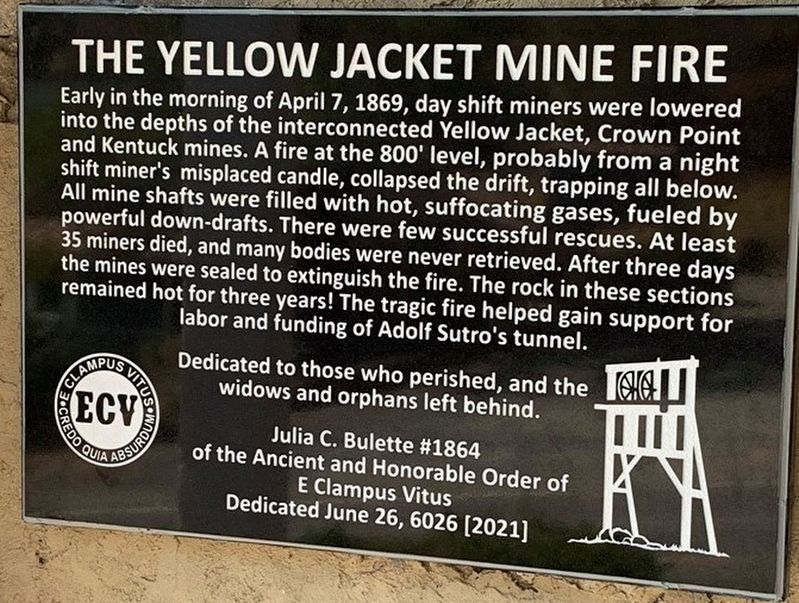
- “The Yellow Jacket Mine Fire.” Historical marker erected by E Clampus Vitus, Julia C. Bulette Chapter #1864, dedicated 2021. Storey County, Nevada.