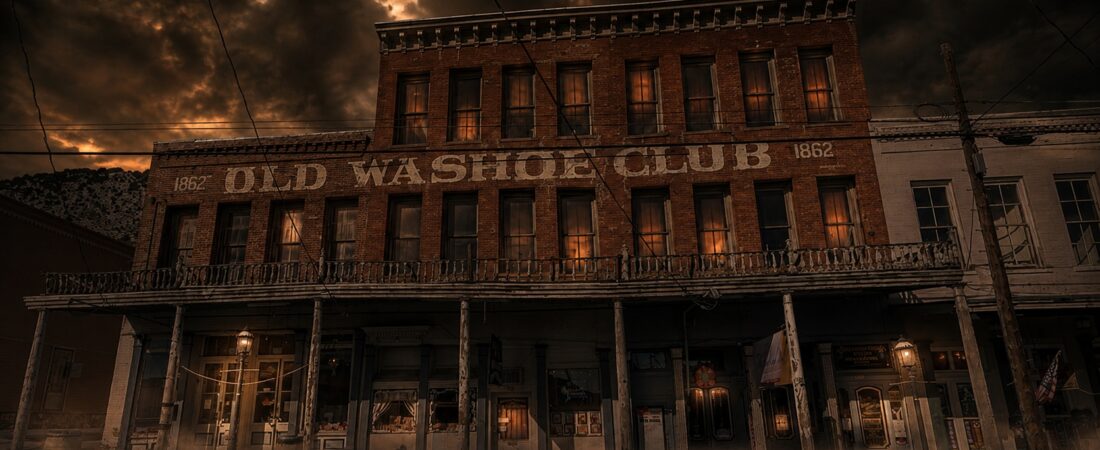
Every October, guides walk visitors down C Street after dark and tell them about Rosie. In Room 11 of the Silver Queen Hotel, the story goes, she cut her wrists in a bathtub sometime in the late 1800s, and she has never checked out since. Guests swear they still hear her cross the floor at night. Down the block at the Delta Saloon, they will show you the Suicide Table, an old faro layout blamed for driving three ruined gamblers to put a pistol to their own heads rather than pay what they owed. And if you linger outside the Old Washoe Club after the shops have closed, keep an eye on the top of the spiral staircase. That is where a woman in blue is said to wait, they tell you, for a lover who never came home. Or for the man who made sure he never would.
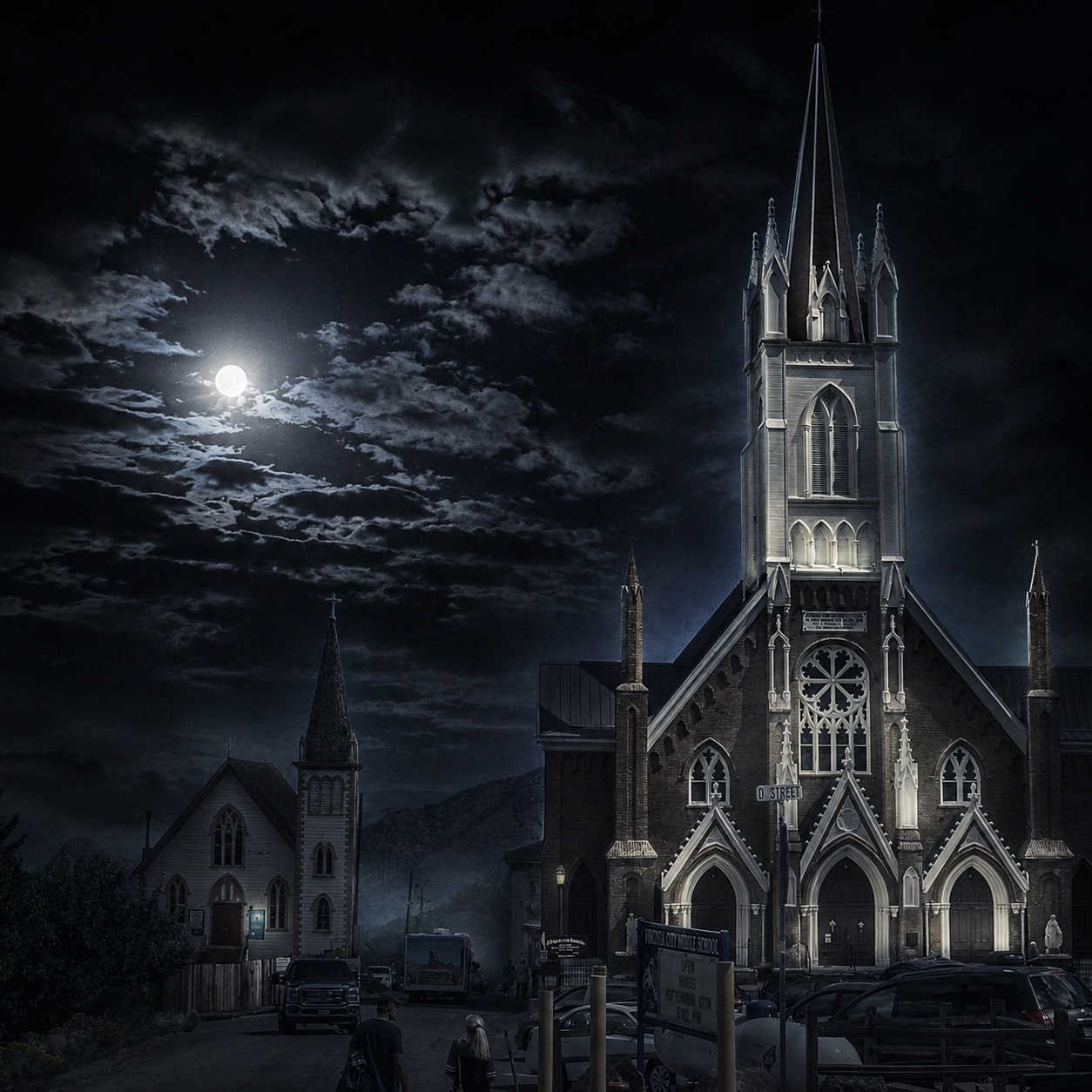
It is a wonderful set of stories, and Virginia City tells them well. It should. Few towns in the American West crowded so much real death into so little time, and the ones its living residents actually know about, the fires, the murders, the men entombed alive in burning mines, would curl your hair without any ghost attached at all. Somewhere between that real history and the version tourists hear tonight, a second Virginia City grew up on top of the first one. This is the story of both towns: the haunted one everybody wants to visit, and the one buried just beneath it, which turns out to be considerably stranger.
A Town That Already Knew How to Spin a Yarn
Long before Virginia City had a single ghost story, it had a taste for tall tales, and the man who gave it that taste is more famous than any spirit on the tour. In October 1862, a twenty-six-year-old reporter named Samuel Clemens, two months into signing his columns “Mark Twain” at the Territorial Enterprise, sat down and invented a corpse. He wrote up the discovery of a petrified man in the mountains south of town, sitting cross-legged, one hand raised to his face in a gesture Clemens described, straight-faced, as the dead man thumbing his nose at the whole world. He had made it up to needle a local official he could not stand. Newspapers clear across the country reprinted it as fact. A year later he did it again, this time with a report so horrifying, a man in nearby Empire murdering his wife and nine children, that readers wrote in genuinely shaken before Clemens admitted the whole thing was fiction.
Twain left town in 1864. The habit he left behind did not. A place that had already learned how far a good story could travel, and how little the truth mattered once it got moving, was always going to end up telling ghost stories eventually. It just took the town a little over a century to try the trick on itself.
The Night the Sky Turned Orange
Skip the ghost tour for a moment and picture the real thing, because what actually happened here on October 26, 1875, needs no embellishing.
It started small, in a rough lodging house on A Street kept by a woman named Kate Shay, known around town as Crazy Kate. A neighbor smelled smoke before dawn and found the room next to Kate’s already burning, caught, she believed, from a candle Kate habitually left lit. A state historical marker gives a different culprit, a knocked-over lamp, and no one has ever settled which account is right. What is certain is what happened next. A hard wind came up out of the southwest and turned a single burning room into a wall of fire moving block by block through the heart of town. By the time it finally died out that night, it had taken St. Mary in the Mountains, the county courthouse, Piper’s Opera House, the International Hotel, the Old Washoe Club, and roughly thirty-three blocks of Virginia City with it. The full account of that night has its own dedicated telling elsewhere on this site, in The Morning Virginia City Burned.
A reporter who arrived the following day filed a dispatch that ran to more than a hundred individual property losses, named owner by named owner, dollar by dollar, the kind of exhausting precision that only makes what comes next hit harder. Two men died in the fire itself. A man named Ketton, of Gold Hill, was crushed when the Carson Brewery’s walls came down on him. A second man, drunk, would not leave Ash’s book store as the flames closed in, and a falling rafter finished the job the fire had started. The next morning, searchers picked through the wreckage of a house on D Street and found the remains of a woman. Nobody ever learned her name. In the ruins of a lodging house nearby, they found a man’s remains too, and believed, though could never quite confirm, that he was a boarder named Martin Slusher.
Sit with that for a second. A woman burned to death in this town, and a century and a half later, nobody knows who she was. No ghost tour stops at the spot where she died. No guide says her name, because there is no name to say. If Virginia City is looking for something to actually haunt it, it is right there, and it has nothing to do with faro tables.
What Still Waits at the Bottom of the Yellow Jacket
A mile and a half south of Virginia City, in the separately incorporated town of Gold Hill, sits a story that makes the Suicide Table look almost quaint. It has a full accounting of its own on this site, in The 1869 Yellow Jacket Mine Fire: Nevada’s Deadliest Mining Disaster, but the short version is chilling enough on its own.
On the morning of April 7, 1869, fire broke out roughly eight hundred feet down inside the Yellow Jacket Mine, right at the seam where it met the neighboring Kentuck workings. The two mines connected underground with a third, the Crown Point, tunnels dug partly for air and partly out of old rivalries between competing claims, and when the fire found those connections, it found three mines’ worth of men to trap. The day shift was on its way down when the smoke was spotted. That timing likely saved lives. It did not save nearly enough of them.
Telegraph dispatches sent that same day show the horror arriving in pieces, the way real disasters do. The first word out was that seventeen men might be trapped, and five bodies were already up. By the following week, a Gold Hill paper ran an Extra headlined “Full Particulars of the Calamity,” listing funerals as fraternal lodges buried their own. But the single most chilling document to survive that day is smaller than any of that. It is a message, written on a plain card, that mine superintendent J. P. Jones sent down by cage to men trapped a thousand feet below in the Crown Point workings, because a card on a cage was the only way left to reach them. We are fast subduing the fire, it read. It is death to attempt to come up from where you are. We will get to you soon. The gas in the shaft is terrible, and produces sure and speedy death. Write a word to us, and send it up on the cage, and let us know how you are.
Nothing came back. The cage returned to the surface exactly as empty as it had gone down.
At least thirty-five men died in the Yellow Jacket that day, and several bodies were never brought up at all. They are still down there. The burned sections of the mine stayed too hot to work for three years afterward, which tells you something about the kind of fire this was. Three years later, a former Yellow Jacket foreman would claim the whole thing had been set on purpose, a scheme tied to stock manipulation between rival mine managers who despised each other. It was never proven. It was never fully buried either, and the question sits open to this day.
Just up the hill, the Gold Hill Hotel still tells its own ghost stories. Guests report William in Room 5, given away by a smell of pipe tobacco that turns up from nowhere. They report Rosie in Room 4, who is said to leave a trace of rose scent behind her. Neither one has ever been matched to a name on the Yellow Jacket’s own casualty list, and Rosie’s name, strangely, belongs to a second and entirely separate ghost story less than two miles up the same ridge, at Virginia City’s Silver Queen Hotel. Maybe that is coincidence. Maybe it just means Virginia City has always had a short supply of names to hang on its ghosts. Either way, thirty-five real men are still down there in the dark, and almost nobody visiting these haunted hotel rooms tonight will hear their names at all.
The Murder Virginia City Turned Into a Legend on Purpose
If you want to see exactly how this town takes a true story and makes it stranger than fiction, look no further than the death of Julia Bulette, because this one is not folklore. It happened, in grim and specific detail, and what came after it happened is almost more remarkable than the crime itself.
Bulette ran her own establishment on the Comstock and had earned an honorary membership in the town’s Engine Company No. 1, a genuine mark of respect in a rough town. On the morning of January 20, 1867, she was found in her home, beaten, strangled, and robbed. A reporter for the Territorial Enterprise who saw the scene wrote in his own diary only that it was the worst murder the city had ever seen, four words doing the work of a much longer account. Months later, a French laborer named John Millain was arrested carrying some of her stolen jewelry. He was convicted after a single day in court and hanged the following April in front of a crowd numbering in the thousands.
Somewhere in that crowd, by his own account, stood Mark Twain, back in town as a visiting lecturer. What he wrote afterward sat forgotten in an archive for more than a hundred years, until a Nevada state archivist named Guy Rocha found it in 1999, a dispatch Twain had sent to a Chicago paper describing the hanging in a voice nothing like the man who invented petrified corpses for a laugh. “I can see that stiff straight corpse hanging there yet,” he wrote, and went on to describe the body’s rigid, discolored hands in language with not one trace of his usual humor in it. Some historians believe this is the moment Twain’s later, very public opposition to the death penalty actually began.
Bulette herself was denied burial in consecrated ground, despite a Catholic funeral, and was laid instead in the town’s older, unofficial cemetery on Flowery Hill. To this day, nobody knows exactly where. That empty space in the record did not stay empty for long. Decades later, a newspaperman named Lucius Beebe built an entire romantic mythology around Bulette’s memory, much of which historians have since had to painstakingly take apart, and for years a coin-operated telescope stood in the Bucket of Blood Saloon, pointed at a grave that was never actually hers, so that tourists could drop a nickel and stare at a lie. The full, harrowing story of Bulette’s murder and everything that grew up around it afterward has its own dedicated telling elsewhere on this site, in Julia Bulette’s Last Night: Murder, Evidence, and Legend in Virginia City. What matters here is smaller and, in its own way, spookier: this town did not simply pick up a ghost story about its most famous murder victim. It built one, brick by brick, on purpose.
Eleven Cemeteries, and the Living Divisions They Kept
Ask a guide about Silver Terrace Cemetery and you will hear about glowing headstones and a groundskeeper’s ghost who does not care for visitors. What they may not mention is that Silver Terrace is not one cemetery at all. It is eleven of them, laid out side by side on a windswept hillside north of town starting around 1867, and every single one belonged to somebody different: the Masons here, the Odd Fellows there, the Knights of Pythias, the volunteer firemen, the Catholics, a Jewish cemetery set apart on its own rise, and a section reserved for whoever happened to be a customer of Wilson and Brown, the town’s undertakers.
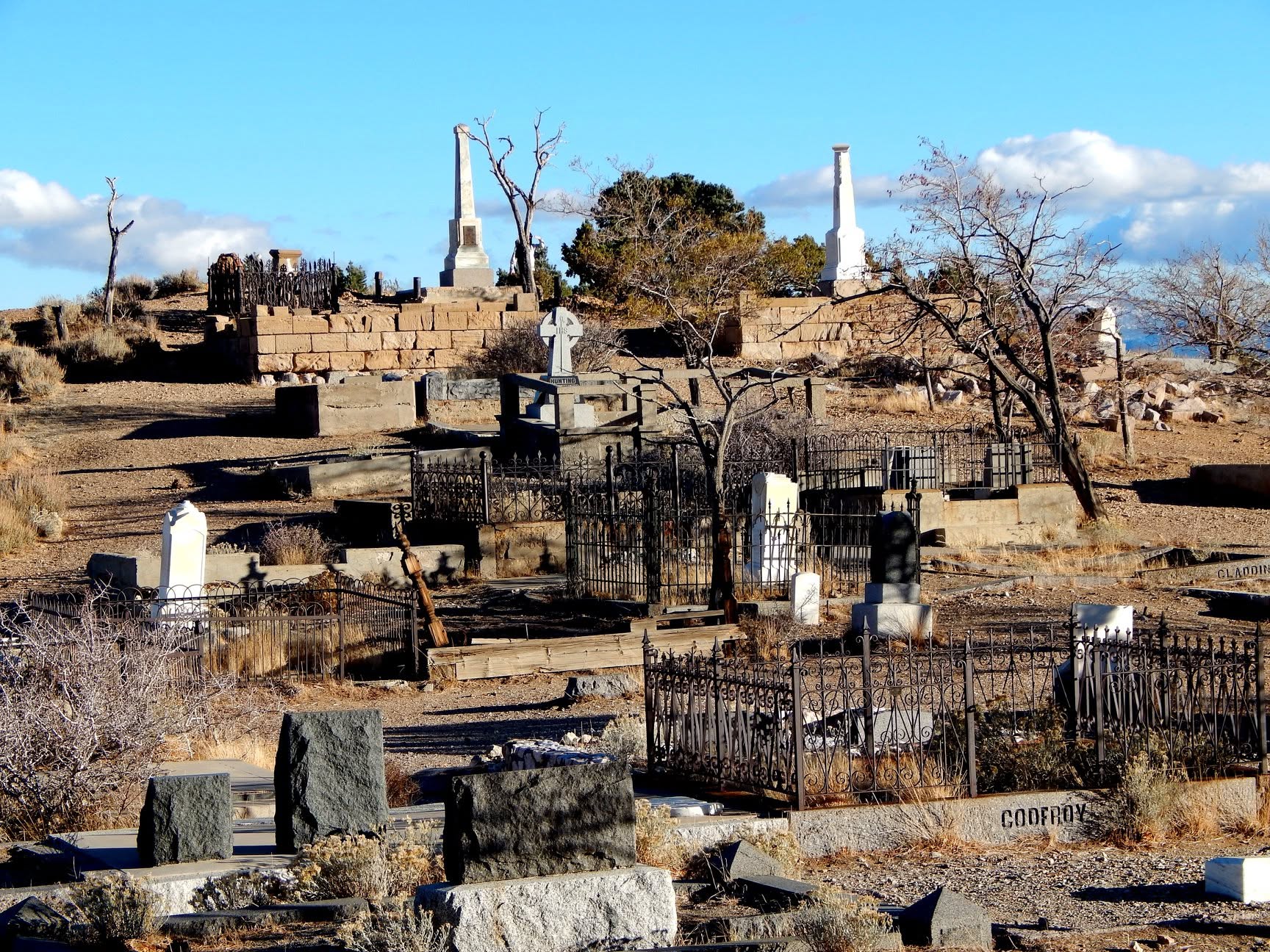
A historian looking into the cemetery’s condition years later put it about as plainly as it can be put. Underground, in the mines, there had been no such distinctions among the men working the same seam of ore. They came back above ground and wanted some distinctions back. That same digging turned up the funeral, in 1867, of a woman named Charlotte Kruttschnitt, wife of the county assessor, killed in a stagecoach wreck and carried to her grave by more than sixty carriages, a genuine spectacle for its day. It also turned up something considerably darker. Chinese laborers and the town’s prostitutes were not permitted burial inside the main grounds at all. A separate Chinese cemetery once stood near the site of St. Mary’s Hospital, complete with a pagoda-topped oven for burning offerings to the dead, and what historians know about that practice elsewhere in the Gold Rush West suggests that, after enough years had passed, a laborer’s bones were dug back up, cleaned, and shipped home across an ocean so he could finally be buried among his own people.
No glowing orb tells you any of that. No moving headstone explains it either. The real story of who this town let rest beside whom, and who it refused, says considerably more about Virginia City than anything that supposedly flickers over a grave after dark.
What Is Really Buried Under the Bucket of Blood
If you want a straight answer for how the Bucket of Blood Saloon got its name, good luck. Every account of it agrees on the shape of the story, some catastrophic bar fight, enough violence that a literal bucket had to be filled and mopped off the floor afterward, and every single account disagrees on when it happened, who was involved, and whether any of it is true at all.
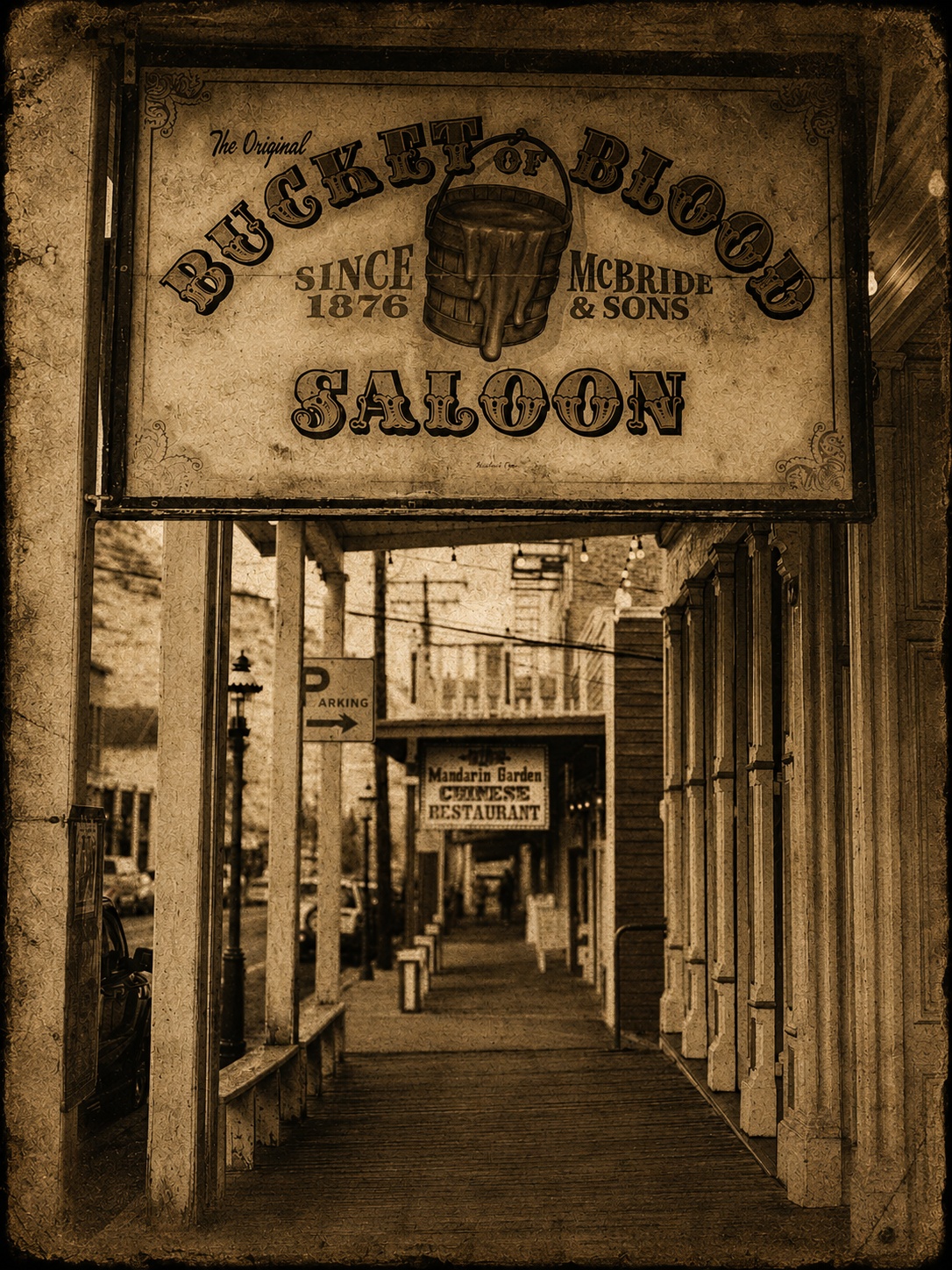
Here is what is true, and it is a far better story than the one on the sign. In 1997, archaeologists dug into the ground beneath the saloon’s parking lot and confirmed what the ghost stories had walked right past for a century. Underneath sat the remains of the Boston Saloon, run from 1866 to 1875 by a free Black proprietor named William A. G. Brown, whose customers, the dig revealed, ate premium cuts of meat rather than the rough bar food most Comstock saloons served. Nevada’s State Historic Preservation Office has since placed an official marker on the spot, put up jointly with the current owners and the Reno-Sparks branch of the NAACP, noting that Virginia City’s Black population never topped roughly a hundred people even at its peak, that some of them ran thriving businesses of their own, that one earned wide respect across the whole town as a physician, and that Black children sat in this town’s integrated schools decades before that would be true again almost anywhere in Nevada, once mining came roaring back under a far less generous set of laws in the new century.
The Boston Saloon has no ghost attached to it. It simply closed, quietly, when Brown sold the business, not long before the Great Fire took the building anyway. What replaced it in the town’s memory was a bucket of blood that nobody can date, in a story built to give tourists a shiver on their way to the bar.
What the Legends Are Really Telling You
None of this means the town’s ghost stories deserve to be laughed out of the room, or that you should feel silly enjoying them tonight. It means they are doing a different job than the one printed on the tour brochure.
A four-story schoolhouse built for a thousand children falls silent when the town’s population collapses by ninety percent in a generation, and an empty building on that scale starts to feel like it is owed some kind of explanation. A hospital that once treated men crushed and burned by round-the-clock mining work closes its doors and sits abandoned for twenty years before anybody thinks to walk back inside. An exclusive club that once used a hidden staircase so its wealthiest members could slip in unseen shutters its upper floors for good as the silver runs dry, and the rooms above the bar stay dark and empty for a hundred years after that. Grief and abandonment on that scale do not actually need a real ghost in order to feel haunted. They only need people willing to keep telling each other, generation after generation, that they are.
So walk the tour tonight. Listen for Rosie’s footsteps, watch the Washoe Club staircase, dare yourself to sit at the Suicide Table if the Delta will let you near it. Just know that the real history walking beside you the whole time, the fire that took a nameless woman on D Street, the men still entombed in the Yellow Jacket, the murder this town turned into its own myth on purpose, is the part that should actually keep you up at night. Virginia City has been telling itself ghost stories since a reporter thumbed his nose at a petrified corpse in 1862. It just took a hundred years to start believing its own trick again.
Sources
- “THE BURNING OF VIRGINIA CITY.” Sacramento Daily Union, Vol. 1, No. 219, October 28, 1875. California Digital Newspaper Collection, Center for Bibliographic Studies and Research, University of California, Riverside, cdnc.ucr.edu.
- Telegraphic dispatches from Virginia City, April 7, 1869, on the Yellow Jacket Mine fire. Reprinted in Merced County Sun, April 17, 1869. California Digital Newspaper Collection, cdnc.ucr.edu.
- “FULL PARTICULARS OF THE CALAMITY.” Gold Hill Daily News Extra, April 15, 1869. Reproduced by the Online Parish Clerks for Cornwall project, opc-cornwall.org.
- Nevada State Historic Preservation Office. State Historical Marker No. 228, “The Great Fire of 1875.” shpo.nv.gov.
- Nevada State Historic Preservation Office. State Historical Marker No. 266, “African Americans and the Boston Saloon.” shpo.nv.gov.
- Lord, Eliot. Comstock Mining and Miners. United States Geological Survey, Monograph 4. Washington: Government Printing Office, 1883. Full digitized text: Internet Archive, archive.org/details/comstockminingmi00lord.
- Clemens, Samuel L. [Mark Twain]. Dispatch to a Chicago newspaper on the hanging of John Millain, 1868. Identified by Nevada state archivist Guy Rocha; reported in the Las Vegas Sun, September 27, 1999.
- Doten, Alfred. Journals (manuscript and published). University Libraries, University of Nevada, Reno, Special Collections and University Archives.
- “Historic Virginia City cemetery lies weathered and desecrated.” Deseret News, June 28, 1997.
- “Archivist discovers Twain’s account of 1868 hanging.” Las Vegas Sun, September 27, 1999.
- Bernstein, Matthew. “Who Started the Infamous 1869 Yellow Jacket Mine Fire That Claimed Three Dozen Men?” HistoryNet, July 27, 2023.
- “Not Even the Tragic 1869 Yellow Jacket Mine Fire Could Kill Gold Hill, Nevada.” HistoryNet, August 18, 2023.
- “Yellow Jacket Disaster.” Online Nevada Encyclopedia, a project of Nevada Humanities, onlinenevada.org.
- Chung, Sue Fawn; Frampton, F.P.; Murphy, T.W. “Venerate These Bones,” in Chinese American Death Rituals. 2005. Cited via University of Idaho Library Special Collections, “Overseas Chinese Cemeteries” inventory, lib.uidaho.edu.
- Julia C. Bulette Chapter No. 1864, E Clampus Vitus. “Julia’s Grave: History Or Myth?” juliacbulette.com.
- “Sex, Murder, and the Myth of the Wild West: How a Soiled Dove Earned a Heart of Gold.” FolkloreThursday.
- La Nae, Sandie. Weird “Haunted” Virginia City. Lulu.com, 2015. Cited for its account of the Old Washoe Club’s modern haunted reputation dating to approximately 1991; not used as authority for any specific historical claim.